Confectionery and Chocolate Inspection AI
Catch the bloomed bar, the bare corner, the double gummy, and the tray missing a hazelnut on every piece, at line speed.
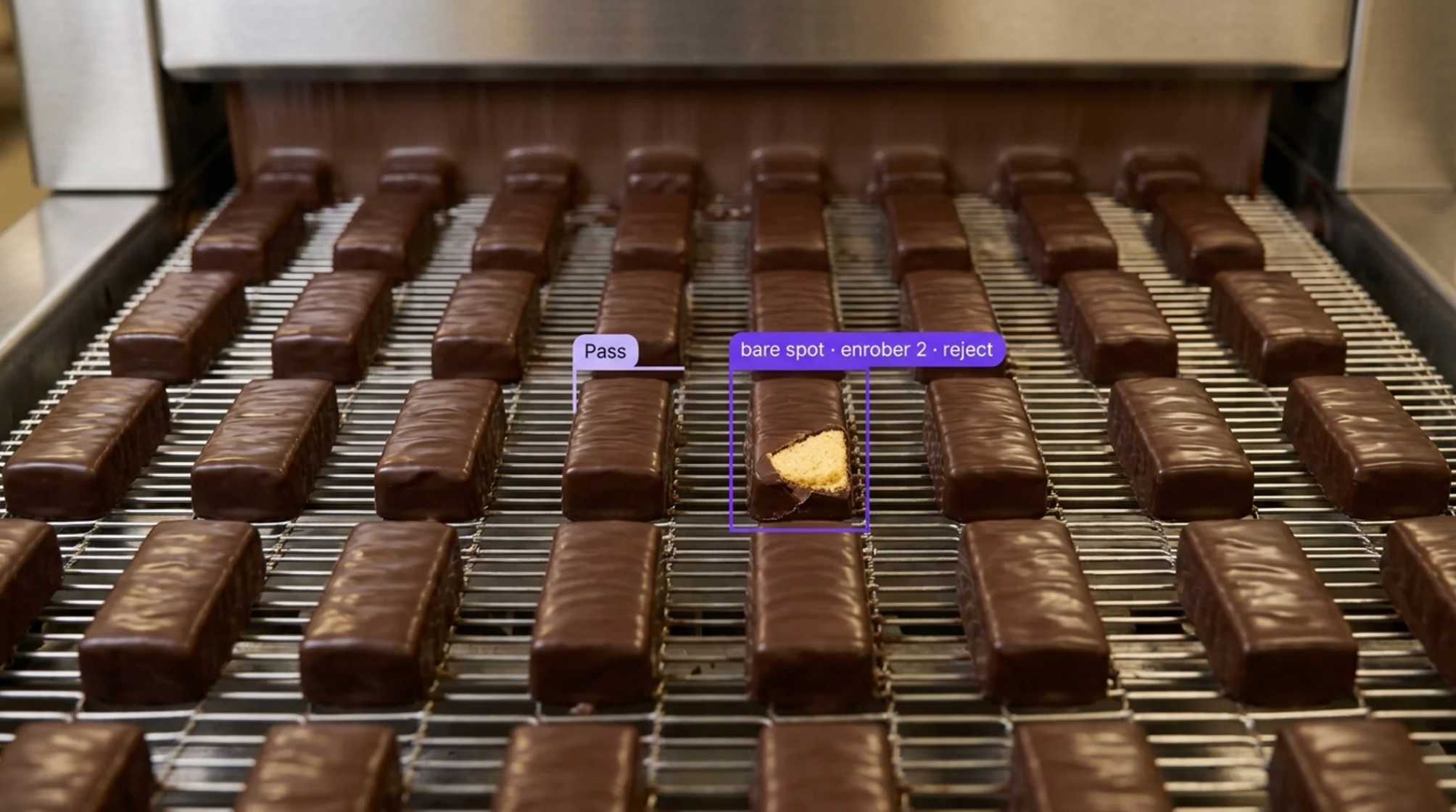
Confectionery Inspection AI Across Moulding, Enrobing, Depositing, Panning, and Packing
Deploy Anywhere, Run Everywhere
Run confectionery and chocolate inspection on the cameras already over your line and an edge device at the line, on-prem, air-gapped, in your VPC, or via API, wherever your moulding, enrobing, depositing, and packing lines need it.
One Platform, Full Adoption
Tools every confectionery plant can adopt, from line operators and QA technicians to quality managers, process engineers, and plant management, no separate ML team required to ship and own inspection models.
Secure, Compliant, and Audit-Ready
Data stays safe with SOC 2 Type II compliance, encrypted data, and an uptime SLA, with per-piece and per-pack image records that support BRCGS, SQF, and FSSC 22000 audits, HACCP documentation, and complaint investigations.
- Bloom, Crack & Surface Defect Detection
- Enrobing Coverage & Decoration Verification
- Double, Broken & Deformed Piece Rejection
- Assortment Tray & Gift Box Verification
- Count, Fill & Wrapper Inspection
- Visible Foreign Object Detection
“We’ve seen situations where, by reducing waste, a single food processor can eliminate the equivalent of millions of tons of carbon per year. It feels great seeing AI-powered insights improve profitability and contribute to sustainability goals.”
Rian McDonnell
Founder and CEO, FloVision
Talk to a Vision AI engineer who's shipped inspection on a live confectionery line.
Bring us your toughest confectionery and chocolate inspection problem and we'll map a working solution.
Ask us about:
- Solution architecture for chocolate moulding and enrobing, gummy, jelly, and hard candy depositing, panning, assortment packing, and wrapping lines, alongside existing checkweighers, metal detectors, and X-ray
- Live demo on your line camera footage or product images, with the defect, bloom, bare spots, doubles, or assortment errors, that drives the most complaints or waste
- Deployment options: existing cameras and an edge device at the line, on-prem, air-gapped, or VPC, with integration into MES, quality, PLCs, and packing robots
- ROI modeling against customer complaints and retailer chargebacks, rework and giveaway, manual inspection labor, changeover verification time, and recall risk
Over 16,000 organizations build with Roboflow.
- Rivian
- Pella
- Chobani
- USG Corporation
- BNSF Railway
- American Woodmark
Vision AI is transforming businesses
Customers across the board are solving complex challenges and driving meaningful impact.
- Automotive customer
$10 million
Saved by automatically detecting defects on the production line
- Logistics & freight company
90%
Less time spent manually tracking shipping inventory
- Building materials supplier
60%
Lower customer return rate with improved product quality