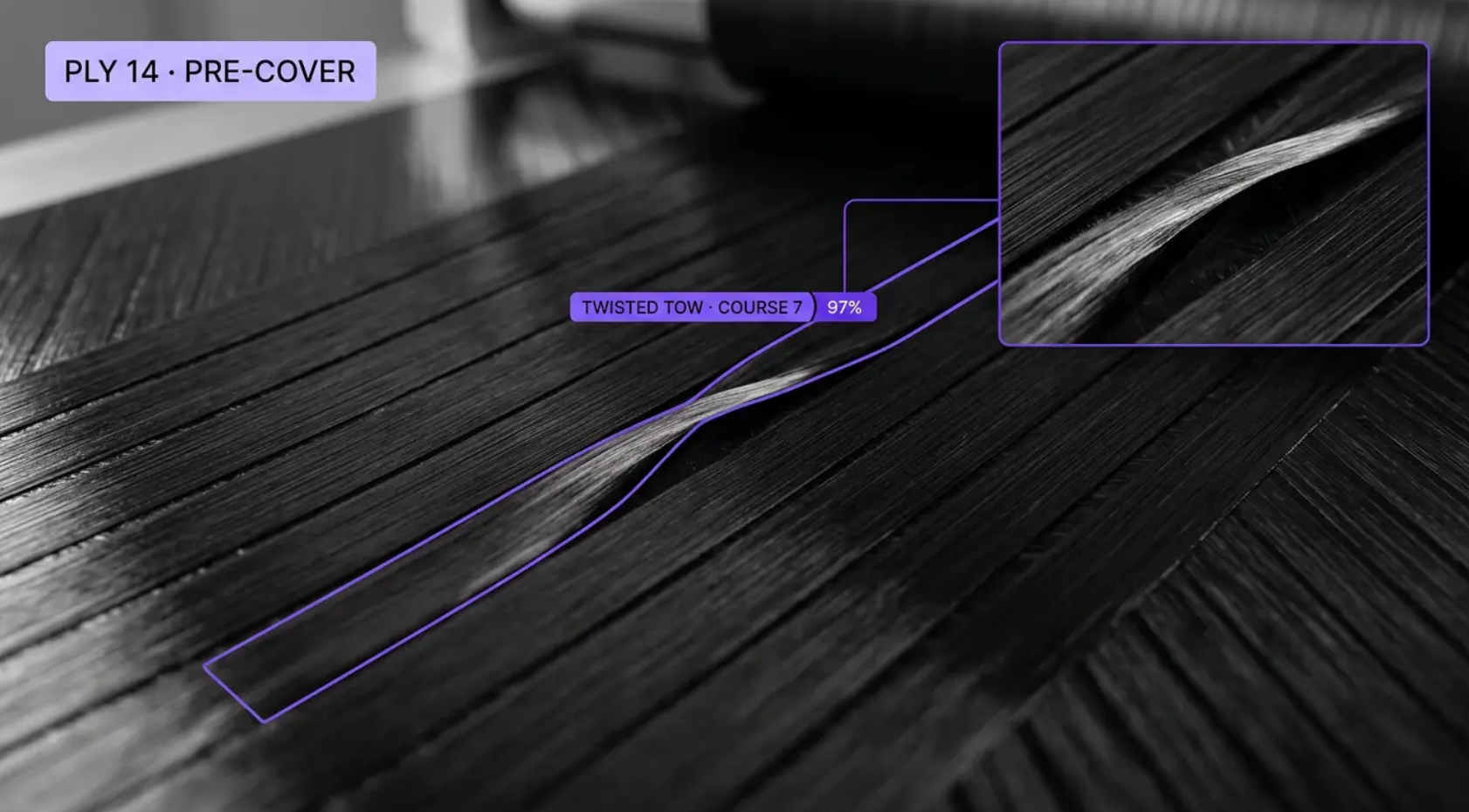
Add a real-time inspection layer to every ply with vision AI for composite layup inspection. Built for the operations where a defect on ply 14 is invisible once ply 15 goes down, black carbon tows on black carbon plies give almost no contrast, the part carries hundreds of hours before it ever reaches the autoclave, and the ultrasonic scan after cure finds the problem when the only option left is scrap or MRB. Whether you're running automated fiber placement and tape laying cells, hand laying prepreg in a clean room, or laying dry fabric in a wind blade mold, Roboflow inspects each ply as it goes down and hands the technician a flagged location with the frame attached, with a per-ply record behind every part.
Tows and Courses:
- Detect gaps, overlaps, missing tows, and tow ends out of tolerance on AFP and ATL courses, so the course is corrected before the next course covers it
- Detect twisted, folded, and bridged tows, splices, and fuzzballs, the defects a gap-and-lap sensor was never built to see
- Detect tow lifting, poor tack, and steering wrinkles on contoured surfaces, so the head slows or stops at the ply instead of the part failing at cure
Plies and Foreign Objects:
- Detect backing paper, release film, gloves, tape, and other foreign object debris on the ply surface before the next ply or the bag goes on
- Verify ply orientation, boundary, and sequence against the ply book, so a 45 laid where a 90 belongs is caught at the ply and not at the ultrasonic scan
- Detect wrinkles, puckers, and fiber waviness in prepreg and dry fabric, and dry spots and voids after infusion in blades, so the laminate defect is a rework at the ply instead of a finding after cure
Cure, Traceability, and Systems Integration:
- Verify bagging, breather, and vacuum layout before the cure cycle starts, so the bag that leaks is caught before the autoclave is booked
- Trend defects by head, spool, material lot, and technician station, so a spool that starts twisting surfaces before the part does
- Integrate with AFP controllers, MES, and QMS, with per-ply records tied to part serial, ply number, location, and imagery for the as-built record
Bring intelligence to every ply today. Stop twisted tows, backing paper, and wrinkles from becoming post-cure scrap, MRB hours, or the blade defect that goes into service.
More About Composite Layup Inspection
What is composite layup inspection with Vision AI?
Composite layup inspection with vision AI uses computer vision models to inspect each ply of a composite part as it is laid, on automated fiber placement and tape laying cells, in hand layup, and in wind blade molds: gaps, overlaps, missing and twisted tows, splices and fuzzballs, wrinkles, puckers, and fiber waviness, backing paper, release film, and other foreign object debris, ply orientation, boundary, and sequence against the ply book, and bagging layout before cure. Models trained on your actual materials, parts, and lighting run on every ply, with per-ply records tied to part serial and location that support AS9100 and Nadcap composites requirements, FAA AC 21-26, and IEC 61400 and DNV blade certification.
Can Vision AI see a twisted tow on black carbon?
Black tow on black ply is exactly where composite layup inspection is hardest: the contrast is close to zero, the resin surface is specular and changes with tack and temperature, the defect is a few millimeters of twist or a fold on a course that is moving under the head, and once the next ply goes down it is gone until the ultrasonic scan after cure. Deep-learning models trained on your actual materials, heads, and lighting learn what a twist, a fold, a gap, a splice, and a fuzzball look like on your tows, and controlled low-angle and structured lighting gives the model the texture and shadow that carry the signal on a black surface where color does not. Detections come back with the ply number, the course, the location on the part, and the frame, so the technician goes to the spot on the tool, and the record says what was found on ply 14 before ply 15 covered it.
Does this replace the profilometry sensor on our AFP head?
No. Head-mounted laser profilometry keeps its role measuring gap and overlap width on each course, and the AFP controller keeps its tolerances, its alarms, and its qualified process. Vision AI adds what a profilometer does not see: twisted, folded, and bridged tows, splices and fuzzballs, backing paper and foreign objects, ply orientation and sequence, wrinkles across a laid ply, and coverage in hand layup and blade molds where there is no head and no sensor. Profilometry measurements and vision detections land in the same per-ply record, and the part that would have gone to MRB after cure gets corrected at the ply.
Can it integrate with our AFP controllers, MES, and QMS?
Yes. Roboflow Inference exposes a standard API and supports common industrial protocols, so inspection results flow into your existing systems: AFP and ATL cell controllers and laser projection systems, MES and ERP platforms like SAP and Oracle, QMS platforms like MasterControl and ETQ, and SCADA and HMI systems like Ignition and AVEVA, through REST, MQTT, OPC UA, and direct database writes. Cell-level integration pauses the head or holds the ply for review the moment a defect is flagged, and every event carries the part serial, ply number, course, location on the tool, defect class, imagery, and disposition, with a full per-ply as-built record for AS9100, Nadcap, and certification audits.