Bubble Detection AI
Find, size, and count air bubbles and voids in fluids, fills, adhesives, resins, and coatings inline.
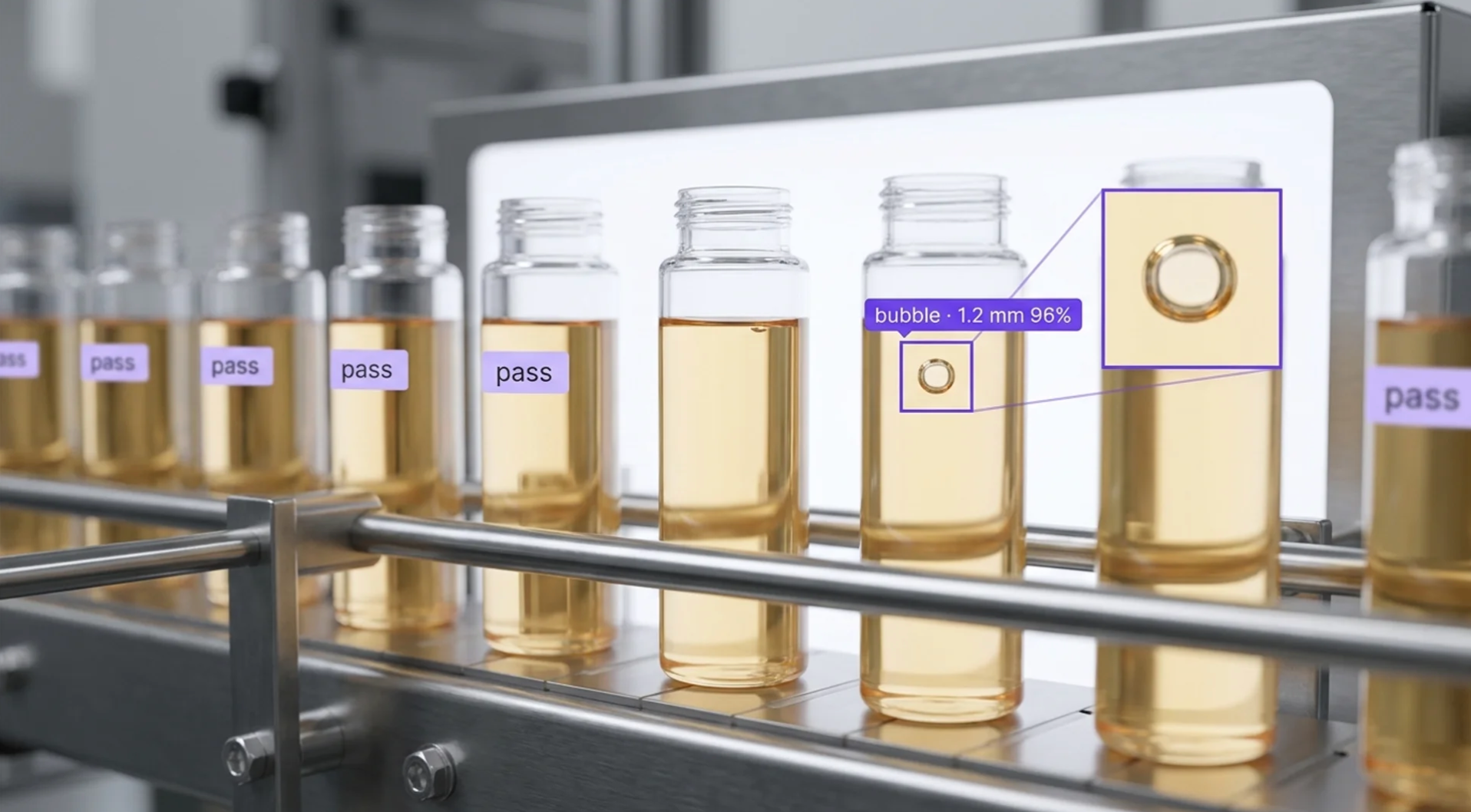
Bubble Detection AI Across Filled Containers, Dispensed Beads, and Cured Coatings
Deploy Anywhere, Run Everywhere
Run bubble detection on backlit, line scan, and station cameras on the edge, on-prem, in your VPC, or via API.
One Platform, Full Adoption
Tools every process and quality team can adopt, from process engineers to quality leads and line technicians, no separate ML team required.
Secure, Compliant, and Audit-Ready
Data stays safe with SOC 2 Type II compliance, encrypted data, HIPAA compliance, and an uptime SLA.
- Air Bubbles in Filled Containers & Vials
- Bubble Size, Count & Area Measurement
- Voids in Adhesive & Sealant Beads
- Bubbles in Resin, Potting & Encapsulation
- Coating & Film Blisters and Craters
- Foam, Froth & Degassing Monitoring
“Roboflow has been instrumental in accelerating our deployment of innovative AI solutions.”
Travis Turnbull
Vice President & CIO, Pella Corporation
Talk to a Vision AI engineer who's shipped in fluids, coatings, and filling.
Bring us your toughest bubble detection problem and we'll map a working solution.
Ask us about:
- Solution architecture for ISO 9001, IATF 16949, and GMP environments where bubble limits are part of the spec
- A live demo on your own fill, bead, or coating images
- Deployment options: edge, on-prem, air-gapped, VPC, or on the backlit stations and line scan cameras your line already runs
- ROI modeling against leaks, weak bonds, cosmetic rejects, overfill giveaway, and rework
Over 16,000 organizations build with Roboflow.
- Rivian
- Pella
- Chobani
- USG Corporation
- BNSF Railway
- American Woodmark
Vision AI is transforming businesses
Customers across the board are solving complex challenges and driving meaningful impact.
- Automotive customer
$10 million
Saved by automatically detecting defects on the production line
- Logistics & freight company
90%
Less time spent manually tracking shipping inventory
- Building materials supplier
60%
Lower customer return rate with improved product quality
Catch Bubbles and Voids Inline, from the Fill Head and Dispense Nozzle to the Cured Part
Add a real-time inspection layer to every fill, bead, and coating on the line with Roboflow Vision AI for bubble detection. Built for the processes where a trapped bubble in a potting compound, a void in a sealant bead, or froth in a fill turns into a leak, a failed bond, or a customer complaint.
Bubbles in fluids and fills:
- Detect and count air bubbles in clear and translucent containers, vials, syringes, and tubing on backlit stations, with a model trained on your own product.
- Measure bubble size and total bubble area and compare to your spec, so a few micro-bubbles pass and a large one fails.
- Watch foam and froth after filling so fill level is read correctly and the degassing step can be tuned.
Voids in beads, resins, and potting:
- Find voids, skips, and bubbles in adhesive, sealant, and gasket beads right after dispensing, where fluid dispensing inspection already checks path and width.
- Inspect resin, epoxy, and potting in electronics, encapsulated parts, and castings for trapped air before cure.
- Detect bubbles under labels, films, and laminates on packaging and displays.
Coatings, trends, and process control:
- Detect blisters, pinholes, and craters in cured coatings, paint, and powder coat, and separate them from dust and scratches.
- Trend bubble counts per nozzle, head, batch, and shift so the process engineer sees a pump, mix ratio, or degassing problem as it starts.
- Send a reject or hold signal to the PLC so a failing unit is diverted before it moves downstream.
Bring intelligence to every fill, bead, and coating today. Stop trapped bubbles from becoming leaks, weak bonds, and cosmetic rejects.
Frequently asked questions
What is bubble detection with Vision AI?
Bubble detection with Vision AI uses backlit, line scan, or station cameras and a trained computer vision model to find, size, and count air bubbles and voids in liquids, fills, adhesive beads, resins, potting, and coatings. The model separates bubbles from particles, scratches, and reflections, and results feed reject logic and process trends. It pairs with fill level inspection, adhesive and glue bead inspection, and particle detection in injectables.
Can Vision AI tell a bubble from a particle or a reflection?
This is the core problem in liquid inspection, because bubbles, particles, and glare can look alike in a single frame. A model trained on your own labeled images learns the round, bright-edged shape of a bubble under your lighting, and a short image sequence helps further, since bubbles rise and particles settle or tumble.
Does bubble detection support ISO 9001, IATF 16949, and GMP requirements?
Bubble detection supports the inspection and record-keeping expectations of ISO 9001 (the quality management system standard), IATF 16949 (the automotive quality management system standard, for adhesive and potting processes), and, for pharma and medical fills, cGMP and FDA 21 CFR Part 11 (electronic records and signatures), with a per-unit image and result record.
Roboflow serves as the inspection engine, and your quality and process engineering teams own the bubble limits, acceptance criteria, and validation.
Can it integrate with our filling, dispensing, and line controls?
Yes. Roboflow writes pass/fail and bubble metrics to a PLC tag over OPC UA, Modbus TCP, or MQTT, so Allen-Bradley and Siemens controllers can trigger a reject or hold, and dispensing systems from Graco or Nordson can be tuned from the trend. Results and images can be sent over REST or written to a database for SCADA and MES platforms such as Ignition and AVEVA.