Fluid Dispensing Inspection AI

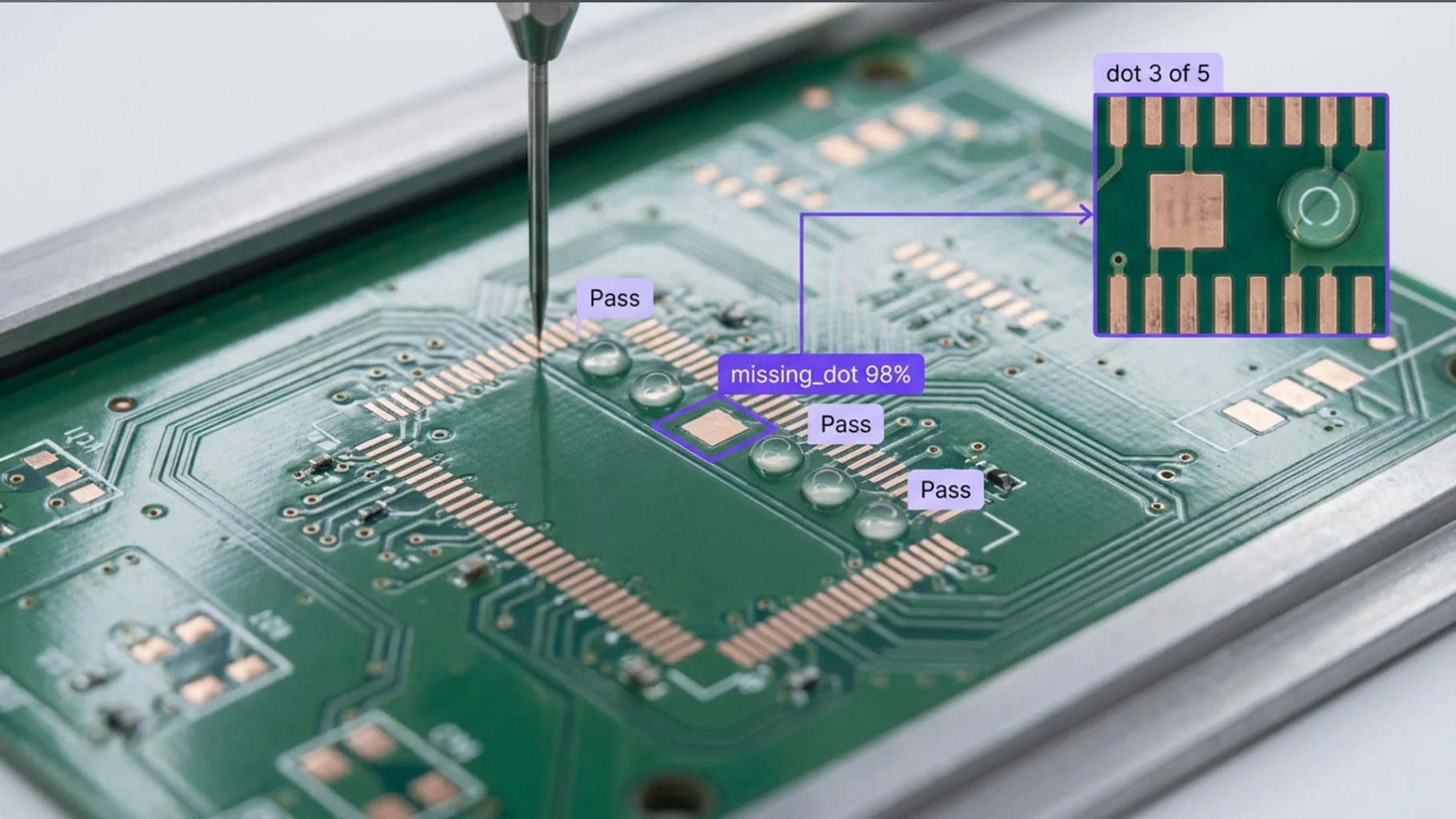
Verify presence, size, position, and shape of every dispensed dot, bead, and coating in real time, down to 100 micron dots, on the dispensing platforms and assembly lines you already run.
Shipping container with OCR output

Dispensing Inspection AI Across Adhesives, Solder Paste, Coatings, and Micro-Dispensed Dots

Deploy Anywhere, Run Everywhere

Run dispensing inspection on the dispense head camera and inline SMT lines on the edge, on-prem, in your VPC, or embedded in your dispensing equipment via API, wherever your line needs it.

One Platform, Full Adoption

Tools every electronics and medical device team can adopt, from process engineers to quality leads and dispensing OEM applications engineers, no separate ML team required.

Secure, Compliant, and Audit-Ready

Data stays safe with SOC 2 Type II compliance, encrypted data, HIPAA compliance, and an uptime SLA.
Dot Presence, Size & Position
Bead Continuity, Width & Skips
Satellites, Stringing & Tailing
Solder Paste Volume Proxy & Bridging
Conformal Coating, Potting & Underfill Coverage
Micro-Dispensed Dots Down to 100 Microns
Dot Presence, Size & Position
Bead Continuity, Width & Skips
Satellites, Stringing & Tailing
Solder Paste Volume Proxy & Bridging
Conformal Coating, Potting & Underfill Coverage
Micro-Dispensed Dots Down to 100 Microns
Dot Presence, Size & Position
Bead Continuity, Width & Skips
Satellites, Stringing & Tailing
Solder Paste Volume Proxy & Bridging
Conformal Coating, Potting & Underfill Coverage
Micro-Dispensed Dots Down to 100 Microns
Dot Presence, Size & Position
Bead Continuity, Width & Skips
Satellites, Stringing & Tailing
Solder Paste Volume Proxy & Bridging
Conformal Coating, Potting & Underfill Coverage
Micro-Dispensed Dots Down to 100 Microns

Talk to a Vision AI engineer who's shipped in electronics and medical device assembly.

Bring us your toughest dispensing inspection problem and we'll map a working solution.
  • Solution architecture that fits IPC-A-610, ISO 9001, and ISO 13485 and FDA 21 CFR Part 820 for medical assembly
  • A live demo on your own dispensed dots, beads, or coated boards
  • Deployment options: edge, on-prem, air-gapped, robot-mounted, VPC, or embedded in the dispensing head or OEM equipment
  • ROI modeling against rework, field failures, scrap, line stoppages, and the cost of a separate AOI or SPI station
  • We will connect you with an AI subject matter expert on our team based on your answers.
    What challenges would you like to solve with vision AI?
    Where will you run vision AI?
    Are you replacing a current solution with AI or will this be a new solution?
    How many detections do you anticipate per month?
    Describe the business problem you would like to solve.
    Oops! Something went wrong while submitting the form.

    Over 16,000 organizations build with Roboflow.

    “Roboflow has been instrumental in accelerating our learning and deployment of innovative AI solutions”
    Travis Turnbull Vice President & CIO, Pella Corporation
    See customer stories
    Trusted by top manufacturers

    Vision AI is transforming manufacturing

    Customers are deploying solutions across the entire business and driving meaningful impact
    $0 million
    Saved by automatically detecting defects
    0%
    Less time spent manually tracking inventory
    0%
    Reduction in customer return rate

    Bring Real-Time Intelligence to Every Dispense Cycle, from the First Dot to the Cured Coating

    Bring real-time intelligence to every dispensed dot, bead, and coating on the line with Roboflow vision AI for fluid dispensing inspection.

    Dots, beads, and micro-dispensing:

    • Confirm every dot and bead is present, in position, and within size tolerance, with segmentation that measures dot diameter and bead width as a volume proxy on each cycle.
    • Detect satellites, stringing, tailing, and skips on adhesive and silicone dispenses, including dots at and below 100 microns with a high-resolution camera on the dispense head.
    • Flag drift in dot size or placement across a run so process engineers can catch a clogged needle or pressure fault before it produces a full tray of rejects.

    Solder paste, underfill, and coatings:

    • Inspect solder paste deposits for presence, bridging, insufficient volume, and smearing as a lightweight complement to SPI on lines that do not have one on every product.
    • Verify underfill and potting fill coverage, voids, and overflow onto keep-out areas.
    • Check conformal coating for coverage, thin spots, and masking-area contamination under UV or white light.

    Embedded inspection and traceability:

    • Embed inspection in dispensing equipment through the Roboflow API or edge runtime so OEMs can ship a system that inspects what it dispenses without a separate vision vendor.
    • Log every dispense with image, measurement, and pass/fail against the board or device serial for IPC and ISO 13485 traceability.
    • Retrain in-house when a new fluid, substrate, or product variant launches so the same inspection model covers the next program.

    Bring intelligence to every dispense cycle today. Stop skipped dots and bridged pads from becoming rework, field failures, and held lots.

    Frequently asked questions

    What is dispensing inspection with Vision AI?

    Dispensing inspection with Vision AI uses a camera on the dispense head, an inline station, or an assembly cell and a trained computer vision model to verify that each dispensed adhesive dot, bead, solder paste deposit, underfill, potting fill, or conformal coating is present, correctly positioned, within size and shape tolerance, and free of satellites, stringing, skips, and bridging. Dot diameter and bead width are measured on each cycle as a proxy for dispensed volume, and results are logged against the board or device serial. The inspection can be documented under IPC-A-610 for electronics assemblies and ISO 9001, with ISO 13485 and FDA 21 CFR Part 820 for medical devices.

    Can Vision AI inspect micro-dispensed dots at 100 microns?

    Yes. The approach uses a high-resolution camera close to the dispense head, telecentric or macro optics where the working distance allows, and a segmentation model that measures each dot rather than only detecting it, with image tiling in the Workflow so small features are not lost when the image is resized.

    Does fluid dispensing inspection support IPC-A-610 and ISO 13485?

    Yes. IPC-A-610 (Acceptability of Electronic Assemblies) defines acceptance criteria for solder, adhesive, and coating conditions such as bridging, insufficient paste, and coating coverage, and ISO 13485 (the quality management standard for medical device manufacturing) expects validated inspection with documented acceptance criteria and traceable records, alongside FDA 21 CFR Part 820 for devices sold in the US. Roboflow serves as the inspection engine: it runs the model, records every image, measurement, and decision, and supports IQ/OQ/PQ documentation. Your quality and process engineering teams keep ownership of the acceptance criteria, class definitions, and reaction plans.

    Can it integrate with our dispensing equipment, SMT line, and MES?

    Yes. Results are available over REST, MQTT, and OPC UA and can be written directly to a database, so pass/fail and measurement data flow into MES and quality systems such as Aegis FactoryLogix, Siemens Opcenter, SAP, Ignition, and MasterControl. For equipment OEMs, the Roboflow API and edge runtime embed inspection in the dispensing platform itself, so a fail can pause the head, trigger a re-dispense, or divert the board through a PLC or machine controller signal. Every decision is stored with its image, timestamp, and model version, and for medical assembly an FDA 21 CFR Part 11 audit trail.

    Stay Connected

    Get the Latest in Computer Vision First

    Thank you for subscribing!
    Oops! Something went wrong!.
    Unsubscribe at any time. Review our Privacy Policy.

    Additional resources

    Vision AI is transforming every industry. Let’s transform yours.