Bipolar Plate Inspection AI

Catch flow field damage, coating defects, weld seam flaws, and seal bead gaps on every plate before it goes into the stack.
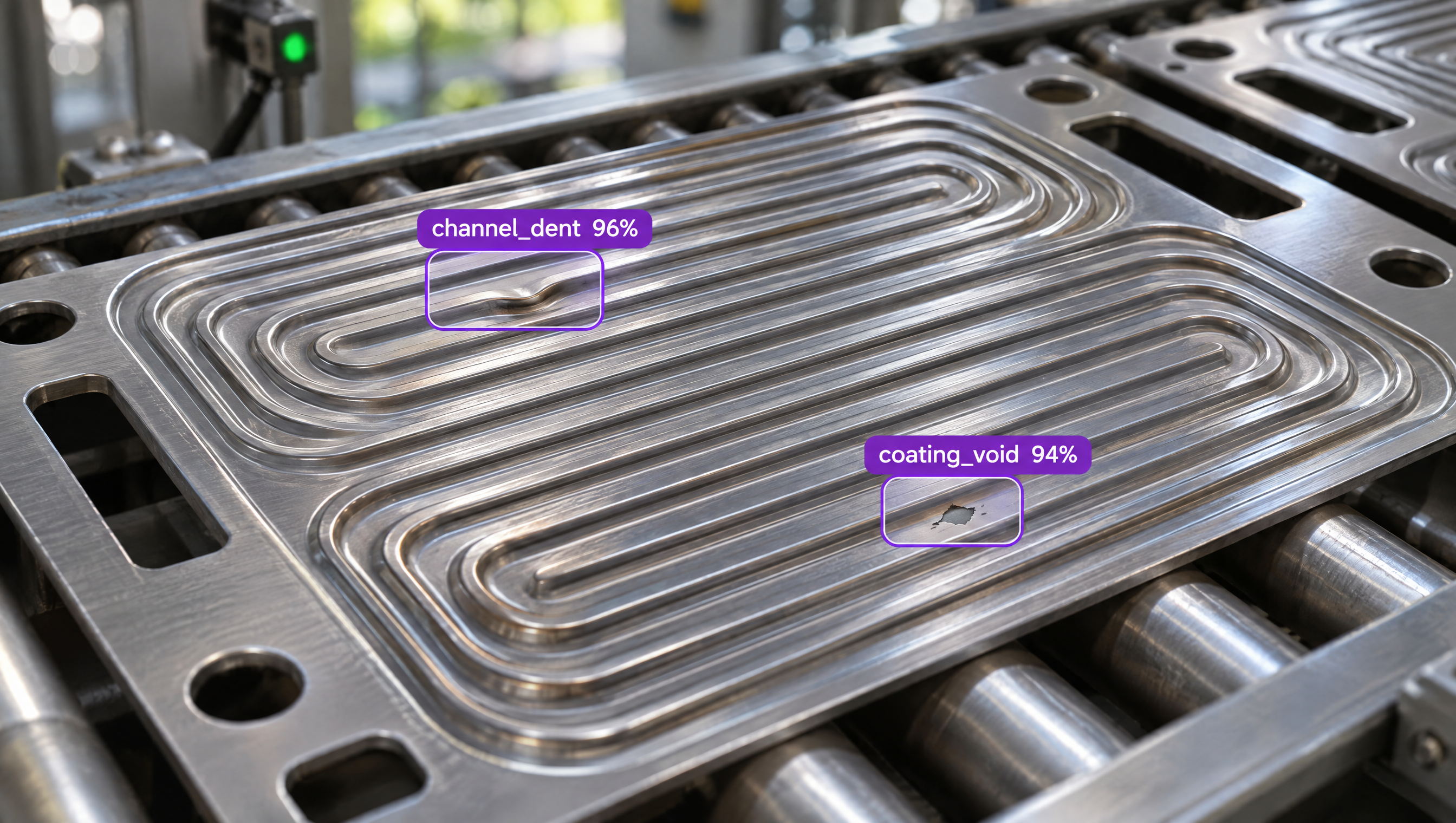
Automated defect detection system identifying a channel dent and coating void on a stamped metal plate on a roller conveyor.

Bipolar Plate Inspection AI for the Toughest Fuel Cell Plate and Stack Lines

  • Deploy Anywhere, Run Everywhere

    Run bipolar plate inspection on the cameras over your presses, coating lines, welders, and sealing stations, on the edge, on-prem, air-gapped, in your VPC, or via API.

  • One Platform, Full Adoption

    Tools every fuel cell team can adopt, from forming and welding process engineers to quality and stack engineers, no separate ML team required.

  • Secure, Compliant, and Audit-Ready

    Data stays safe with SOC 2 Type II compliance, encrypted data, and an uptime SLA, with per-plate records that support IATF 16949 and ISO 9001 documentation.

  • Flow Field Channel Defects
  • Dents, Scratches & Cracks
  • Coating Voids & Pinholes
  • Half-Plate Weld Seams
  • Seal & Gasket Bead Checks
  • Per-Plate Inspection Records
“The vision AI solutions we developed with Roboflow have been a core component of connecting our teams and unlocking their ability to collaborate.”

Lou Stocco

Director of Manufacturing Advanced Analytics, USG

Talk to a Vision AI engineer who's shipped in automotive manufacturing.

Bring us your toughest bipolar plate inspection problem and we'll map a working solution.

Ask us about:

  • Solution architecture for IATF 16949 and ISO 9001 environments
  • A live demo on images of your own plates and defects
  • Deployment options: edge, on-prem, air-gapped, or VPC
  • ROI modeling against scrapped plates, stack rework, and early stack failures

Over 80,000 organizations build with Roboflow.

  • Rivian
  • Pella
  • Chobani
  • USG Corporation
  • BNSF Railway
  • American Woodmark
Start where you are

Vision AI is transforming businesses

Customers across the board are solving complex challenges and driving meaningful impact.

  • Automotive customer

    $10 million

    Saved by automatically detecting defects on the production line

  • Logistics & freight company

    90%

    Less time spent manually tracking shipping inventory

  • Building materials supplier

    60%

    Lower customer return rate with improved product quality

Inspect Every Bipolar Plate, from Forming to Stacking

Add a real-time inspection layer to every bipolar plate with Roboflow Vision AI for bipolar plate inspection. Built for fuel cell plants where a stack holds hundreds of plates, one dented flow channel or uncoated spot can starve a cell or start corrosion, and the defect is buried the moment the plate is stacked. Whether you're stamping and welding metal plates, molding graphite composite plates, or coating and sealing them, Roboflow inspects every plate at line rate, with a per-plate record behind every stack.

Forming and flow field inspection:

  • Detect dents, scratches, cracks, and burrs on stamped metal and molded graphite plates
  • Flag deformed, collapsed, or blocked flow field channels before they starve a cell
  • Verify manifold and port openings are clean, complete, and free of debris

Coating, welding, and sealing:

  • Catch coating voids, pinholes, scratches, and discoloration on the plate surface, alongside coating thickness measurement
  • Inspect the laser weld seam that joins the two half plates for gaps, spatter, and burn-through, the same way weld inspection works on other parts
  • Verify the seal or gasket bead is present, continuous, and in position around every port and the active area

Lines, stacking, and systems integration:

  • Trend findings by press, die, coating batch, and welder, so a wearing die shows up in channel defects before it shows up in stack testing
  • Run the same pass and fail criteria on every plate, every shift, instead of a sampled lot
  • Route rejected plates in real time through PLC integration and send per-plate records to your MES

Bring intelligence to every plate today. Stop plate defects from becoming starved cells, early stack degradation, or a teardown that ends at a plate nobody inspected.

Frequently asked questions

What is bipolar plate inspection with Vision AI?

Bipolar plate inspection with Vision AI uses cameras on the forming, coating, welding, and sealing lines and a trained computer vision model to inspect every fuel cell bipolar plate before it goes into a stack. It checks the flow field channels, the plate surface and coating, the weld seam between half plates, and the seal bead, and keeps an image-backed record for each plate. It works with surface inspection and porosity detection on the same stations.

Which bipolar plates does it work on?

Stamped stainless steel and titanium plates, coated metal plates, and molded graphite or composite plates, for PEM fuel cells in cars, trucks, buses, and stationary power. The model is trained on images of your own plates, channel patterns, and defects, so it learns what a good plate looks like on your line and flags anything outside it.

How does it find rare defects when we have few examples?

Start with images of good plates and the defects you have, and grow the defect model as production adds examples. Few-shot defect detection and an active learning loop collect new defect images from the line for review and retraining. Our guide to training a model for defects you almost never see covers the steps.

Can it integrate with our PLC, MES, and quality systems?

Yes. Roboflow Workflows send pass and fail results to line PLCs to reject a plate the moment a check fails, and write per-plate records over MQTT, OPC UA, REST, or a database to your MES and quality systems. Our integration stack guide shows how each layer connects.