Belt Rip Prevention AI
Spot tramp metal, sharp rock, and lodged objects at the load zone, and stop the belt the moment a tear starts.
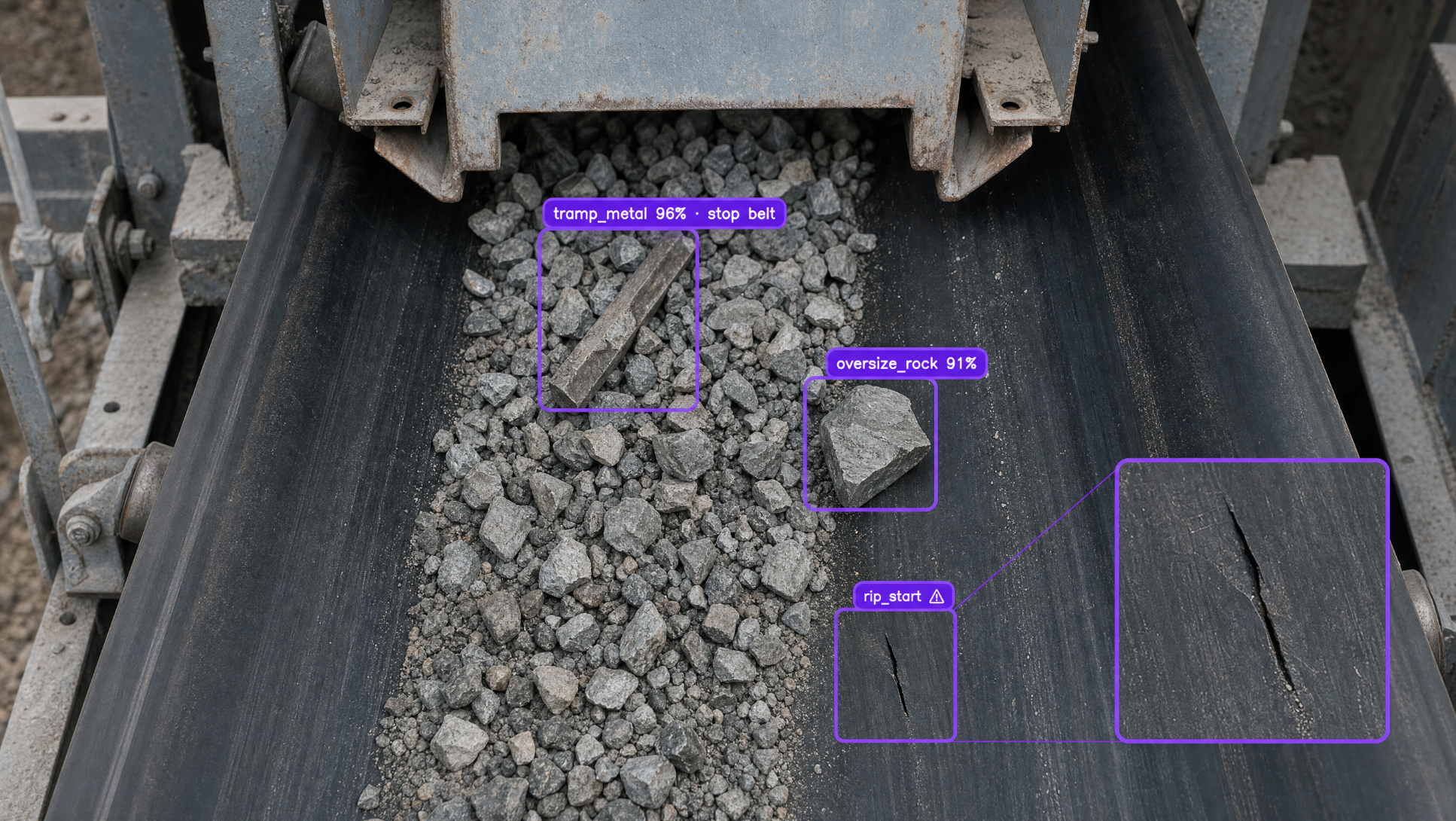
Belt Rip Prevention AI for the Toughest Mines, Quarries, Cement Plants, and Ports
Deploy Anywhere, Run Everywhere
Run belt rip prevention on chute, transfer point, and underbelt cameras on the edge, on-prem, in your VPC, or via API.
One Platform, Full Adoption
Tools every maintenance and operations team can adopt, from reliability engineers to belt crews and control room operators, no separate ML team required.
Secure, Compliant, and Audit-Ready
Data stays safe with SOC 2 Type II compliance, encrypted data, HIPAA compliance, and an uptime SLA.
- Tramp Metal & Foreign Objects at the Load Zone
- Oversize & Sharp Rock on the Belt
- Objects Wedged in Chutes & Skirt Boards
- Longitudinal Rips & Tears in Progress
- Cuts, Gouges & Edge Damage
- Belt Stop Signals & Rip Event Clips
“Roboflow has been instrumental in accelerating our deployment of innovative AI solutions.”
Travis Turnbull
Vice President & CIO, Pella Corporation
Talk to a Vision AI engineer who's shipped in mining and bulk materials.
Bring us your toughest belt rip problem and we'll map a working solution.
Ask us about:
- Solution architecture that fits your conveyors, belt protection systems, and PLC stop logic
- A live demo on your own chute and belt camera footage
- Deployment options: edge, on-prem, air-gapped, VPC, or on the cameras and network your site already runs
- ROI modeling against belt replacement, splice repairs, lost tonnage, and unplanned downtime
Over 16,000 organizations build with Roboflow.
- Rivian
- Pella
- Chobani
- USG Corporation
- BNSF Railway
- American Woodmark
Vision AI is transforming businesses
Customers across the board are solving complex challenges and driving meaningful impact.
- Automotive customer
$10 million
Saved by automatically detecting defects on the production line
- Logistics & freight company
90%
Less time spent manually tracking shipping inventory
- Building materials supplier
60%
Lower customer return rate with improved product quality
Stop Every Rip Before It Runs, from the Loading Chute to the Head Pulley
Add a real-time inspection layer to the load zone of every critical conveyor with Roboflow Vision AI for belt rip prevention. Built for mines, quarries, cement plants, and ports where one piece of tramp steel wedged in a chute can open a belt along its length, and the replacement belt and downtime cost far more than catching it early.
Catch the cause at the load zone:
- Detect tramp metal, drill steel, bucket teeth, and other foreign objects on the belt as it leaves the chute, with a model trained on your own material and lighting.
- Flag oversize and sharp-edged rock before it reaches a transfer point where it can wedge between the belt and the chute.
- Watch chutes, skirt boards, and impact beds for objects lodged against the belt and for worn or missing liners and skirting.
Spot damage and stop the rip:
- Detect a longitudinal rip or tear as it starts, from a camera above or below the belt, and send a stop signal to the PLC to keep the damage short.
- Find cuts, gouges, edge damage, and cover wear on every pass, and log each by belt position so the belt crew knows where to look.
- Catch unusual belt surfaces that were never labeled with anomaly detection that learns what a normal belt looks like.
Records and maintenance:
- Save an image and clip of every tramp metal, wedged object, and rip event with the conveyor, camera, and time.
- Trend foreign object and damage events by conveyor, shift, and source so the team can fix the magnet, screen, or chute that lets them through.
- Run idler monitoring and conveyor belt monitoring on the same cameras for a full view of belt health.
Bring intelligence to every load zone today. Stop tramp metal and sharp rock from turning into a ripped belt and days of downtime.
Frequently asked questions
What is belt rip prevention with Vision AI?
Belt rip prevention with Vision AI uses cameras at the loading chute, transfer points, and along the belt with a trained computer vision model to find the objects that cause rips, such as tramp metal, sharp rock, and objects wedged at the chute, and to detect a rip or tear as it starts so the belt can be stopped. It pairs with conveyor belt monitoring, conveyor idler monitoring, and ore car fill detection.
Why do conveyor belts rip?
Most longitudinal rips start near the loading area, when a hard object such as tramp metal or a sharp rock punctures the belt or wedges between the belt and the chute or skirting. Once started, the rip runs along the belt as it moves, so the time between the first cut and the belt stop decides how much belt is lost.
Does it work alongside rip detection sensors and metal detectors?
Yes. Cameras add a view of what is coming off the chute, what is lodged at the skirting, and what the belt surface looks like, with an image for every event. Results from cameras, rip sensors, and metal detectors can all feed the same stop logic in the PLC.
Roboflow serves as the detection engine, and your maintenance and controls teams own the stop logic, thresholds, and response.
Can it integrate with our PLC, SCADA, and maintenance systems?
Yes. Roboflow writes detections and stop requests to a PLC tag over OPC UA, Modbus TCP, or MQTT, so Allen-Bradley and Siemens controllers can stop the belt or raise an alarm. Results and images can be sent over REST or written to a database for SCADA platforms such as Ignition and AVEVA, and to maintenance systems as work orders.