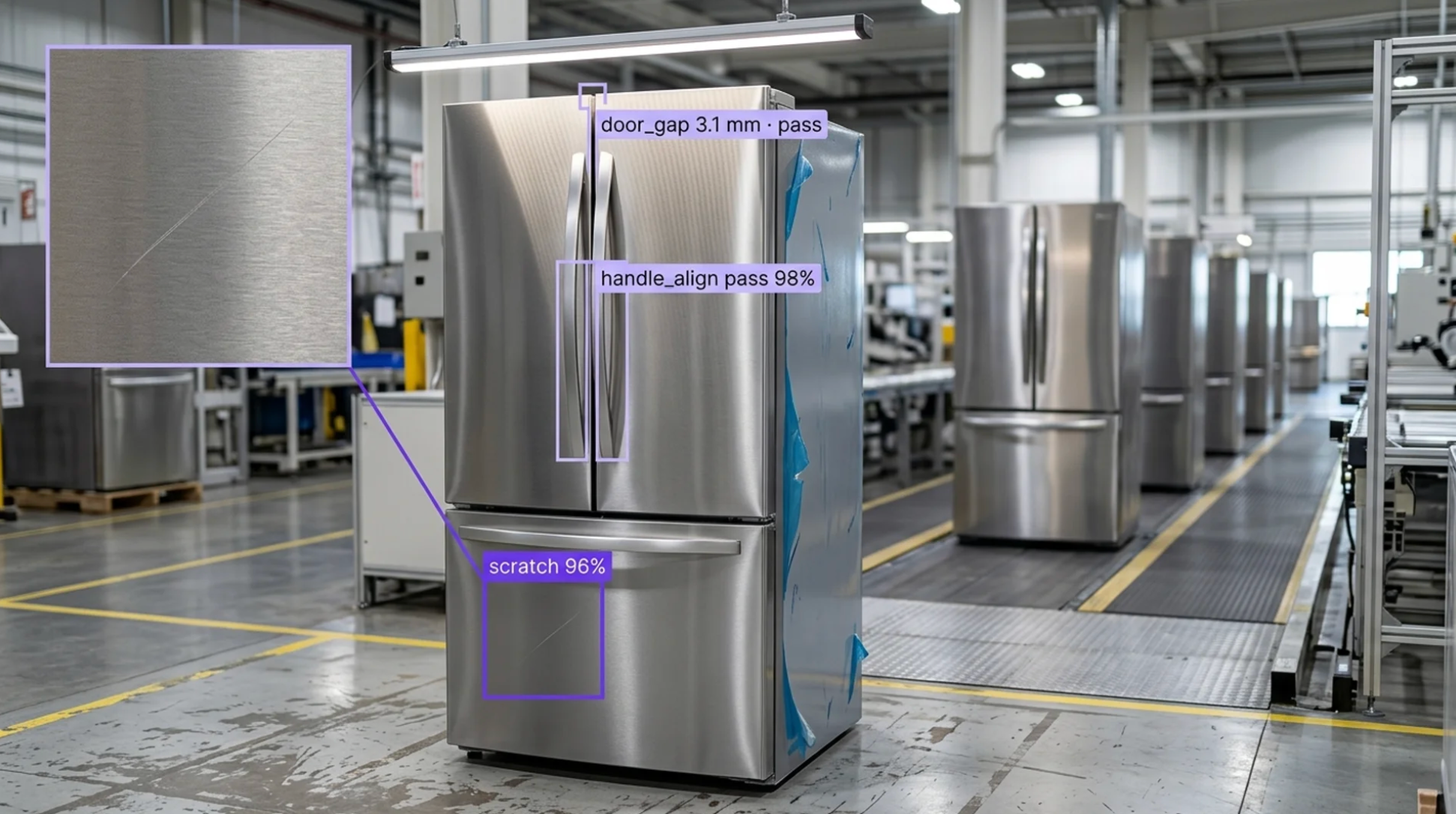
Add a real-time inspection layer to every refrigerator, washer, dryer, range, and dishwasher on the line with Roboflow Vision AI for appliance manufacturing quality inspection.
Finish and fit on doors, panels, and cabinets:
- Detect scratches, dents, dings, orange peel, and color mismatch on painted, powder-coated, and stainless doors and side panels under the plant's own lighting, including the low-angle scratches that only show up as a unit passes the light tunnel.
- Measure door gap and flush at hinge, handle, and top-edge points on French door refrigerators, front-load washers, and dishwashers, and flag units outside the model's tolerance before they leave door hang.
- Verify gasket seating around refrigerator and dishwasher doors and washer door boots, and confirm foam and insulation coverage on cabinets after the foaming fixture, with no voids or bare corners.
Harness, fasteners, and control panels inside the box:
- Verify harness routing follows the model's path, clips are closed, and connectors are fully seated at the compressor, inverter board, pump, motor, and user interface before the back panel or top deck closes them off.
- Confirm fastener, clip, and bracket presence on drum and tub assemblies, hinge plates, and compressor mounts, and check drum, spider, and counterweight assembly on washers before the tub is sealed.
- Check control panel, badge, and label placement against the model variant, including rating plate, ENERGY STAR label, and DOE energy guide, so the right label lands on the right SKU.
Final assembly completeness, kitting, and packaging:
- Verify final assembly completeness per model variant from the build manifest: shelves, crisper bins, ice maker, water filter, dispenser trim, and door bins present and correct for the SKU.
- Confirm accessory kit contents (drain hoses, inlet hoses, power cord, leveling feet, manuals, and racks) and packaging state (corner posts, film, and carton labels) before the unit is crated and palletized.
- Write pass/fail and defect location to the PLC or MES at each station so the unit is held, routed to repair, or released, and keep a per-serial image record for warranty and field service investigations.
Bring intelligence to every appliance on the line today. Stop cosmetic escapes, fit issues, and short kits from becoming warranty claims and retailer returns.
Frequently asked questions
What is appliance manufacturing quality inspection with Vision AI?
Appliance manufacturing quality inspection with Vision AI uses cameras on the assembly line and a trained computer vision model (opens in a new tab) to check each refrigerator, washer, dryer, range, or dishwasher at the stations where defects are introduced: panel scratches, dents, and color mismatch after paint and stainless handling, door gap and flush after door hang, gasket seating and foam coverage after cabinet foaming, harness routing and connector seating before close-out, fastener and clip presence on drum and tub assemblies, control panel and label placement, and final assembly and accessory kit completeness by model variant. Results are written to the PLC or MES per serial number and stored with images, which supports ISO 9001 quality records, UL and IEC 60335 factory surveillance, ENERGY STAR and DOE label and test documentation, and AHAM standards.
Can Vision AI inspect painted and stainless panels for scratches and dents across dozens of colors and finishes?
Yes. A segmentation model trained on your own line imagery learns what scratches, dents, dings, orange peel, and color mismatch look like on gloss white, matte black, slate, and brushed stainless under your light tunnel, and it holds up as new colors and finishes enter the line because it is retrained on new images rather than reprogrammed per SKU. The same approach covers door gap and flush and metal surface defects on side panels.
Does appliance manufacturing inspection support ISO 9001 and UL and IEC 60335 factory inspections?
Appliance manufacturing inspection supports the record-keeping expectations of ISO 9001 (the quality management system standard that requires documented inspection, nonconformance, and corrective action records), UL and IEC 60335 (the household appliance safety standards whose listings depend on follow-up factory inspections verifying that production units match the certified construction, including grounding, wiring, and guarding), ENERGY STAR and DOE test records (the efficiency programs that require the correct label and rating plate on each certified model), and AHAM standards (the Association of Home Appliance Manufacturers performance and verification standards), by keeping a per-serial image and pass/fail record at each inspection station. Roboflow serves as the inspection engine, and your quality, compliance, and manufacturing engineering teams own the acceptance criteria, the tolerances per model, and the disposition of held units.
Can it integrate with our MES, PLC, and end-of-line test systems?
Yes. Roboflow writes pass/fail, defect class, and defect location to the PLC at each station over OPC UA, Modbus TCP, or MQTT, so Allen-Bradley, Siemens, and Mitsubishi controllers can hold the conveyor, route the unit to repair, or release it. Per-serial results, images, and variant checks can be sent over REST (opens in a new tab) or written to a database for an MES such as SAP Digital Manufacturing, Siemens Opcenter, or Rockwell Plex, for SCADA platforms such as Ignition and AVEVA, and for the end-of-line functional and hipot test records that travel with the serial number. The same model variant data that drives final assembly inspection comes from the build manifest in the MES, so the check for each SKU matches the order.