Aircraft Skin Inspection AI
Find and map dents, corrosion, lightning strike damage, paint damage, and missing fasteners.
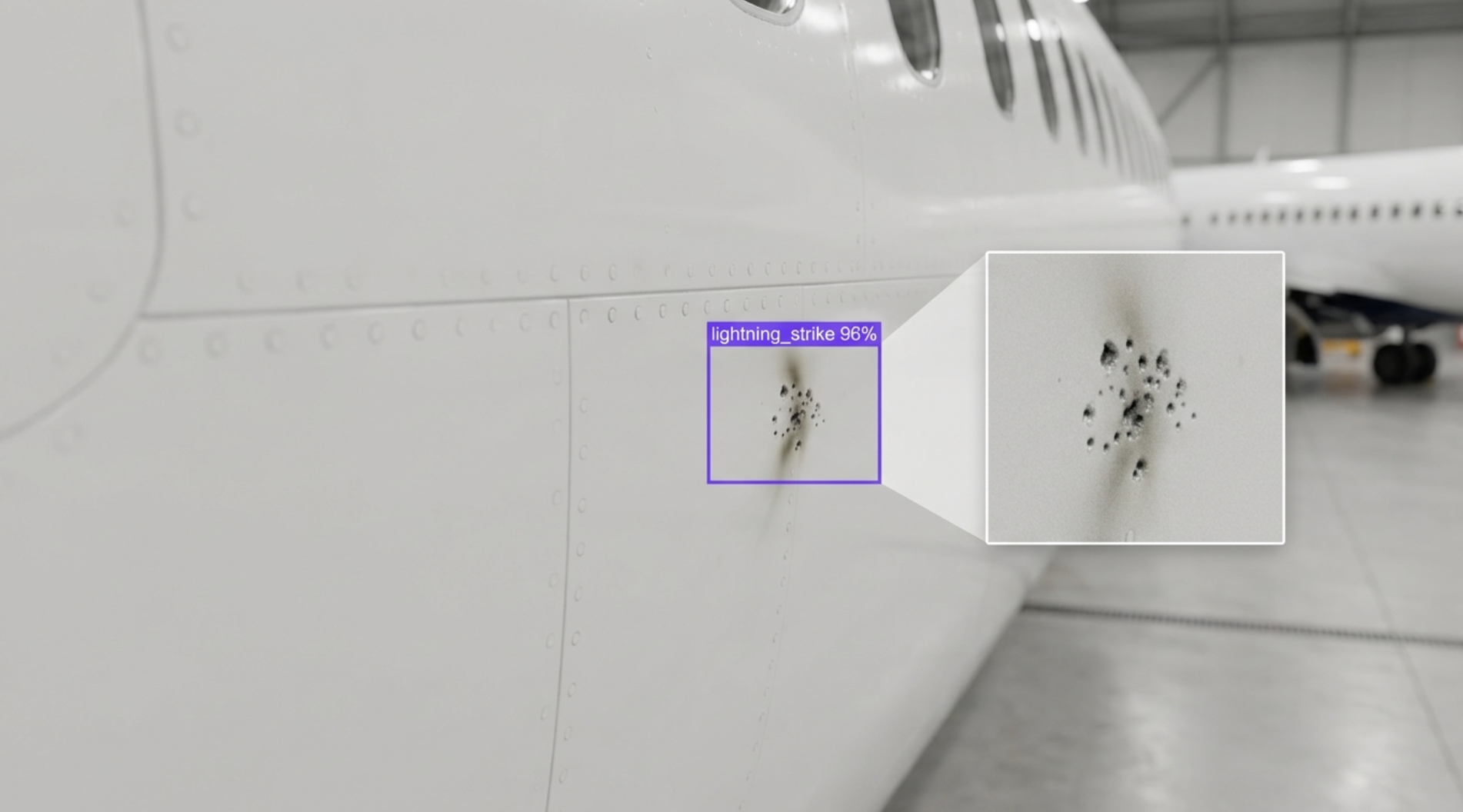
Aircraft Skin Inspection AI for the Toughest Line Maintenance, Heavy Check, and MRO Hangars
Deploy Anywhere, Run Everywhere
Run aircraft skin inspection on hangar drones, fixed hangar cameras, and handheld devices on the edge, on-prem, in your VPC, or via API.
One Platform, Full Adoption
Tools every MRO team can adopt, from licensed technicians to tech ops leaders, no separate ML team required.
Secure, Compliant, and Audit-Ready
Data stays safe with SOC 2 Type II compliance, encrypted data, HIPAA compliance, and an uptime SLA.
- Dent & Buckle Detection on Fuselage Skin
- Corrosion & Paint Blistering
- Lightning Strike Entry & Exit Marks
- Missing, Loose & Popped Fasteners
- Sealant, Panel & Access Door Damage
- Finding Location on the Aircraft Map
“Roboflow has been instrumental in accelerating our deployment of innovative AI solutions.”
Travis Turnbull
Vice President & CIO, Pella Corporation
Talk to a Vision AI engineer who's shipped in aviation MRO.
Bring us your toughest aircraft skin inspection problem and we'll map a working solution.
Ask us about:
- Solution architecture that fits FAA Part 145 and Part 43, EASA Part-145, AS9110, and your structural repair manual workflow
- A live demo on your own drone or hangar imagery
- Deployment options: edge in the hangar, on-prem, air-gapped, VPC, drone-mounted, or handheld
- ROI modeling against aircraft on ground time, inspection hours per check, missed findings, and repeat defects
Over 16,000 organizations build with Roboflow.
- Rivian
- Pella
- Chobani
- USG Corporation
- BNSF Railway
- American Woodmark
Vision AI is transforming businesses
Customers across the board are solving complex challenges and driving meaningful impact.
- Automotive customer
$10 million
Saved by automatically detecting defects on the production line
- Logistics & freight company
90%
Less time spent manually tracking shipping inventory
- Building materials supplier
60%
Lower customer return rate with improved product quality
Inspect Every Panel on Every Aircraft, from the Radome to the Tail Cone
Bring real-time intelligence to every skin panel in the hangar with Roboflow Vision AI for aircraft skin inspection. Built for airlines and MROs where a general visual inspection means hours on lifts and scaffolding, where dents and lightning strike marks hide in the paint, and where every hour of aircraft on ground costs money.
Structural and surface damage:
- Detect dents, buckles, and creases on fuselage, wing, and tail skins from drone and hangar images, with a model trained on your own fleet and paint schemes.
- Find corrosion, paint blistering, and filiform corrosion around fasteners and lap joints.
- Flag lightning strike entry and exit marks, burn spots, and pitting that need a closer look.
Fasteners, panels, and seals:
- Detect missing, loose, and popped fasteners, and damaged or missing sealant along seams.
- Check access panels, doors, and fairings for damage and correct closure.
- Find erosion on leading edges, radomes, and antennas.
Locate, disposition, and track:
- Map each finding to a location on the aircraft by station, stringer, and zone so the inspector goes straight to it.
- Hand the finding and image to the licensed inspector for disposition against the structural repair manual limits.
- Compare each check with the last one on the same tail number to see what is new and what has grown.
Bring intelligence to every aircraft in the hangar today.
Frequently asked questions
What is aircraft skin inspection with Vision AI?
Aircraft skin inspection with Vision AI uses hangar drones, fixed cameras, or handheld devices and a trained computer vision model to find dents, corrosion, lightning strike damage, paint damage, and missing fasteners across the aircraft skin, then map each finding to a location on the aircraft. Licensed inspectors review and disposition each finding. It is part of Vision AI for aerospace MRO, alongside automated borescope inspection and corrosion detection.
Can Vision AI find a shallow dent on a painted fuselage?
Yes. Shallow dents are hard to see, so lighting is the key: raking light, structured light, or images taken from several angles make a dent visible to both people and models. A model trained on your own fleet under that lighting flags dent candidates.
Does aircraft skin inspection support FAA Part 145 and EASA Part-145?
Aircraft skin inspection supports the inspection and record-keeping requirements of FAA 14 CFR Part 145 (repair stations) and Part 43 (maintenance, preventive maintenance, rebuilding, and alteration), EASA Part-145 (approved maintenance organizations), and AS9110 (the quality management standard for aviation maintenance organizations), with image records for each finding.
Roboflow serves as the detection engine, and your licensed inspectors, engineering, and quality teams own the disposition of every finding against the aircraft manufacturer's structural repair manual and the return to service decision.
Can it integrate with our maintenance and engineering systems?
Yes. Roboflow sends findings, locations, and images over REST or writes them to a database, so they can open non-routine cards in maintenance systems such as AMOS, TRAX, Ramco, and SAP, and feed engineering reliability programs. Drone inspection data can be processed in the hangar at the edge, so images of the aircraft do not need to leave the site.