Jetson vs Raspberry Pi

Prototype on a Pi, scale on a Jetson. Roboflow runs on both.

Raspberry Pi 5 is a low-cost Arm computer that runs vision models on its CPU. Jetson Orin Nano Super adds an NVIDIA GPU with up to 67 TOPS for real-time video. Train a model in Roboflow and deploy it with Roboflow Inference on either one. Over 2 million developers build with Roboflow.
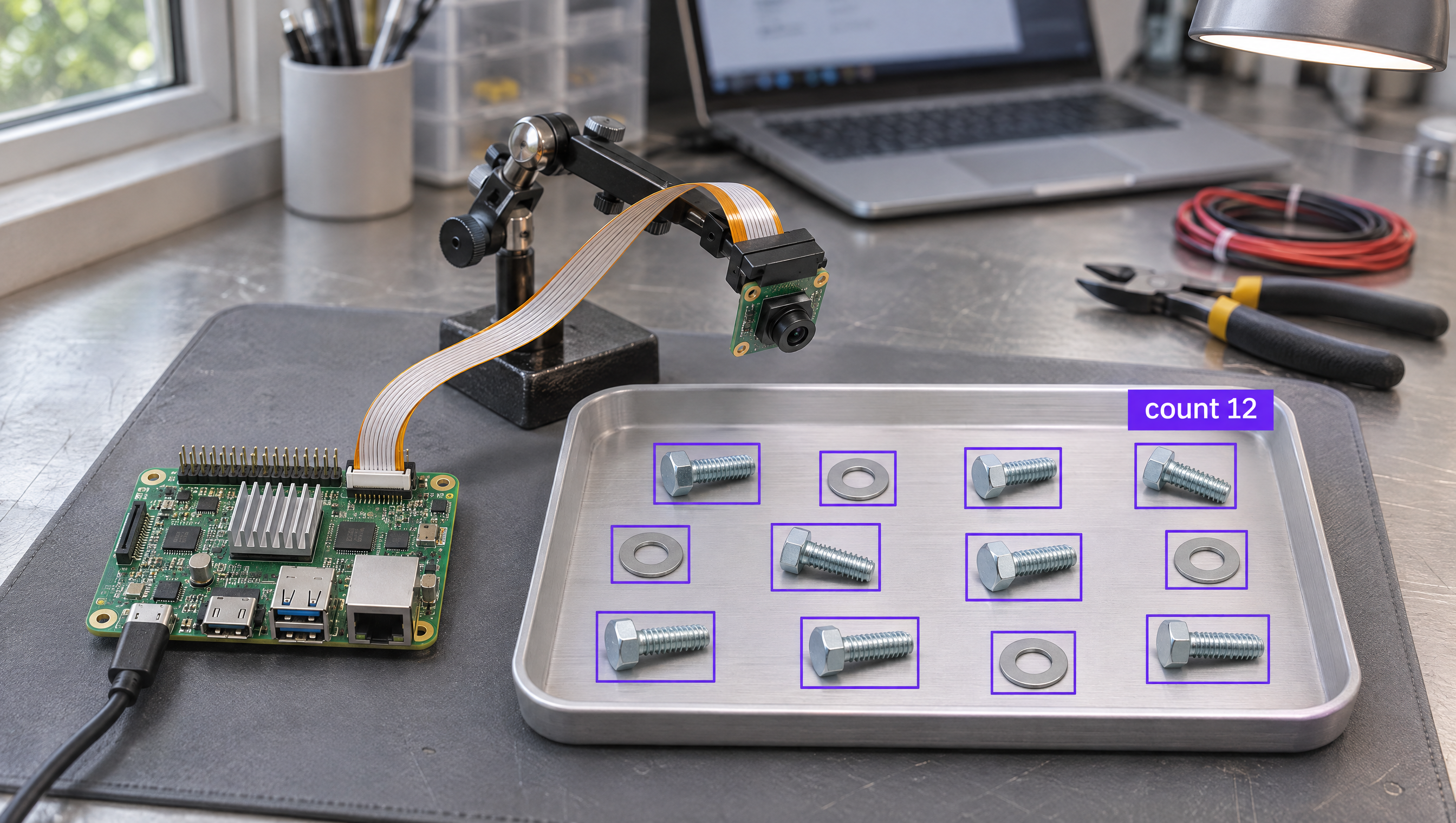
A computer vision setup featuring a small camera connected to a single-board computer, detecting and counting bolts and washers in a metal tray with purple bounding boxes.

Why are companies choosing Roboflow?

Roboflow is enterprise vision AI infrastructure, used by more than half of the Fortune 100, with SOC 2 Type II, HIPAA, and air-gapped deployment. Create datasets, train models, and deploy to production.

  • One Model, Pi or Jetson

    Train once in Roboflow and run the same model on a Raspberry Pi 4 or 5, or on any Jetson.

  • Runs Offline

    Roboflow Inference runs models on the device itself, with no cloud connection needed.

  • Room to Grow

    Move from a Pi to a Jetson or Roboflow hardware as camera count and model size grow, without retraining.

Which board fits your project?

Both run the same Roboflow model, so you can start on one and move to the other.

  • Raspberry Pi 5: Low-Cost Prototypes

    Runs small models on its CPU at a few frames per second. Best for learning, single-camera projects, and checks that don't need real-time video.

  • Jetson Orin Nano Super: Real-Time Vision

    Up to 67 TOPS on an NVIDIA GPU at 7W to 25W. Best for live video, larger models, or more than one camera.

  • Both: Prototype, Then Scale

    Build on a Pi, then move the same Roboflow model to a Jetson when you need more speed.

OK I’m ready, how do I use Roboflow?

Roboflow makes it easy to build, train, and deploy custom computer vision models, even if you’re not a machine learning expert.

Talk to a Vision AI engineer before you pick a board

Outgrowing your prototype? Bring Roboflow your use case and we'll size the hardware and show you a model running on it on the first call.

Ask us about:

  • A recommendation on Raspberry Pi, Jetson, or Roboflow hardware for your cameras
  • A live demo of a model trained on your own images
  • Roboflow hardware that ships with Jetson inside
  • Your trained model served over MCP, so frontier models can call it

Over 80,000 organizations build with Roboflow.

  • Rivian
  • Pella
  • Chobani
  • USG Corporation
  • BNSF Railway
  • American Woodmark
Start where you are

Compare NVIDIA Jetson and Raspberry Pi

Raspberry Pi 5 and NVIDIA Jetson Orin Nano Super are both small Arm computers that can run vision models, but they're built for different workloads and budgets.

Raspberry Pi 5 uses a quad-core Arm Cortex-A76 CPU at 2.4GHz with 1GB to 16GB of memory, two MIPI camera connectors, and a PCIe 2.0 port for add-ons. It has no built-in AI accelerator, so vision models run on the CPU unless you add an accelerator such as the AI HAT+ 2. Raspberry Pi says Pi 5 will stay in production until at least January 2036, though memory costs have pushed its prices up several times in 2026.

Jetson Orin Nano Super pairs a 6-core Arm CPU with an NVIDIA Ampere GPU, 8GB of LPDDR5 memory, and up to 67 TOPS at 7W to 25W. It runs NVIDIA's CUDA and TensorRT stack, so models run faster and one board can handle live video from more cameras. If you outgrow it, Orin NX and AGX Orin offer more compute on the same software.

Whichever board you choose, Roboflow handles the vision model. Label images with Auto Label, train a model such as RF-DETR (opens in a new tab), Roboflow's open-source detection, segmentation, and keypoints model, and deploy it with Roboflow's open-source Inference server (opens in a new tab), which runs on a 64-bit Raspberry Pi 4 or Pi 5 and on Jetson with JetPack 4.5 through 6. On a Pi 5, expect about 4 FPS for a nano-size detection model on the CPU; on a Jetson, TensorRT acceleration is available when you need faster models.

Teams can also use Roboflow Workflows to build applications that combine computer vision models with business logic, then run them on a Raspberry Pi, NVIDIA Jetson, or Roboflow hardware next to your cameras.

You can also skip running the model on a board. Roboflow Cloud Streaming runs your model on cloud GPUs that Roboflow manages, while a lightweight connector near your RTSP or USB cameras sends video outbound.

For organizations building production computer vision applications in manufacturing, logistics, robotics, healthcare, or retail, Roboflow offers a complete training-to-deployment solution, from the first prototype to a fleet of edge devices.

Jetson vs Raspberry Pi: Feature by Feature

FeatureJetson Orin Nano SuperRaspberry Pi 5
What it isNVIDIA developer kit built on the Orin Nano 8GB moduleSingle-board computer from Raspberry Pi
CPU6-core Arm Cortex-A78AE at up to 1.7GHz4-core Arm Cortex-A76 at 2.4GHz
AI accelerationUp to 67 TOPS; Ampere GPU with 1,024 CUDA cores and 32 tensor coresNone built in; the $130 AI HAT+ 2 adds a Hailo-10H accelerator (40 TOPS INT4)
Memory8GB LPDDR5, 102 GB/s1GB to 16GB LPDDR4X
Video decode (H.265)1x 4K60, or up to 11x 1080p301x 4K60
Power7W to 25W5V/5A over USB-C; 27W supply recommended
Price$399 for the Developer Kit (NVIDIA list price after July 2026)$45 (1GB) to $385 (16GB) after 2026 memory price increases
SoftwareNVIDIA JetPack (Linux) with CUDA and TensorRTRaspberry Pi OS (Linux)
Runs Roboflow modelsYes, GPU-accelerated Roboflow Inference on JetPack 5 and 6, with TensorRTYes, Roboflow Inference on the CPU of a 64-bit Pi 4 or Pi 5

Which One Should You Choose?

  • Choose Raspberry Pi 5 to learn, prototype, or run a small model on one camera where a few frames per second is enough.
  • Choose Jetson Orin Nano Super for real-time video, larger models, or more than one camera.
  • Move up to Orin NX or Roboflow hardware for production lines and many camera streams.
  • Choose Cloud Streaming when you want models on RTSP or USB camera feeds without buying a board for inference.
  • Whichever you pick, train and deploy the model with Roboflow, and move it to a bigger device later without retraining.

More on Edge Devices and Roboflow