Statsyuk Gives Professional Player Tracking to Every Hockey Team with Vision AI
This sports analytics company turns footage from a single camera into structured data of every player on the ice.

Sports
- AI Dataset Optimization
- Hosted Model Training
- Continuous Model Improvement
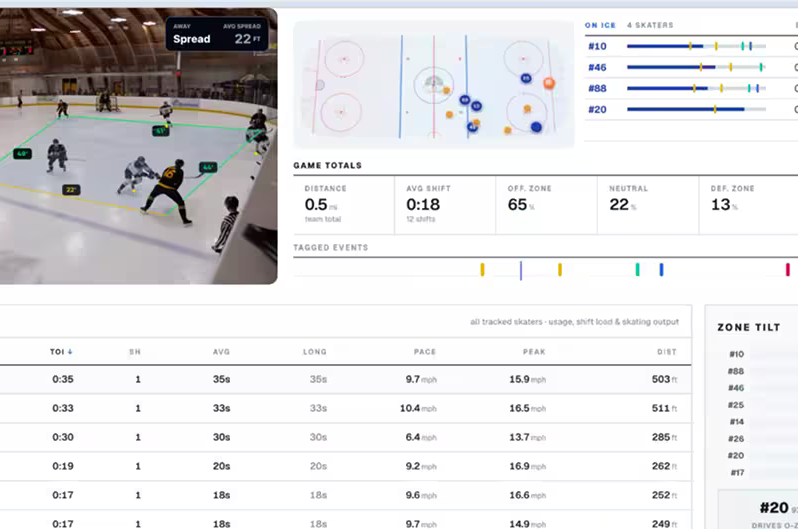
Statsyuk is a sports analytics company on a mission to make professional-grade player tracking available to every hockey team. Using computer vision, the company turns footage of games and practice sessions into detailed, shift-by-shift data for each player on the ice. A team that once spent days breaking down game footage by hand, or paid a third party to do it, can now get a full game report in hours.
Turning game footage into structured player data
Previously, getting detailed player tracking required a system of cameras mounted around the arena, at a cost only professional teams could justify. Outside professional leagues, teams had to chart games by hand, and most of what happened on the ice went unmeasured. That meant the stats for junior and collegiate players were limited to things like goals, assists, and points. Traditional systems didn't tell you how fast a player skates or about their fatigue level across shifts.
Statsyuk is changing that. The company built an application that uses computer vision to process hockey game footage and automatically generate the advanced statistics teams previously lacked. It takes footage from a single moving camera and returns structured data about entire games, teams, and each player.
"In hockey, all this useful information hasn't been possible to capture until now, like how fast a player accelerates or how often a team executes formations. It required expensive rigs that you only see in leagues like the NHL," said Tanner Manett, CTO of Statsyuk. "We're excited to bring this kind of data to youth teams that might just have a single camera set up near the boards."
Reading the game, from formations to shifts
At the team level, Statsyuk shows a coach whether the team actually ran the plays it practiced. Like most team sports, hockey has designed plays for different areas of the rink, even if the action can look chaotic to an outsider. Statsyuk reads where the players are and how they move to recognize which play a team is running, and whether each player was in the right place.
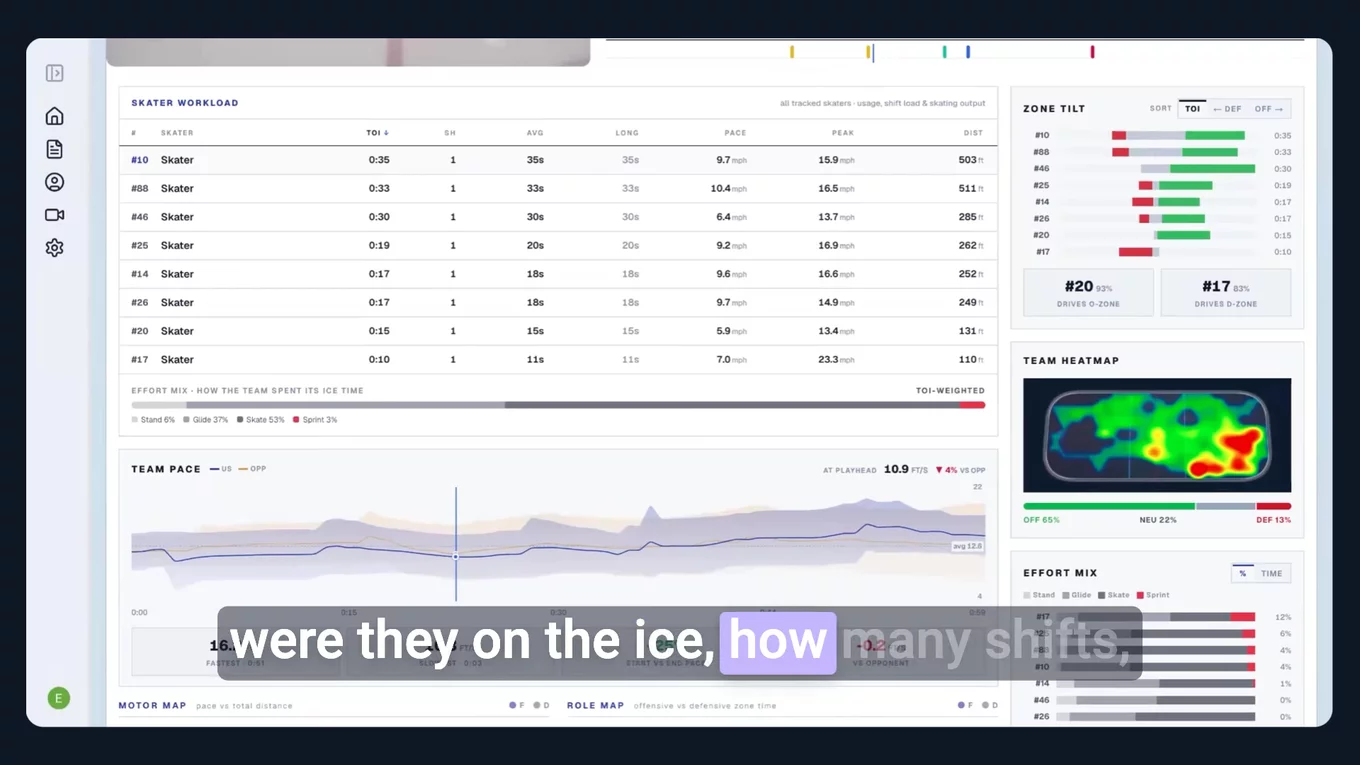
The system provides information on individual players. Hockey players rotate on and off the ice in short bursts called shifts, usually 11 or 12 times per game. Statsyuk breaks a game into those shifts and reports how fast each player skated, where they spent their time, how long they stayed out, and when they started to become fatigued.
"In hockey, your spacing and your system are extremely important. The computer vision system we built lets you review footage and ask, are we playing our system right? Are we in the right space? Because we track the distance between players, you can see if guys are too scrunched up or too spread out," said Evan Cohen, CPO of Statsyuk. "That wasn't possible for these teams before."
Helping players study their own game
Statsyuk gives players a way to study their own game. Instead of scrolling an hour of video to find their shifts, a player can jump straight to a play, see how they performed, and download the clip to keep or share.
"It is not just for the coaches. We want players who are looking for their own plays and the exciting things they did, and want to show their friends," Cohen said. "They can hop on and download a clip from their shift and share it. If they had a full game video, they'd have to scroll through the whole hour-long recording to find their shifts, but this makes it easy to jump straight to a moment and find your own plays."
Getting overlooked players noticed by scouts
Statsyuk also wants to help players get discovered by scouts. Many talented players go unnoticed until a scout happens to attend the right game, and the record that follows them stops at the box score. Statsyuk turns that same footage into skating and movement data for each player, so the ones who would otherwise be overlooked have something to point to.
"There isn't a lot of data on the junior players who eventually get drafted. For the top pick in this year's draft, we know he put up a ton of points, but we don't really know how good of a skater he is, or whether he can stop on a dime," Manett said. "We can give scouts a lot more to go on than the box score, so players who would otherwise be overlooked get noticed."
Building a vision system for fast-paced hockey games
Bringing computer vision to hockey is challenging compared to other sports. Every player wears the same equipment head to toe, goalies blend into the white ice in their pads, players collide and stack up at face-offs, and the camera sometimes films through the netting or partition that protects the crowd.
Making sense of footage like that with a single model would not be feasible. To get reliable results, Statsyuk built a data-processing pipeline consisting of 14 specialized vision models, each responsible for one job and handing its output to the next. The result is a pipeline that is both fast and accurate.
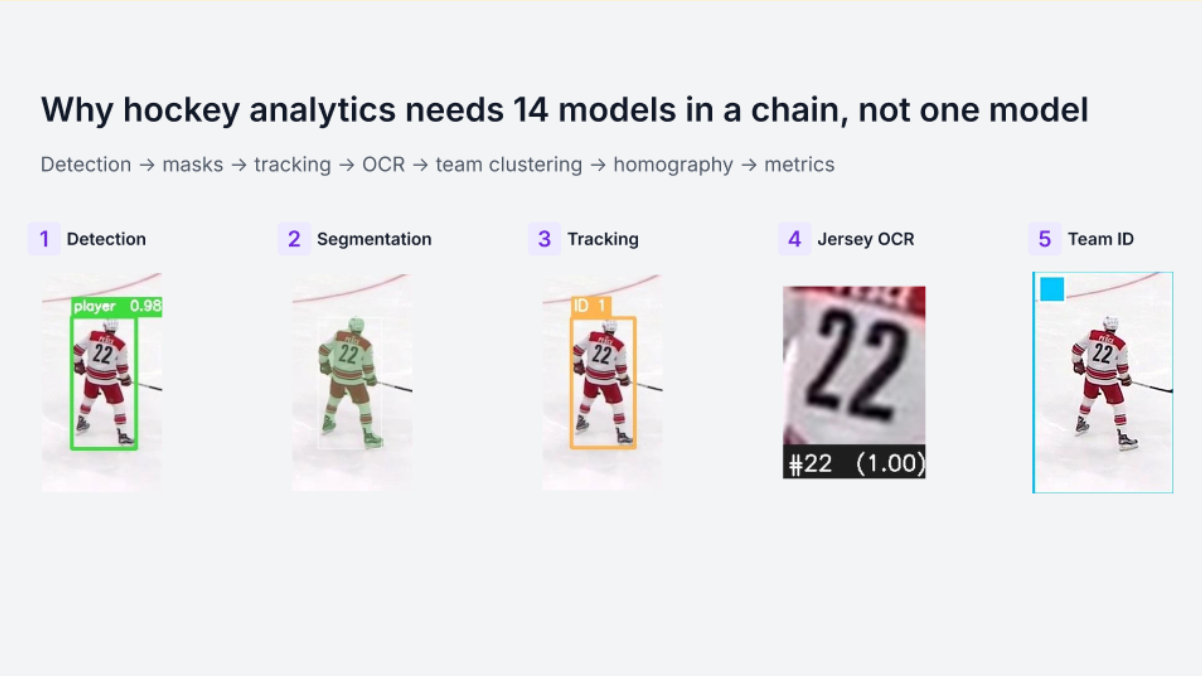
An important part of the pipeline is finding each player in the frame and keeping track of their identities, so stats can be properly assigned to the right player. Statsyuk accomplishes this with a mix of object detectors, segmentation models, tracking algorithms, and optical character recognition. The quality of the object detector is important, because it impacts the reliability of the downstream player tracking and identification. The detector must provide accurate results even when players are grouped together tightly.
"Everything downstream is tied to the players. If we can't detect them, we can't assign a tracking ID, we can't read the jersey number, and we can't get the stats, of course," Manett said. "The quality of the detector is crucial."
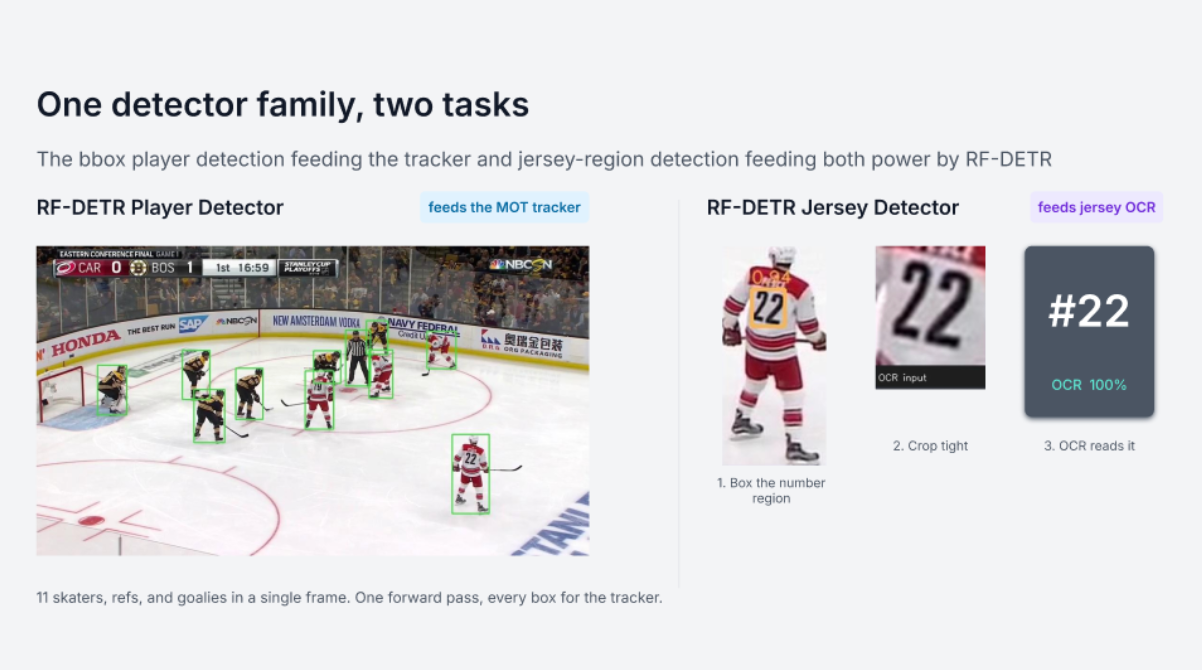
Statsyuk uses RF-DETR, a real-time object detection model developed by Roboflow. Older vision models struggle when players pack tightly together and overlap. They generate a pile of candidate boxes and then throw out the ones that overlap, which can mean discarding a real player who is simply standing near a teammate. RF-DETR works differently. It identifies each player without discarding candidates, so even players stacked on top of one another keep their own box.
"RF-DETR performs better during scrums and face-offs where you have players on top of each other. It can still detect half a player or just a head popping out, which keeps player tracking consistent and accurate downstream," Manett said. "It even detects players reliably through netting and through occlusion, so no matter what footage you give us, we know where they are on the ice."
Training accurate models on limited data
Training a computer vision model to be accurate usually means gathering and hand-labeling a large set of sample images, and getting that data right is often the hardest part of the whole project.
Statsyuk builds its detection models with Roboflow. Because RF-DETR starts from a backbone pretrained on a large set of relevant images, Statsyuk was able to fine-tune accurate models with just a couple thousand sample images, far fewer than a model trained from scratch would need. Statsyuk uses Roboflow to organize the data, label images, fine-tune the models, and track versions as it retrains and improves them.
"Where we've seen the most value is in structuring clean datasets," Manett said. "Roboflow keeps our data and versions organized, so we can put our time into improving the models instead of managing all of it ourselves."
Running the models fast in production
A model that performs well in testing is not automatically fast enough to use in production. Statsyuk processes entire games through its pipeline, so the models have to run quickly and cheaply, or generating the analytics would take too long to be practical. To get there, each model is converted to a format called ONNX and then compiled into a TensorRT engine, which tunes it to run efficiently on the GPU.
That conversion and setup process isn't a one-time cost. When they update or replace a model, it has to be rebuilt and compiled again. "Getting a model fast in production means exporting to ONNX and building a TensorRT engine so it runs efficiently on the GPU. That is low-level hardware work that takes time to solve," Manett said. "If you use Roboflow Inference, it handles all of that heavy lifting for you."
Bringing pro-grade analytics to every hockey rink
By turning ordinary game footage into detailed player data, Statsyuk puts a kind of insight that used to belong only to professional organizations in reach of every team. A coach can see whether the team held its shape, or which players faded late in a game. Movement data that was invisible in hockey, from top speed to effort, is now something a team can review after every game and practice. Even an argument as ordinary as how much ice time a player is getting becomes a settled fact rather than a guess.
"We're excited to bring this kind of data to teams that have never had it. So much of what happens on the ice at this level has gone unmeasured, and we believe we can help a lot of teams understand their game in a way they never could before," Manett said.
About Statsyuk
Statsyuk provides pro-level player tracking built for every team. It turns standard game and practice footage into structured player data, identifying every skater, goalie, and referee on the ice and turning their movement into shift-by-shift statistics that coaches, players, and scouts can use. Statsyuk is currently in private beta with minor, junior, and collegiate teams.
Additional resources
Vision AI is transforming every industry. Let’s transform yours.
- Computer Vision9 min read
Sports Analytics AI with Roboflow
Mostafa IbrahimJune 1, 2026