Build with RF-DETR
Build a Parking Occupancy Detection App Free with RF-DETR
See which parking spaces are open and which are taken, from any camera over the lot. Label images, train RF-DETR free, and deploy it as a workflow.
- No credit card
- No ML team required
- Edge, on-prem or API
Build a Parking Occupancy Detection App with Roboflow’s Free RF-DETR
In short
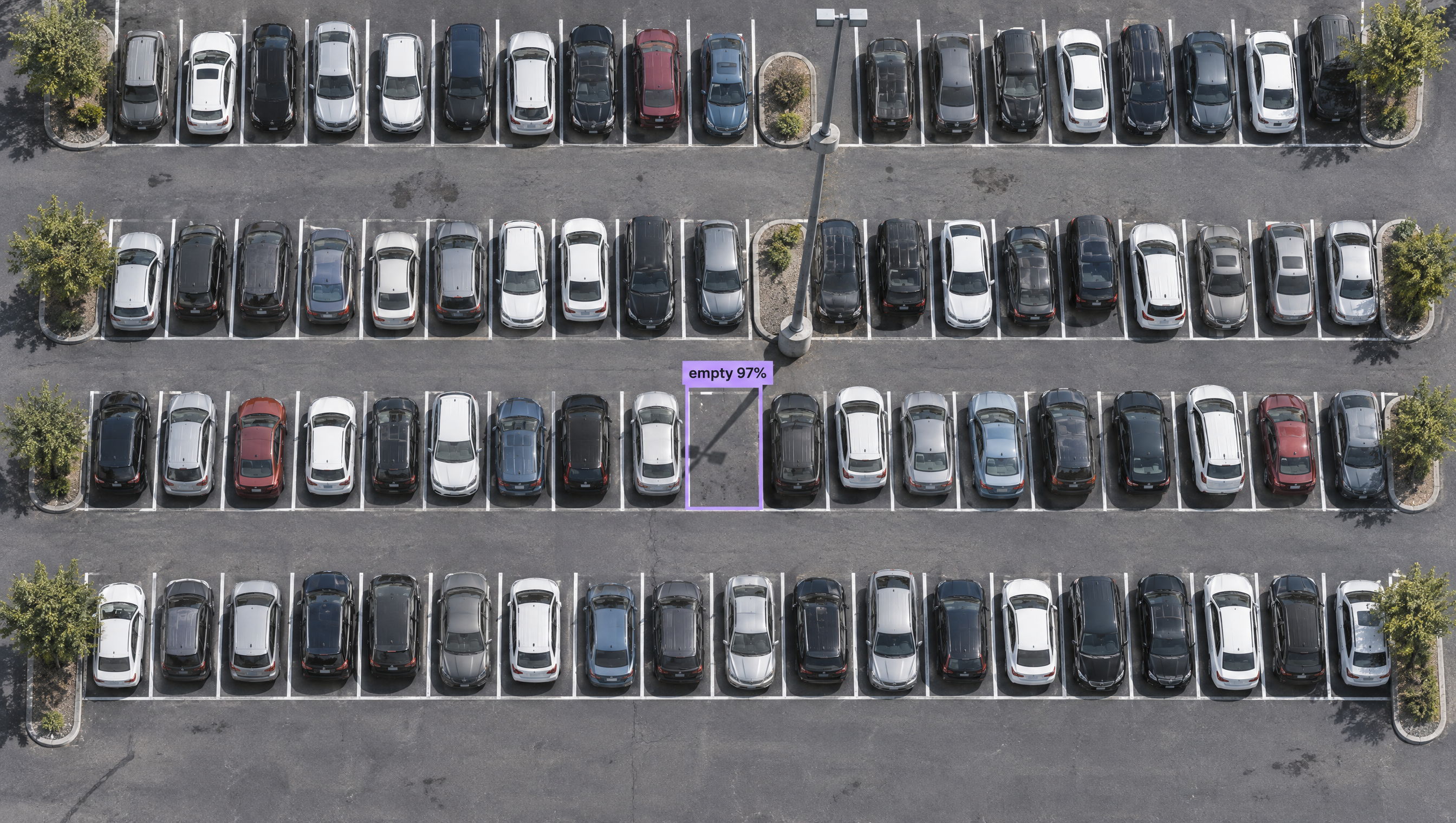
A parking occupancy detection app uses computer vision to look at a parking lot from a camera and tell which spaces are empty and which are occupied, so drivers and operators know how many spots are free in real time. The model to train for it is RF-DETR, Roboflow's open-source real-time detection model. With Roboflow you label your lot images, train RF-DETR for free, and deploy it as a workflow that returns an annotated image, counts of open and occupied spaces, and the lot's status.
How it works
The workflow behind the parking occupancy detection app
Use this Parking Occupancy Detection with RF-DETR workflow: each image goes to an RF-DETR model that labels every space as empty or occupied, then through a per-class confidence filter. Two counters tally the open and occupied spaces and the open count sets the lot status, while the other track draws boxes and labels, and both meet where the status and counts are written onto the image. Every block is editable in the low-code builder, and the Roboflow Agent can build it from a description.
- output_image
- lot_status
- open_spaces
- occupied_spaces
- predictions
How to build a parking occupancy detection app with RF-DETR
Open the workflow and add your lot images
Click "Use this free template" to copy the workflow into your Roboflow workspace. Upload images from the cameras over your lot or garage, taken at different times of day and from empty to full.
Label spaces and train RF-DETR
Use Auto Label to box each space as empty or occupied, then review and correct the results. Train an RF-DETR model and select it in the detect_parking_spaces block. RF-DETR fine-tunes well on small custom datasets, so you can start with the images you have.
Tune the thresholds and the status rule
Set the thresholds in filter_by_confidence for empty and occupied spaces. Change the rule in lot_status if, for example, the lot should show as full when only a few spaces are left.
Deploy and connect it to your signs or app
Deploy the workflow as a Serverless Cloud API, or on your own hardware through Inference. Each image returns output_image, lot_status, open_spaces, occupied_spaces, and predictions for your signage, parking app, or dashboard to use.
Roboflow MCP
Build it from your AI assistant with the Roboflow MCP
Connect the Roboflow MCP Server to Claude, Cursor, or any MCP-compatible assistant and build the whole parking occupancy detection app in natural language, without leaving your editor.
Ask an assistant like Codex or ChatGPT to search Roboflow Universe for parking lot datasets, upload and auto-label your lot images, and train an RF-DETR model on empty and occupied classes. It can then create and run the parking occupancy workflow on test images and deploy it to your devices.
Paste it into your coding agent and it walks you through the rest. Setting up by hand? The server is https://mcp.roboflow.com/mcp.
Open the Roboflow listing, select Connect, then sign in to Roboflow. Available on desktop, web and mobile.
Run these commands in your terminal, then sign in to Roboflow. Claude Code CLI has no documented browser install link.
Opens the Roboflow plugin listing. Sign in if prompted and confirm the install on Cursor to add MCP and skills.
Opens the Roboflow plugin listing. Install the plugin and sign in to Roboflow when prompted to connect your account.
Opens the Roboflow plugin listing shared by ChatGPT and Codex. Install the plugin and sign in to Roboflow when prompted to connect your account.
Then run /mcp auth roboflow in Gemini CLI to sign in. Gemini CLI has no documented browser install link.
What your parking occupancy detection app can do
Trained on your lot images, an RF-DETR model handles the specific, hard-to-catch cases that matter in your lot:
- Tell open spaces apart from ones with small or dark cars
- Count every space in a wide shot of a full lot
- Keep detecting through shadows, glare, and changing daylight
- Handle cars parked over the line or across two spaces
- Work from the angle of an existing pole or security camera
- Update open-space counts as cars arrive and leave
Want to customize your parking occupancy detection app?
Describe the parking occupancy app you want in plain English: your lot, your cameras, and what drivers or staff need to know. The Roboflow Agent finds the data, trains an RF-DETR model, and assembles the workflow for you.
Open source
Roboflow’s RF-DETR is open source, Apache-2.0, and free to use
RF-DETR is an open-source, Apache-2.0 licensed real-time object detection model developed by Roboflow. The rfdetr Python package and most RF-DETR models are free to use, including in commercial products, and you can train and run everything on your own hardware. No account or lock-in required.
Apache-2.0 and free
The rfdetr package, Nano to Large detection, every segmentation size and Keypoint are Apache-2.0 licensed and free to use, including commercially.
Install and train locally
pip install rfdetr on Python 3.10+. Fine-tune on your own data in a few lines and run it entirely on your machine.
State of the art on COCO
RF-DETR is a real-time detector that is SOTA on COCO. RF-DETR-Large reaches 56.5 AP at 6.8 ms on an NVIDIA T4, and uses a DINOv2 backbone.
Deploy anywhere
Export to ONNX or TensorRT and run on GPU, CPU, or NVIDIA Jetson at the edge, or serve it through the Roboflow hosted API.
| Models | Licence |
|---|---|
| Detection: Nano, Small, Medium, Large | Apache-2.0 |
| Segmentation: every size, Nano to 2XLarge | Apache-2.0 |
| Keypoint (preview) | Apache-2.0 |
| Detection: Atto, Femto, Pico, XL, 2XL (rfdetr[plus]) | PML 1.0: commercial use included on Roboflow; commercial self-hosting needs the Enterprise add-on |
RF-DETR vs. other free detectors
A parking occupancy detection app has to label dozens of spaces in one wide camera view, often with small, distant cars and changing light, so the model needs to be both accurate and fast. Here is how RF-DETR, fine-tuned on your own lot images, compares for real-time detection.
| Model | Tasks | Best for | License |
|---|---|---|---|
| RF-DETR | Detection, segmentation (keypoints in preview) | Real-time detection you fine-tune on your own data, one model across tasks | Apache-2.0 (Nano to Large, all segmentation); PML 1.0 (Atto, Femto, Pico, XL, 2XL) |
| D-FINE | Detection | Precision localization when you do not need to fine-tune | Apache-2.0 |
| YOLO | Detection, segmentation, pose | Fast CNN-based detection with a large ecosystem | AGPL-3.0 (commercial license required for closed-source use) |
| GroundingDINO | Open-vocabulary detection | Finding objects by text prompt with no training, not real-time | Apache-2.0 |
| SAM 2 / SAM 3 | Segmentation | Pixel-precise masks; SAM 3 adds text-prompted segmentation | Apache-2.0 (SAM 2), SAM License (SAM 3) |
| Florence-2 | Vision-language | Reading, captioning, and OCR on images | MIT |
The takeaway for this app: RF-DETR runs in real time, so it can keep open-space counts current as cars come and go. It fine-tunes well on small custom datasets and is open source, so you can train on your own lot and run the model wherever your cameras are.
Build your parking occupancy detection app free today
Label, train, and deploy your parking occupancy detection app in one place.