Our First Video Tutorial: YOLOv3 in PyTorch on a Custom Dataset
 Joseph NelsonPublished Apr 8, 2020
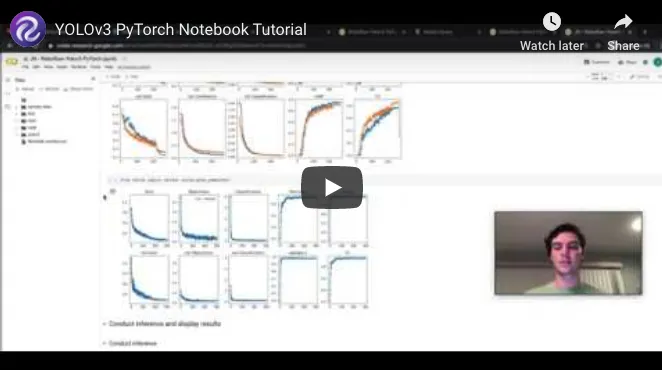
We're introducing a new experiment this week:
Roboflow is launching a Roboflow YouTube channel (opens in a new tab).
We've been encouraged by the popularity of our computer vision tutorials. When Googling for some architectures, Roboflow content ranks at the top of what researchers, developers, and aspiring computer vision practitioners are finding valuable.
Increasingly, we've had our users ask us for a more guided approach to our tutorials. Initially we were able to guide users with individual feedback. But the volume has grown, as have the nature of the requests. It's time to experiment with a new approach.

Roboflow will be narrating tutorials we publish to our model library (opens in a new tab), new features, and more on the Roboflow YouTube (opens in a new tab). We're hoping this serves as a more engaging way to provide the support our users have come to expect from us. In time, it may even become a valued growth channel.
Our debut video (opens in a new tab) demonstrates how to use our PyTorch YOLOv3 implementation (opens in a new tab), leveraging an implementation from Ultralytics, but making it even easier to use your own dataset for training. We continue to encourage feedback through Roboflow Support (opens in a new tab) and help@roboflow.ai.
While we don't anticipate ever reaching the trending page, we humbly ask that you might "smash that like and subscribe button" to get more Roboflow computer vision videos (opens in a new tab) in the interim.