Wind Turbine Inspection AI
Find, grade, and track every defect on every blade, tower, and nacelle from drone imagery, and turn a campaign into a repair list in days.
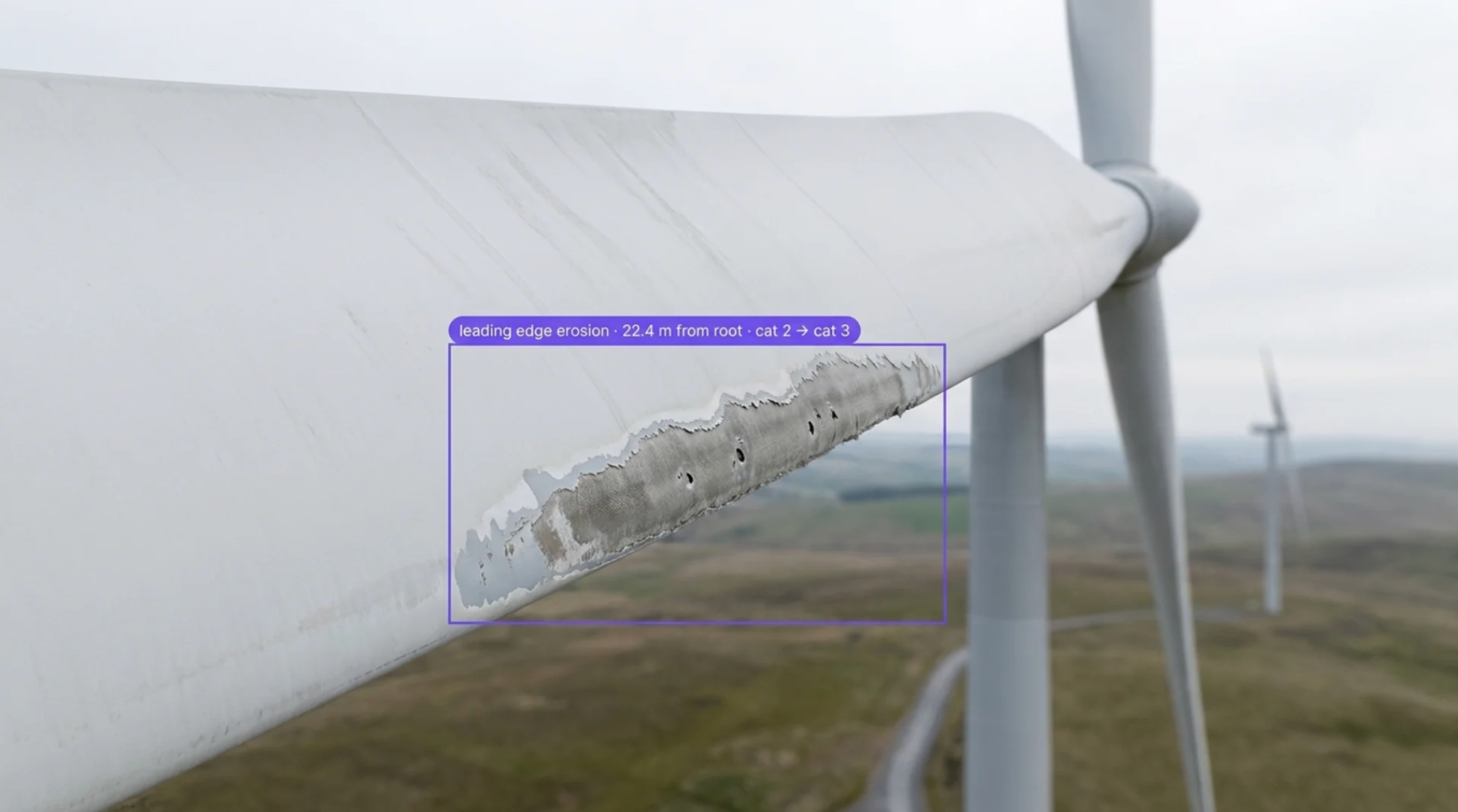
Wind Turbine Inspection AI Across Blades, Towers, Nacelles, Foundations, and Offshore Structures
Deploy Anywhere, Run Everywhere
Run wind turbine inspection in the cloud or your VPC for campaign processing, at the edge on a field laptop for same-day review, or via API, wherever your drone imagery, sites, and asset systems are.
One Platform, Full Adoption
Tools every wind team can adopt, from drone pilots and field technicians to blade engineers, asset managers, and O&M leadership, no separate ML team required to ship and own inspection models.
Secure, Compliant, and Audit-Ready
Data stays safe with SOC 2 Type II compliance, encrypted data, and an uptime SLA, with per-turbine, per-campaign image records that support warranty claims, service agreement reporting, and regulatory and insurer inspections.
- Leading Edge Erosion & Blade Cracks
- Lightning Receptor & Add-On Condition
- Tower Corrosion, Welds & Flange Bolts
- Nacelle Seals, Hatches & Leaks
- Foundation, Grout & Monopile Inspection
- Campaign-to-Campaign Growth & Fleet Ranking
“Roboflow has been instrumental in accelerating our deployment of innovative AI solutions.”
Travis Turnbull
Vice President & CIO, Pella Corporation
Talk to a Vision AI engineer who's shipped inspection on real turbine imagery.
Bring us your toughest wind turbine inspection problem and we'll map a working solution.
Ask us about:
- Solution architecture for owner-operators, ISPs, OEM service teams, and drone inspection providers, onshore and offshore, across blades, towers, nacelles, and foundations
- Live demo on your drone campaign imagery or technician photos, with the component and defect class, erosion, receptors, bolts, or corrosion, that drives the most repair spend
- Deployment options: cloud or VPC for campaign processing, edge on a field laptop for same-day review, with integration into asset management, CMMS, drone platforms, and SCADA
- ROI modeling against analyst review time and report turnaround, rope-access and crane days, turbine downtime for inspection, repair prioritization, and warranty recovery
Over 16,000 organizations build with Roboflow.
- Rivian
- Pella
- Chobani
- USG Corporation
- BNSF Railway
- American Woodmark
Vision AI is transforming businesses
Customers across the board are solving complex challenges and driving meaningful impact.
- Automotive customer
$10 million
Saved by automatically detecting defects on the production line
- Logistics & freight company
90%
Less time spent manually tracking shipping inventory
- Building materials supplier
60%
Lower customer return rate with improved product quality
Inspect Every Blade, Tower, and Nacelle, and Rank Every Repair Across the Fleet, with Vision AI
Roboflow reads drone, crawler, ground-camera, and internal imagery of blades, towers, nacelles, foundations, and substations, finds and grades every defect, tracks it turbine by turbine and year by year, and turns an inspection campaign into a prioritized work list, at fleet scale.
Blades in the Field:
- Detect and grade leading edge erosion, cracks, delamination, lightning damage, and coating loss from drone imagery of blades in place, and localize each finding to the blade, the side, and the distance from root
- Inspect lightning receptors, vortex generators, serrations, and leading edge protection for damage, loss, and detachment, and verify repairs against the previous campaign
- Detect surface contamination, oil streaks from the hub, and internal blade defects from crawler and borescope imagery
Tower, Nacelle, and Foundation:
- Detect corrosion, coating failure, weld cracks, and flange gaps on towers and transition pieces from drone and ground imagery, and detect loose, missing, and marked bolts at flange joints
- Inspect nacelle covers, roof seals, hatches, and cooling louvers for damage and leaks, and detect oil and grease leaks on the nacelle, tower, and pad
- Inspect foundations, grout, and anchor bolts for cracks and spalling, and offshore transition pieces and monopiles for corrosion, marine growth, and scour indicators
Fleet, Campaigns, and Systems Integration:
- Rank findings by severity and growth across the fleet, so the repair campaign goes to the blades and towers that need it first and the Category 2 that became a Category 4 is not a surprise
- Process a full campaign of drone imagery in hours rather than months, with every image tied to its turbine, component, position, and date, and compared with the previous inspection
- Push findings, severity, and imagery into asset management, CMMS, and inspection reporting systems through API integration, with a full record behind every work order and every warranty claim
Bring intelligence to every turbine today. Stop the images that sat in a folder for two months, the receptor nobody re-checked, and the bolt nobody could see from becoming a blade failure, a tower collapse, and a warranty claim with no evidence behind it.
More About Wind Turbine Inspection
What is wind turbine inspection with Vision AI?
Wind turbine inspection with vision AI uses deep-learning models on drone, crawler, ground-camera, and internal imagery to detect, classify, grade, and locate defects across the whole turbine in the field: leading edge erosion, cracks, delamination, lightning damage, and receptor and add-on condition on blades; corrosion, coating failure, weld cracks, flange gaps, and bolt condition on towers and transition pieces; cover, seal, hatch, and leak condition on nacelles; and cracks, spalling, and anchor condition on foundations and monopiles. Each finding is graded, localized to the component and position, compared with previous campaigns, and ranked across the fleet, so an inspection campaign becomes a prioritized repair list with imagery behind every item. For the blade-level defect detail that spans factory inspection, MRO, and gas turbines as well as wind, see turbine blade inspection; this page covers the whole turbine as an asset in the field.
How much faster is this than analysts reviewing drone imagery?
A drone campaign produces several hundred to several thousand high-resolution images per turbine, and manual review is the bottleneck: an analyst takes hours per turbine, findings are inconsistent between analysts, and the report arrives weeks or months after the flight, which is why the folder sits. Vision models process the full campaign as it lands, flag and grade every defect, and route only the uncertain findings to an analyst with the image and the location, so the analyst reviews exceptions rather than every frame and the report is ready in days. Consistency is the other gain: the same grading applied to every blade on every turbine on every campaign, which is what makes year-over-year growth measurement and fleet-wide prioritization possible. Models are trained on your fleet's blade types, coatings, and imagery, and validated against your analysts' own gradings.
Does it cover the tower, nacelle, and foundation, not just the blades?
Yes. Blade campaigns get the attention, but tower flange bolts, weld seams, coating failure on the tower and transition piece, nacelle roof seals and hatches, oil and grease leaks, and foundation and grout condition are inspected less often and by fewer people, and their failures are the expensive ones. The same drone flight, with a flight plan that covers the tower and nacelle, and ground and internal imagery from technician visits, feed models trained on those components, so a campaign produces a finding list for the entire structure. Offshore, the transition piece, monopile splash zone, and boat landing are included from vessel and drone imagery. Vision findings target the physical inspections, bolt tensioning, and NDT that remain necessary; they do not replace them.
Can it integrate with our asset management, CMMS, and inspection reporting?
Yes. Roboflow Inference runs in the cloud, in your VPC, or at the edge on a field laptop and exposes a standard API and webhooks, so findings, severity, and imagery flow into your existing systems: asset performance and management platforms, CMMS and EAM systems like IBM Maximo and SAP PM for work orders, drone data and inspection reporting platforms, SCADA and condition monitoring for correlation with performance data, warranty and service agreement documentation, and GIS and fleet dashboards, through REST, webhooks, and direct database writes. A severe finding becomes a work order with the image and blade position attached, a campaign becomes a ranked fleet report, and every finding carries site, turbine, component, position, severity, campaign date, previous-campaign comparison, and imagery, with a full record behind every repair decision and every warranty claim.