Transformer Winding Inspection AI
Catch winding defects during production, so a misplaced conductor or missing spacer is corrected at the station instead of discovered at electrical test.
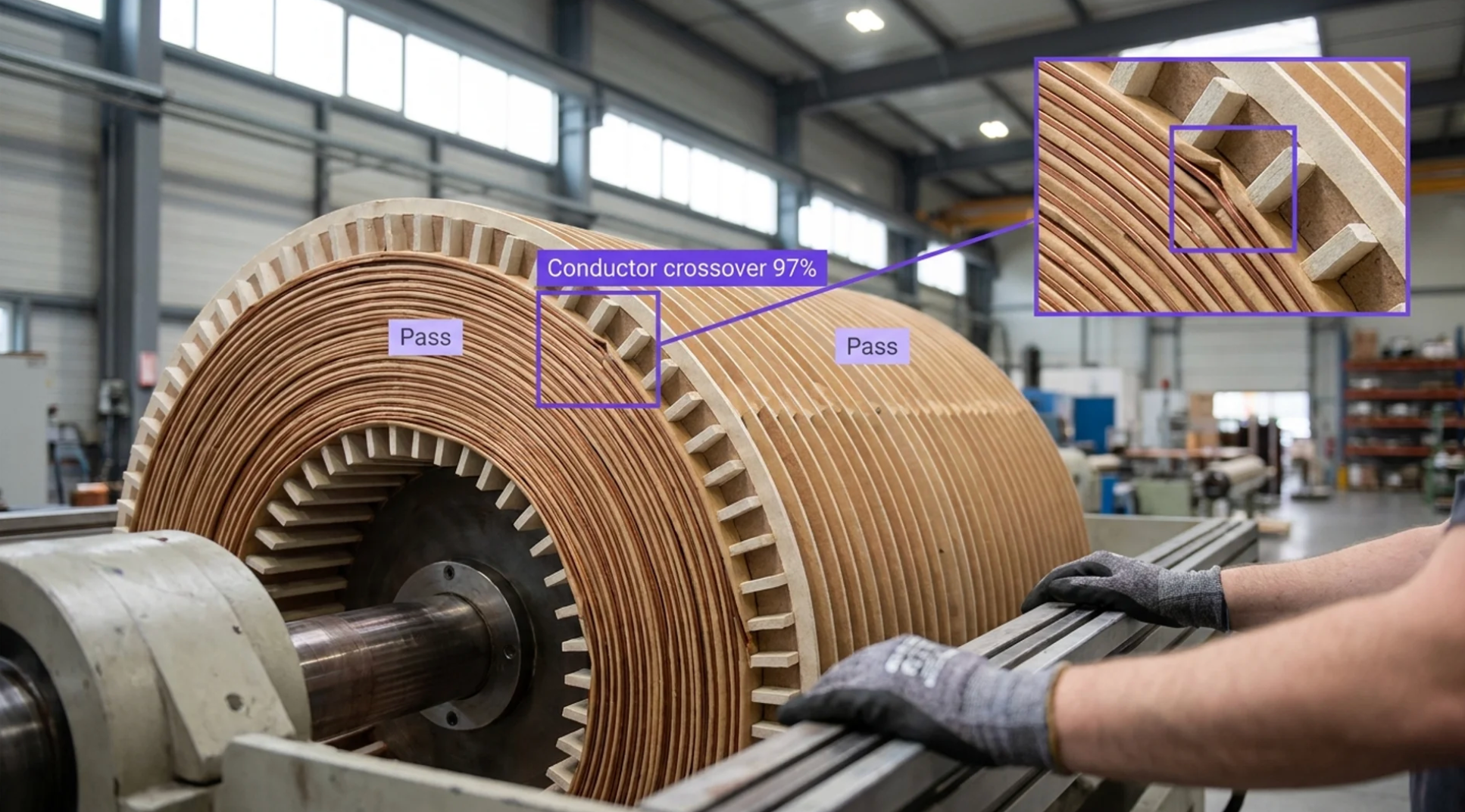
Transformer Winding Inspection AI for the Toughest Electrical Equipment Quality Problems
Deploy Anywhere, Run Everywhere
Run transformer winding inspection on the cameras already mounted over your winding machines, on a Jetson at the station, on-prem, in your VPC, or via API, wherever your winding bay needs it.
One Platform, Full Adoption
Tools every transformer and capacitor team can adopt, from winding operators and process engineers to quality, test, and innovation leads, no separate ML team required to ship and own inspection models.
Secure, Compliant, and Audit-Ready
Data stays safe with SOC 2 Type II compliance, encrypted data, and an uptime SLA, with image records and inspection logs that support ISO 9001, IEC 60076, IEEE C57, and IEC 60871 quality and test documentation.
- Conductor Position & Crossover Detection
- Turn Spacing, Gaps & Overlap
- Insulation Paper, Pressboard & Spacer Placement
- Tap Lead, Crimp & Brazed Joint Verification
- Damaged Conductor, Nicks & Enamel Defects
- Capacitor Element Winding & Layer Count
“Roboflow has been instrumental in accelerating our deployment of innovative AI solutions.”
Travis Turnbull
Vice President & CIO, Pella Corporation
Talk to a Vision AI engineer who's shipped in transformer and capacitor manufacturing.
Bring us your toughest transformer winding inspection problem and we'll map a working solution.
Ask us about:
- Solution architecture that fits ISO 9001, IEC 60076, IEEE C57, and IEC 60871 quality and test requirements
- A live demo on images from your own winding machines
- Deployment options: edge at the winding station, on-prem, air-gapped, VPC, or integrated with the camera vendor you already run
- ROI modeling against rework hours, scrapped coils, station throughput, first pass yield at electrical test, and on-time delivery
Over 16,000 organizations build with Roboflow.
- Rivian
- Pella
- Chobani
- USG Corporation
- BNSF Railway
- American Woodmark
Vision AI is transforming businesses
Customers across the board are solving complex challenges and driving meaningful impact.
- Automotive customer
$10 million
Saved by automatically detecting defects on the production line
- Logistics & freight company
90%
Less time spent manually tracking shipping inventory
- Building materials supplier
60%
Lower customer return rate with improved product quality
Bring Real-Time Intelligence to Every Winding, from the First Turn to Final Test
Add a real-time inspection layer to every winding on the floor with vision AI for transformer winding inspection, whether you're winding disc and helical coils for power transformers, layer windings for distribution units, or film and foil elements for high-voltage capacitors.
Catch Defects During Winding, Not at Test:
- Detect conductor crossovers, doubled turns, and gaps as the winding progresses, and alert the operator while the defect is still reachable
- Verify insulation paper, pressboard spacers, and duct sticks are present, positioned, and undamaged across the full winding
- Check turn and layer counts against the design sheet for each unit, which matters when every transformer on the line is built to a different specification
Cover the Joints and Leads That Fail Later:
- Check tap leads, crimps, and brazed joints for position, coverage, and cold-joint indicators before the winding is buried inside the core-and-coil assembly
- Flag nicked, scraped, or enamel-damaged conductor that will become a turn-to-turn fault after years in service on a high-voltage line
- Pair the camera with your existing measurement tools so dimensional checks, heights, and photographs land in one record per winding
Turn Winding Data into a Factory-Wide Quality Record:
- Store an image history for every winding, tied to the unit serial, so a field return can be traced back to the exact winding and shift that built it
- Feed pass/fail and defect counts into your MES, SPC, or traceability system, and drive the machine's hold state through the PLC when a critical defect is found
- Retrain on your own escapes, with the same workflow deployed across the plants that share the process
Bring intelligence to every winding today.
More About Transformer Winding Inspection
What is transformer winding inspection with Vision AI?
Transformer winding inspection with Vision AI uses cameras at the winding machine and a trained computer vision model to check the winding as it is built: conductor position, crossovers, turn spacing, insulation and spacer placement, lead joints, and conductor damage. The operator gets a real-time result at the station, and images are stored as a record tied to the unit serial. It adds a consistent inspection layer alongside the operator's own checks, so coverage extends to every winding rather than the ones a walk-by catches. Results and records can be structured to support ISO 9001 quality systems and IEC 60076, IEEE C57, and IEC 60871 test and documentation requirements.
Can Vision AI detect a single crossed conductor on a large power transformer winding?
A crossed or misplaced conductor is one of the highest-stakes defects in transformer manufacturing, because it is hidden once the winding continues and typically surfaces as a failed impedance or turn ratio test later. Detection works by training a segmentation or detection model such as RF-DETR on images of correct and defective windings from your own machines, so the model learns your conductor sizes, paper, and lighting rather than a generic dataset.
Does transformer winding inspection support IEC 60076 and IEEE C57 requirements?
IEC 60076 (power transformers, including routine, type, and special tests) and IEEE C57.12.00 (general requirements for liquid-immersed distribution, power, and regulating transformers) define the tests a finished unit must pass, and IEC 60871 does the same for shunt capacitors on AC power systems. Vision AI does not replace those tests. It reduces how often a unit fails them by catching winding defects during manufacture, and it produces the inspection evidence, defect classification, and image history that quality teams attach to the unit record and to factory acceptance test packages. Roboflow is the inspection engine; your quality and test engineering teams own the acceptance criteria and the release decision.
Can it integrate with our MES, SPC system, and winding machine PLCs?
Yes. Roboflow Inference exposes a standard API and supports common industrial protocols, so inspection results publish over REST, MQTT, or OPC UA, or write directly to a database, and pass/fail, defect type, and images flow into SAP, Siemens Opcenter, Ignition, AVEVA, or your traceability system alongside the winding parameters you already log. For line behavior, PLC-level integration can set a hold bit on the winding machine so the operator corrects a critical defect before continuing. Models and data export in standard formats with no lock-in, and the same workflow can be deployed at the edge, on-prem, or in your cloud VPC without sending images off site.