Tire and Wheel Tracking AI
Read DOT codes, TINs, and green-tire barcodes at line speed with computer vision.
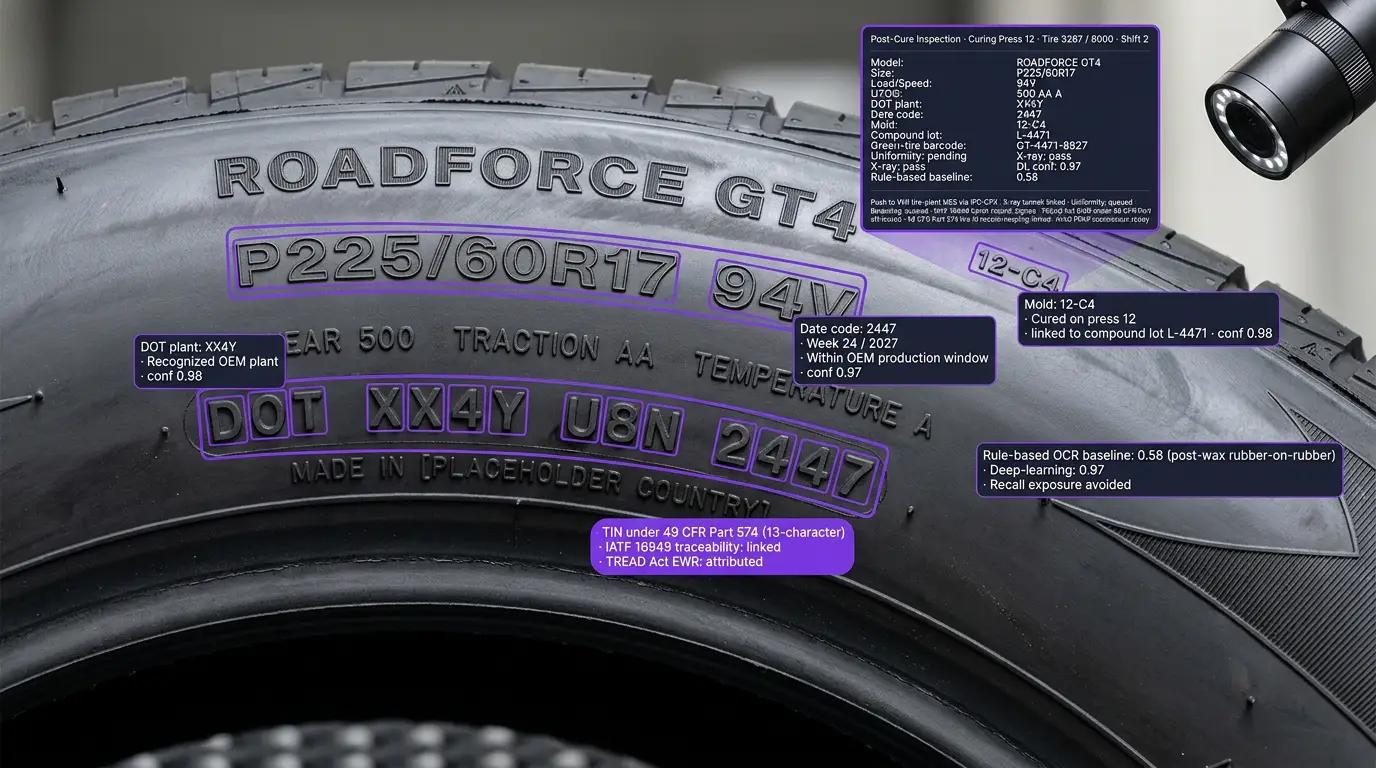
Tire and Wheel Tracking AI Across Building, Curing, X-Ray, Uniformity, and Final Finish
Deploy Anywhere, Run Everywhere
Run tire and wheel tracking on on the edge, on-prem, in your VPC, or via API, wherever your tire and wheel plant needs it.
One Platform, Full Adoption
Tools every tire manufacturing team can adopt, no separate ML team required.
Built for DOT, TREAD Act, ECE, and IATF 16949 Traceability
Update OCR logic in minutes when DOT plant codes, TIN formats, ECE marking specs, or aluminum wheel spec codes change. SOC 2 Type II, encrypted data, and an uptime SLA on every deployment.
- DOT Code & TIN Reads on Cured Tire Sidewalls
- Green-Tire Barcode & 2D DataMatrix Tracking
- Mold Number & Compound Lot Traceability
- Aluminum Wheel Spec Code Reads
- IATF 16949, TREAD Act & DOT Records
- X-Ray, Uniformity & Balancing OCR Integration
“Roboflow has been instrumental in accelerating our deployment of innovative AI solutions.”
Travis Turnbull
Vice President & CIO, Pella Corporation
Talk to a Vision AI engineer who's shipped tire and wheel tracking on the plant floor.
A single misread DOT code on a cured sidewall, illegible green-tire 2D DataMatrix at the curing-press loader, or wrong-mold-number stamp can mean a TREAD Act Early Warning Reporting exposure, a curing-press hold that costs a full shift, or an IATF 16949 field-return warranty claim on a tier-one program. Bring us your toughest tire and wheel tracking problem and we'll map a working solution.
Ask us about:
- Solution architecture for US DOT (FMVSS 139/119, 49 CFR Part 574/573/579), UN ECE R30/R54, EU Tyre Label 2020/740, IATF 16949, and AIAG PPAP
- Live demo on your building drum, curing-press, X-ray, uniformity, or aluminum wheel imagery
- Deployment: edge, on-prem, air-gapped, or VPC, with tire-plant MES, curing-press PLC, X-ray, and OEM traceability portal integration
- ROI modeling against TREAD Act exposure, curing-press quarantine cost, IATF 16949 warranty, PPAP losses, and OCR hardware refresh
Over 16,000 organizations build with Roboflow.
- Rivian
- Pella
- Chobani
- USG Corporation
- BNSF Railway
- American Woodmark