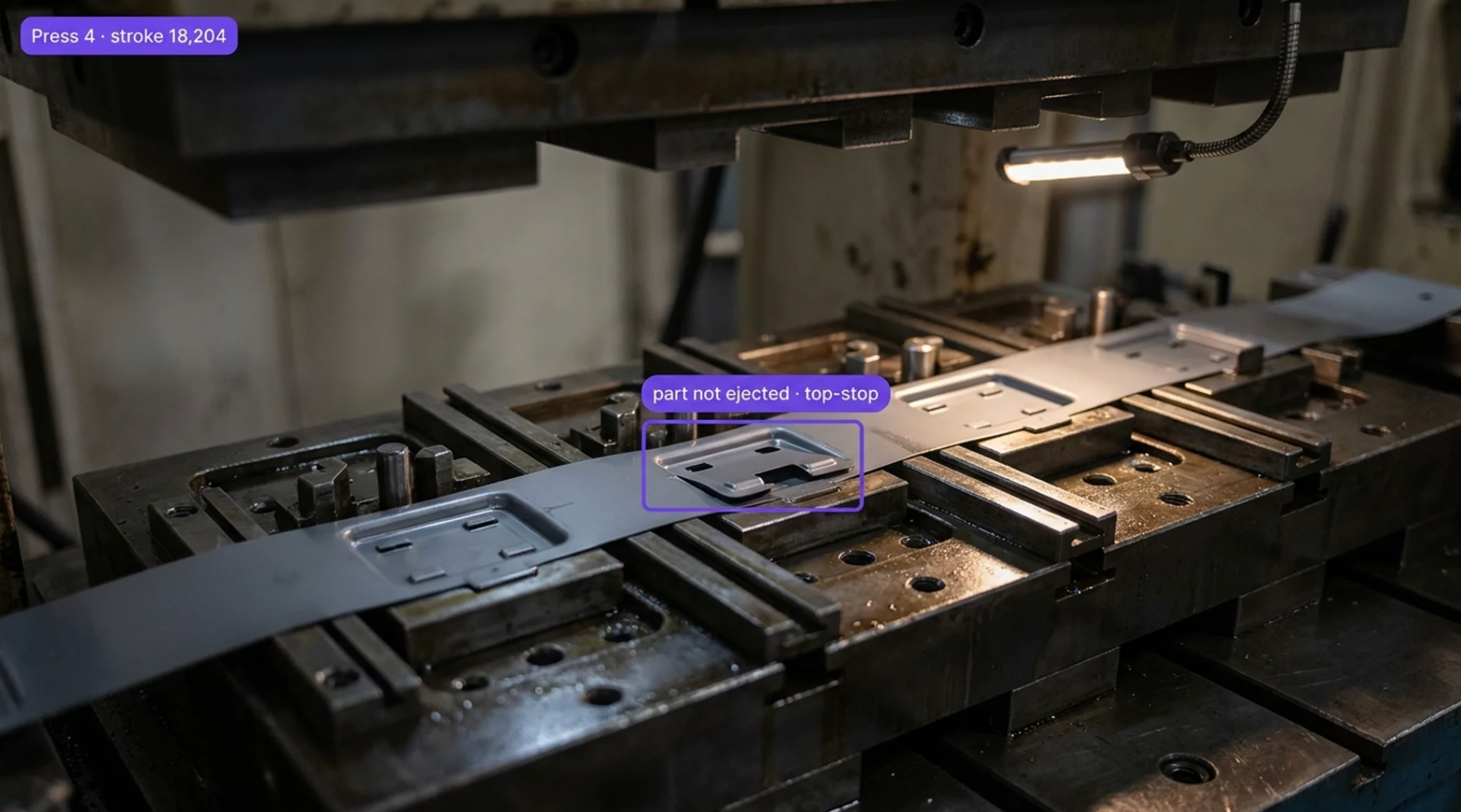
Add a real-time monitoring layer to every stroke with a stamping press inspection vision system built on vision AI. Built for the press rooms where a part that did not eject gets hit again and takes the die with it, a slug pulled up on the punch stamps its outline into the next two hundred parts before anyone sees, and the misfeed that a probe sensor was supposed to catch happens on the one station nobody could fit a sensor into. Whether you're running progressive dies at hundreds of strokes a minute, transfer presses on deep draws, or blanking lines feeding the plant, Roboflow watches the die area, the strip, and the part on every stroke from cameras mounted at the press, and stops the press before the crash, with a photo record behind every stop.
Die Protection and Press Monitoring:
- Verify part ejection on every stroke, so a part stuck in the die or hung on the punch stops the press before the ram comes down on it
- Detect slugs pulled up on punches, scrap and slivers left in the die, and debris on the strip, the die-area conditions that no probe or proximity sensor can see
- Catch misfeeds, short feeds, double blanks, and strip walk-off at the feed and in the die, and hold the press on the stroke it happens
Strip, Blank, and Part Verification:
- Inspect coil and strip at the feed for edge damage, surface defects, and wrong material, before it reaches the first station
- Verify blank presence, position, and orientation in transfer and blanking lines, so the press never forms on an empty or crooked blank
- Check every part at the exit for missed operations, missing pierces, and gross forming defects, with detailed part-level inspection handled by stamping defect detection
Press Controls, Records, and Systems Integration:
- Stop or top-stop the press through the press control and PLC the moment a die-area condition is flagged, with the image of what the camera saw attached to the stop
- Trend stops, near-misses, and die-area conditions by die, station, and shift, so a die that is starting to pull slugs shows up as a pattern before it crashes
- Keep per-stroke and per-stop records with imagery that support die maintenance history, ISO 9001 and IATF 16949 documentation, and crash investigations
Bring intelligence to every stroke today. Stop stuck parts, pulled slugs, and misfeeds from becoming die crashes, a shift of scrap, and the six-figure rebuild nobody planned for.
More About Stamping Press Inspection Vision Systems
What is a stamping press inspection vision system?
A stamping press inspection vision system uses cameras mounted at the press and computer vision models to watch the die area, the strip, and the part on every stroke: verifying part ejection, detecting pulled slugs, scrap, and debris in the die, catching misfeeds and double blanks, checking blank position, and flagging gross defects at the part exit. It extends conventional die protection, which relies on probe, proximity, and part-out sensors at fixed points, to the conditions those sensors cannot see, and connects to the press control and PLC to stop the press before a crash. Models trained on your actual dies, materials, and press lighting run on an edge device at the press, with a per-stop image record that supports die maintenance history and ISO 9001 and IATF 16949 documentation. For part-level surface and forming defects, see stamping defect detection.
Can Vision AI see into the die area fast enough to stop the press?
The die area is the hard case: it is dark, oily, and vibrating, the window between the ram lifting and the next stroke is a fraction of a second at high speed, a pulled slug is a thin disc of the same metal as the strip, and reflections off drawing oil look different every stroke. Deep-learning models trained on your actual dies, stations, and press lighting learn what a clean die area and a properly ejected part look like for each die, and flag departures from that on every stroke. Inference runs on an edge device at the press, inside the stroke window, and the stop signal goes to the press control over the same interface a die protection sensor uses, so the press top-stops before the next hit. Camera placement, lighting, and frame timing are sized to the press speed and die geometry during solution design, and the honest tradeoff is that a station the camera cannot see is a station that still needs a sensor.
Does this replace our die protection sensors and press controls?
No. Probe, proximity, and part-out sensors, tonnage monitors, and the press control's own die protection logic stay in place; they are fast, proven, and required by your press safety program. Vision adds the conditions they cannot detect: the slug on the punch, the sliver in the die, the part hung at an angle that still trips the part-out sensor, the debris on the strip, and the station where no sensor would fit. Both feed the same press control, so a vision stop looks like any other die protection stop to the operator, and the press safety system under ANSI B11.1 and OSHA 1910.217 is unchanged, since the vision system requests a stop through the press control rather than acting on the press directly.
Can it integrate with our press controls, PLCs, and MES?
Yes. Roboflow Inference (opens in a new tab) runs on an edge device at the press and exposes a standard API and common industrial protocols, so die-area events flow into your existing systems: press controls and die protection systems from Wintriss, Link Systems, and Toledo Integrated Systems for top-stop and fault signals, press and line PLCs from Allen-Bradley and Siemens, MES and ERP platforms like SAP and Oracle for stroke counts and downtime coding, and SCADA and HMI platforms like Ignition and AVEVA, through REST, MQTT, OPC UA, discrete I/O, and direct database writes. PLC-level integration requests the stop on the stroke the condition is seen, and every event carries press, die, station, stroke count, timestamp, and imagery, with a full history behind every die.