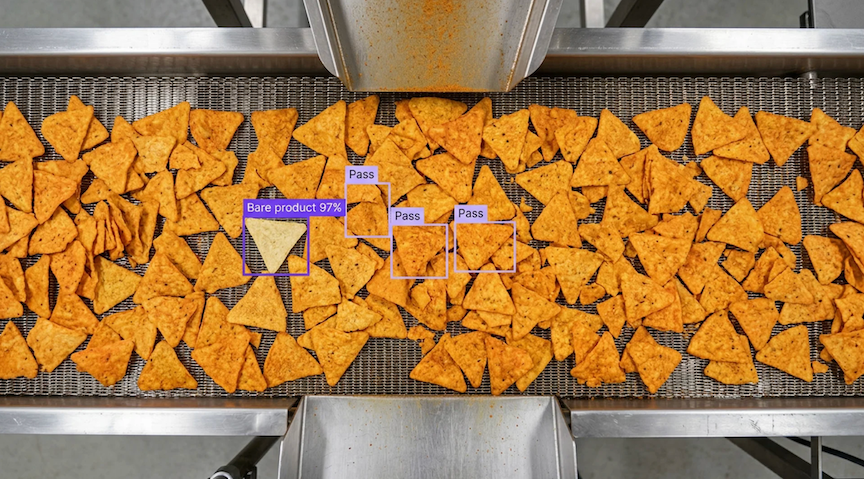
Add a real-time inspection layer to every chip, pretzel, cracker, and flake on the line with Vision AI for seasoning coverage inspection and CPG.
Coverage, uniformity, and application faults:
- Score seasoning coverage percentage per piece and per belt section, so process engineers see tumbler feed, oil spray, and seasoning applicator drift in minutes instead of at the next lab pull.
- Flag bare product, under-seasoned edges, over-seasoned pieces, and clumped or wet seasoning as they leave the tumbler, with the image and timestamp attached to every event.
- Catch coverage problems that only show against a specific base color or bake shade, the kind that change lot to lot as potatoes, corn, and oil change through the season.
Mis-product, wrong flavor, and cross-contact:
- Detect the wrong flavor or SKU mixed into a run at a flavor changeover, and tie the alert to your line clearance procedure so the run holds before it reaches the bagger.
- Identify allergen-bearing seasonings (cheese, dairy, sesame, nut-based) showing up on product that should not carry them, and log the event as HACCP and allergen-control evidence.
- Verify topping, coating, and inclusion coverage on baked goods and cereal (seeds, salt, sugar, chocolate, fruit pieces) against the spec for that SKU.
Color consistency, deployment, and audit records:
- Track bake color and seasoning color against a golden reference on every piece, and alert when the line drifts outside the tolerance your quality team set, with a trend chart your QA lead can put in front of an SQF auditor.
- Run on existing overhead cameras and inspection stations, on edge devices in washdown-rated enclosures, on-prem, or in your VPC, with no new sorter capex required to start.
- Keep every inspection result, image, and threshold change in an audit trail that supports FSMA preventive controls, HACCP CCP records, SQF, BRCGS, and GFSI-benchmarked audits, with your food safety team owning the acceptance criteria.
Stop bare product, clumps, and wrong-flavor chips from becoming complaints, chargebacks, and recalls with Roboflow's vision AI.
Frequently asked questions
What is seasoning coverage inspection with Vision AI?
Seasoning coverage inspection with Vision AI uses cameras over the seasoning line and computer vision models trained on your own product to measure how much seasoning is on each piece, how evenly it is applied, and whether the color and flavor match the SKU being run. Instead of a colorimeter spot check on a handful of chips every half hour, the system scores every piece on the belt and reports coverage percentage, bare product, clumping, and wrong-flavor events in real time. Results feed your process team for tumbler and applicator tuning and your quality team for HACCP, SQF, BRCGS, and FSMA preventive-control records.
Can Vision AI measure seasoning coverage accurately on chips and extruded snacks?
Seasoning coverage is one of the highest-stakes measurements on a snack line because seasoning is a major cost input and the first thing a consumer notices. Vision AI handles it by segmenting each piece from the belt and then measuring seasoned versus unseasoned surface area within that piece, which works well on high-contrast pairs like a cheese powder on a pale corn base and a salt-and-vinegar on a golden potato base. Low-contrast pairs (a light seasoning on a light base, or a translucent oil-based coating) need more care: controlled lighting, sometimes a specific camera angle or wavelength, and a larger labeled set covering base-color variation across lots. We tell customers up front which pairs will be quick and which will take an extra iteration or two, and RF-DETR-Seg trained on a few hundred labeled pieces is usually the starting point.
Does seasoning coverage inspection support FSMA, HACCP, SQF, and BRCGS?
Yes. The inspection layer produces the records these programs ask for: FSMA (the FDA Food Safety Modernization Act, including preventive controls for human food), HACCP (Hazard Analysis and Critical Control Points, with CCP monitoring and verification), SQF (the Safe Quality Food code), and BRCGS (the Brand Reputation Compliance Global Standard for food safety), both of which are GFSI-benchmarked. Roboflow is the inspection engine: it captures the image, the score, the threshold in force, and the timestamp for every event. Your food safety and quality teams own the acceptance criteria, the CCP definitions, and the allergen-control plan the records support.
Can it integrate with our line PLCs, sorters, checkweighers, and MES?
Yes. Inspection results publish over REST, MQTT, or OPC UA into Ignition, AVEVA (Wonderware), Rockwell FactoryTalk, and Siemens platforms, and into MES or quality systems such as SAP QM, Infor, and Plex. For line behavior, pass/fail and coverage scores can drive a PLC output to divert product, hold the bagger, or trigger an alarm at flavor changeover, and can run alongside Key Technology or TOMRA sorters and existing checkweigher stations rather than replacing them. Every result can also be written to your database of record for SQF and BRCGS traceability.