Roll and Web Handling Inspection AI
Catch the wander, the splice, the telescope, and the tine through the wrap, at the winder and on the way to the dock.
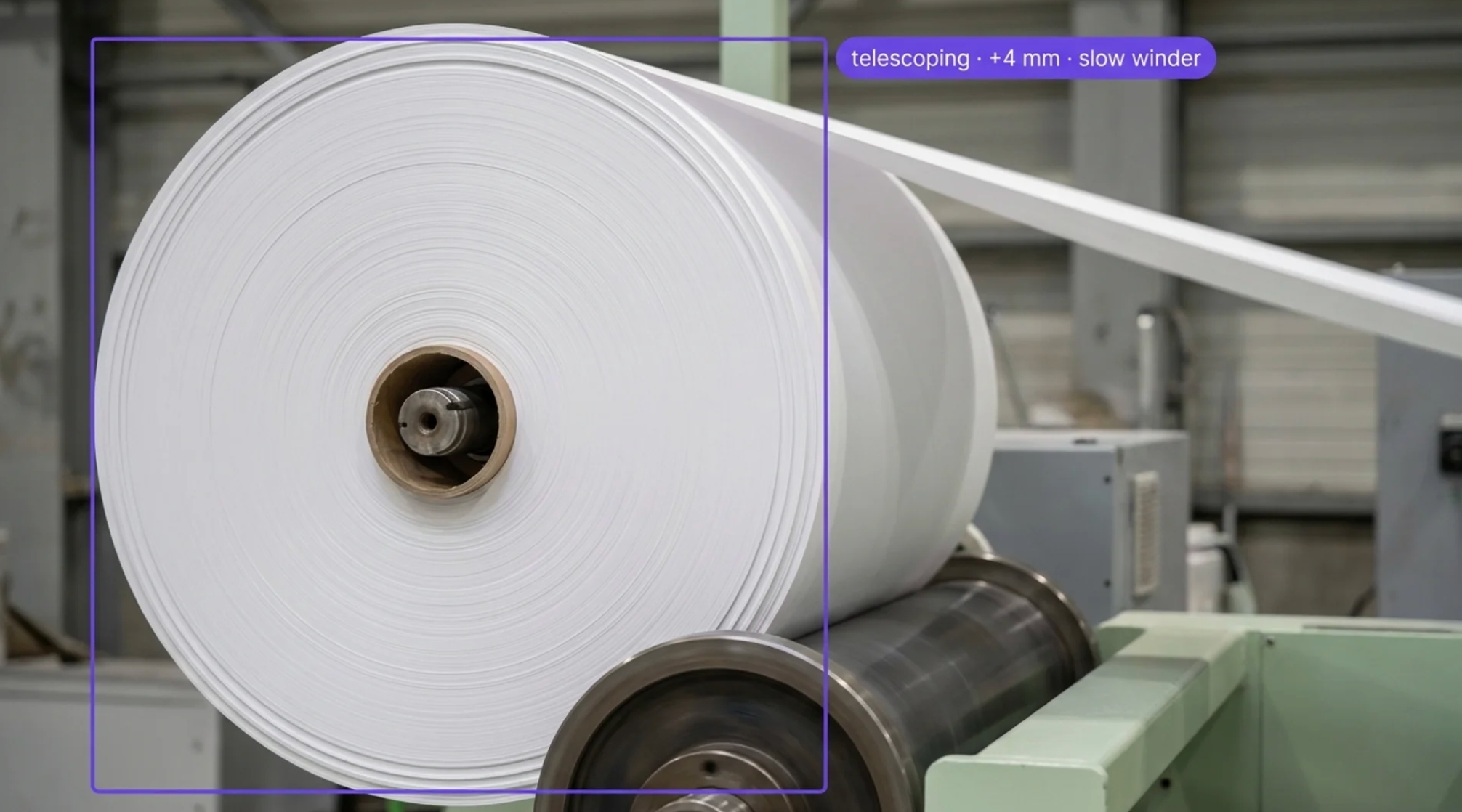
Roll and Web Handling Inspection AI Across Winding, Slitting, Splicing, and Roll Handling
Deploy Anywhere, Run Everywhere
Run roll and web handling inspection on the cameras already at your winders, unwinds, splicers, and roll handling and an edge device at the machine, on-prem, air-gapped, in your VPC, or via API, wherever your converting lines and mills need it.
One Platform, Full Adoption
Tools every converting team can adopt, from winder operators and roll handlers to process engineers, quality, and plant management, no separate ML team required to ship and own handling models.
Secure, Compliant, and Audit-Ready
Data stays safe with SOC 2 Type II compliance, encrypted data, and an uptime SLA, with per-roll handling records from doff to dock that support ISO 9001 quality systems and customer claim investigations.
- Web Edge Position & Weave Monitoring
- Splice Quality & Tape Verification
- Telescoping & Winding Profile Detection
- Core Crack, Crush & Size Inspection
- Roll Dimension, Tail & End-Seal Checks
- Wrap, Tine & Handling Damage Detection
“Roboflow has been instrumental in accelerating our deployment of innovative AI solutions.”
Travis Turnbull
Vice President & CIO, Pella Corporation
Talk to a Vision AI engineer who's shipped inspection on a live winder.
Bring us your toughest roll and web handling problem and we'll map a working solution.
Ask us about:
- Solution architecture for paper, film, foil, nonwoven, and textile winding, slitting and rewinding, laminating and coating, and roll handling and storage, alongside existing guides, edge sensors, and web inspection
- Live demo on your winder, splicer, or roll handling camera footage, or the fault, telescoping, splices, edge wander, or wrap damage, that costs you the most rolls
- Deployment options: existing cameras and an edge device at the machine, on-prem, air-gapped, or VPC, with integration into winder controls, PLCs, MES, and roll tracking
- ROI modeling against downgraded and scrapped rolls, web breaks at the next unwind, customer claims and returns, handling damage, and winder downtime
Over 16,000 organizations build with Roboflow.
- Rivian
- Pella
- Chobani
- USG Corporation
- BNSF Railway
- American Woodmark
Vision AI is transforming businesses
Customers across the board are solving complex challenges and driving meaningful impact.
- Automotive customer
$10 million
Saved by automatically detecting defects on the production line
- Logistics & freight company
90%
Less time spent manually tracking shipping inventory
- Building materials supplier
60%
Lower customer return rate with improved product quality
Watch Every Web, Wind Every Roll Right, and Track Every Handling Fault, with Vision AI
Roboflow watches the cameras already at your winders, unwinds, splicers, and roll handling, and catches the handling faults that surface inspection systems never look at, in real time.
Web Handling and Tracking:
- Monitor web lateral position, edge alignment, and weave against the guide at unwinds, slitters, laminators, and rewinds, so a wander is corrected before it becomes a crooked slit or a wrinkled lane
- Detect web flutter, bagginess, slack edges, and tension loss across spans, and flag the roller or the guide that is out
- Verify splices, tape position, overlap, and alignment at the splicer, and verify the splice flag and the log entry, so a bad splice is caught before it reaches the next unwind
Winding, Rolls, and Cores:
- Detect telescoping, dishing, starring, and offset winding on the winder and at the roll stand, and measure roll edge straightness and profile against tolerance
- Inspect cores for cracks, crush, out-of-round, and wrong size before loading, and verify core plug and chuck engagement
- Verify roll diameter, length, and width at doff, and detect loose tail, tail tape, and end-seal condition, so the roll that ships is the roll the order says
Roll Handling, Storage, and Systems Integration:
- Detect wrap and end-cap damage, tine and clamp marks, dents, and crushed edges on finished rolls during handling, staging, and loading, with the image and the handling point behind every finding
- Verify roll labels and IDs against the order at the winder and the dock, and track roll moves through storage so a roll's handling history is complete
- Push web position, winding faults, roll measurements, and handling events into winder controls, MES, and roll tracking through PLC and API integration, with a per-roll record behind every shipment
Bring intelligence to every roll today.
More About Roll and Web Handling Inspection
What is roll and web handling inspection with Vision AI?
Roll and web handling inspection with vision AI uses cameras at unwinds, splicers, guides, slitters, winders, roll stands, and roll handling and storage areas and deep-learning models to monitor how the web and the roll are handled rather than what is on the web's surface: lateral position and edge alignment, flutter and tension loss, splice quality, telescoping and winding profile, core condition, roll dimensions and tail condition, wrap and end-cap damage, and roll identity and moves. Events feed winder and guide controls, MES, and roll tracking, and every roll gets a handling record from doff to dock. It complements the web inspection systems that look for surface defects; for gels, holes, streaks, and coating faults on the web itself, see web and film inspection, and for sheet defects on paper machines, see pulp and paper defect detection.
Can it catch telescoping and winding faults while the roll is still on the winder?
Yes. A camera on the winder end sees the roll edge as it builds, and a model trained on your winding profiles detects offset, telescoping, dishing, and starring as they begin, so the winder can be slowed or stopped and the roll saved or downgraded on the spot rather than discovered at the dock, at the customer, or on the truck. The same view measures roll diameter and edge straightness against tolerance at doff, and a second camera at the roll stand or the doffing station checks tail, tail tape, and end-seal condition and reads the roll label. Detection runs at the edge inside the winder's response window and feeds the winder controls directly.
Can it integrate with our winder controls, MES, and roll tracking?
Yes. Roboflow Inference runs on an edge device at the machine and exposes a standard API and common industrial protocols, so web position, winding faults, roll measurements, and handling events flow into your existing systems: winder, slitter, and guide controls, PLCs from Allen-Bradley, Siemens, and Beckhoff for slow-down and stop, MES and roll tracking, WMS and roll storage, shipping and labeling systems, and quality and claims records, through REST, MQTT, OPC UA, discrete I/O, and direct database writes. PLC-level integration slows the winder when the profile starts to telescope or flags the splice before the unwind, and every event carries roll ID, machine, position, timestamp, fault class, measurement, and the image, with a full handling record behind every roll that ships and every claim that comes back.