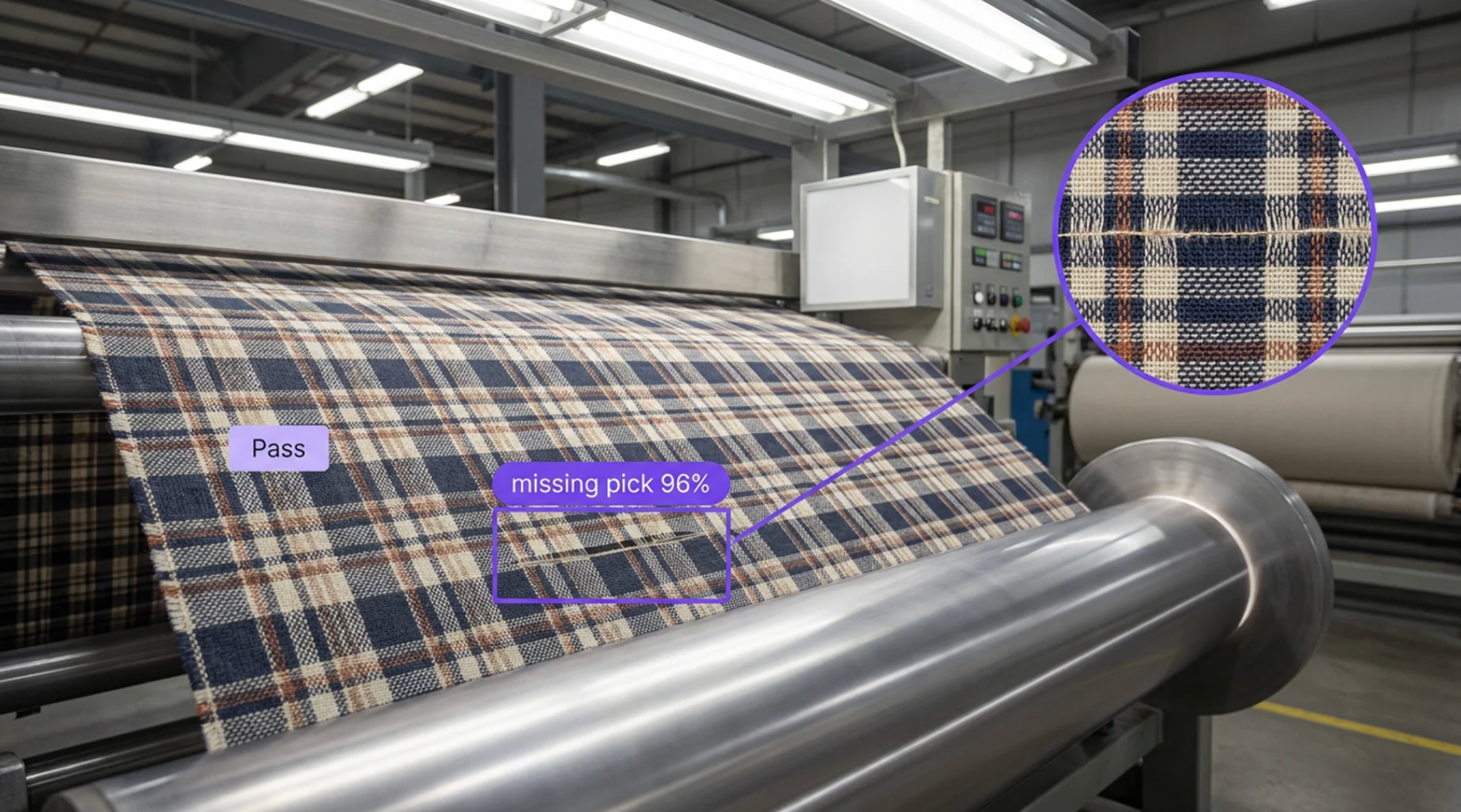
Add a real-time inspection layer to every meter of ribbon and narrow fabric with vision AI for ribbon and textile defect detection. Built for the narrow fabric mills and converters where a needle loom runs forty tapes side by side and one of them has been weaving a bad selvedge for an hour, a slit satin edge frays a millimeter at a time until the bow will not hold, and a printed grosgrain repeat drifts across a thousand-meter run before anyone unwinds it. Whether you're weaving satin, grosgrain, organza, and velvet ribbon, running webbing, elastic, and tapes for apparel and industrial use, or printing and finishing woven labels, trims, and packaging ribbon, Roboflow inspects every tape on every lane at loom, slitter, and spooler speed, with per-spool defect maps and lane-level trends behind every shipment.
Selvedges, Edges, and Width:
- Catch frayed, wavy, and curled selvedges, loose picot, and broken catch threads on woven ribbon and tape the moment a lane starts producing them
- Detect fused-edge faults, melt beads, and fray on slit satin and organza, so the edge that will not hold a bow gets flagged at the slitter instead of at the customer
- Verify width, edge straightness, and camber on every tape, lane by lane, against the spec for that construction
Weave, Surface, and Color:
- Detect broken ends, missing picks, floats, slubs, and knots on woven ribbon, webbing, and labels, and needle lines and dropped stitches on knitted elastic and tapes
- Flag stains, oil spots, crush marks, pile faults on velvet, and sheen and shade variation against the standard, so a dye lot problem surfaces as a flagged spool instead of a returned order
- Verify print registration, repeat alignment, smears, and missing color on printed ribbon and woven labels against the approved artwork, and check foil, glitter, and coating coverage on decorative lines
Lanes, Spools, and Systems Integration:
- Inspect every lane of a multi-tape needle loom or slitter independently, so the one lane weaving a defect gets stopped without stopping the other thirty-nine
- Map every defect by spool, lane, and meter, with cut-and-splice points for rewinding and defect-free length reported per spool
- Stop a lane or flag a spool in real time through PLC integration, with per-spool records that support customer specifications, ASTM D5430 grading, and ISO 9001 documentation
Bring intelligence to every tape today. Stop bad selvedges, frayed edges, and drifting print from becoming rejected spools, chargebacks, or the packaging account that moves to another mill.
More About Ribbon and Textile Defect Detection
What is ribbon and textile defect detection with Vision AI?
Ribbon and textile defect detection with vision AI uses computer vision models to inspect ribbon and narrow fabrics at production speed: selvedge, edge, and width faults on woven and slit ribbon, tape, and webbing, broken ends, missing picks, slubs, and knots, needle lines and dropped stitches on knitted elastic, stains, crush marks, pile faults, and shade variation, and print registration, smears, and coating coverage on printed ribbon and woven labels. Models trained on your actual constructions, colorways, and artwork inspect every lane of every loom and slitter, with per-spool defect maps that support customer specifications, ASTM D5430 grading, and ISO 9001 records. For broadloom woven and knit fabric, see fabric defect detection.
Can Vision AI inspect forty lanes of ribbon at once?
The multi-lane loom is the hard case: a needle loom or slitter runs dozens of narrow tapes side by side, each a few millimeters to a few centimeters wide, moving fast, with a selvedge fault or a width drift on one lane looking exactly like the neighboring good lanes from a meter away. Deep-learning models trained on your actual tapes, constructions, and lighting inspect each lane as its own product, learn what a correct selvedge, edge, and surface look like for that ribbon, and hold that judgment identically across lanes, shifts, and lots. Camera count, resolution, and lighting are sized to tape width, lane count, and defect size during solution design, and borderline flags route to review by policy rather than by which operator is watching the loom.
Does this support our customer specifications and ASTM D5430 grading?
Yes. Ribbon and narrow fabric buyers write their own specifications for width tolerance, edge quality, color, and defect-free length, and many apparel and home customers reference ASTM D5430 (the four-point system for visually inspecting and grading fabrics) alongside ISO 9001 quality management. Roboflow is the inspection engine that generates the records those specifications expect, every defect logged by spool, lane, meter, size, and type with imagery, so defect-free length and penalty points come from a complete map rather than a sample. Your quality team owns the tolerances, the acceptance thresholds, and the customer-specific rules that sit on top.
Can it integrate with our needle looms, slitters, spoolers, and ERP?
Yes. Roboflow Inference (opens in a new tab) exposes a standard API and supports common industrial protocols, so ribbon inspection events flow into your existing systems: needle loom, slitter, and spooler PLCs from Allen-Bradley and Siemens driving lane stops and flag markers, MES and ERP platforms like SAP and Oracle, and SCADA and HMI platforms like Ignition and AVEVA, through REST, MQTT, OPC UA, and direct database writes. PLC-level integration stops a single lane the moment a running defect starts, and every event carries spool, lane, machine, meter, timestamp, and imagery, with a full defect map behind every spool that ships.