Railcar Identification AI

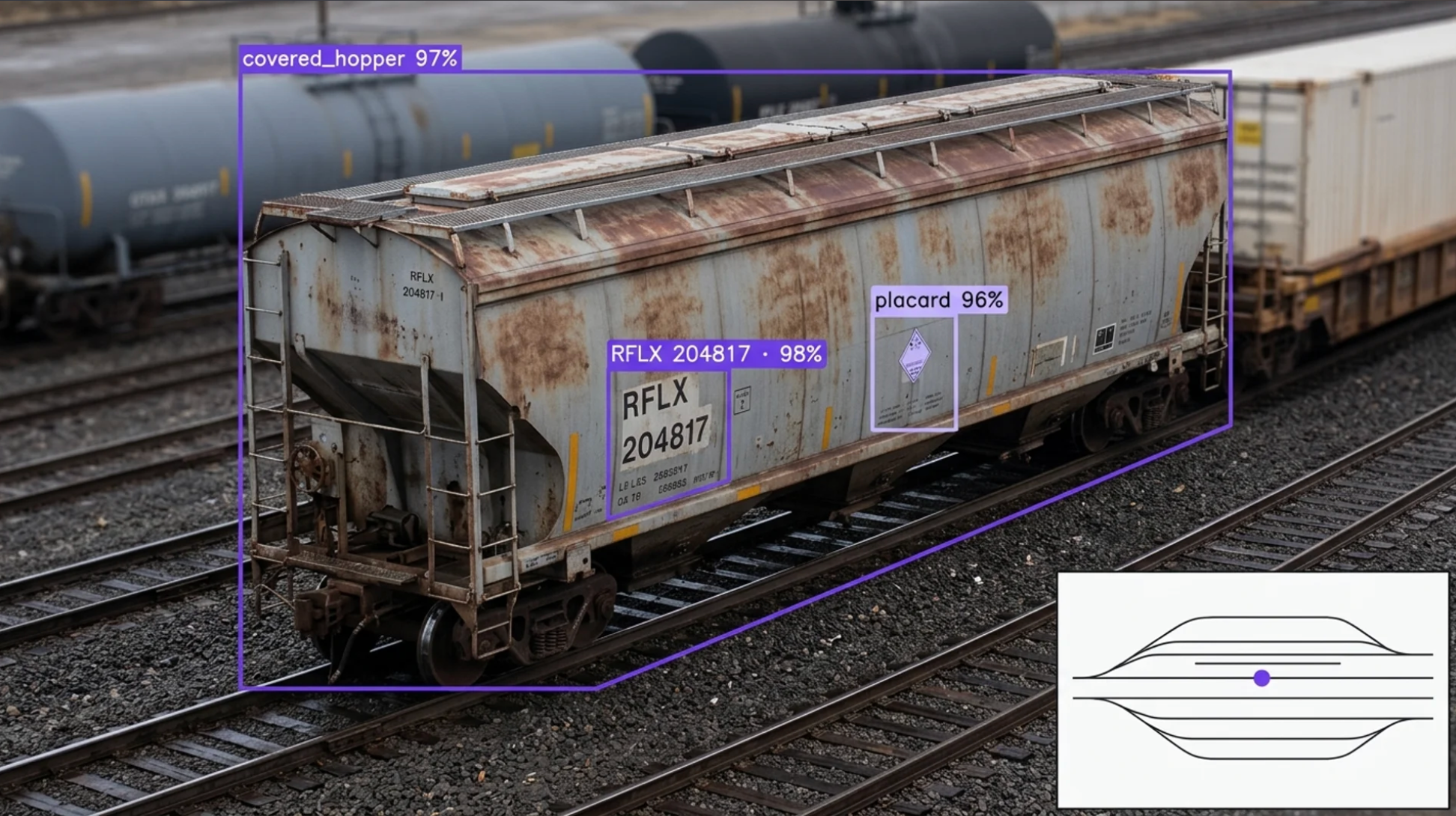
Read reporting marks and car numbers from oblique, moving, weathered railcar views, classify tank cars, hoppers, boxcars, and intermodal units, and place every identified car on a 2D yard map for location and dwell tracking.
Shipping container with OCR output

Railcar Identification AI for the Toughest Rail Yard, Intermodal Terminal, and Lessor Fleet Views

Deploy Anywhere, Run Everywhere

Run railcar identification on existing yard tower, gate, crossover, and drone cameras on the edge, on-prem, in your VPC, or via API.

One Platform, Full Adoption

Tools every rail operations team can adopt, from yard managers and terminal superintendents to fleet and IT leads, no separate ML team required.

Secure, Compliant, and Audit-Ready

Data stays safe with SOC 2 Type II compliance, encrypted data, HIPAA compliance, and an uptime SLA, with validation documentation that supports FRA 49 CFR record-keeping and AAR interchange audits.
Reporting Mark & Car Number OCR from Oblique Views
Tank, Hopper, Boxcar, Intermodal & Chassis Classification
Logo, Placard & Stencil Recognition
2D Yard Map Placement & Dwell Tracking
AEI Tag Gap Fill & UMLER Cross-Check
Rare Car Type & Logo Search Across Camera Archives
Reporting Mark & Car Number OCR from Oblique Views
Tank, Hopper, Boxcar, Intermodal & Chassis Classification
Logo, Placard & Stencil Recognition
2D Yard Map Placement & Dwell Tracking
AEI Tag Gap Fill & UMLER Cross-Check
Rare Car Type & Logo Search Across Camera Archives
Reporting Mark & Car Number OCR from Oblique Views
Tank, Hopper, Boxcar, Intermodal & Chassis Classification
Logo, Placard & Stencil Recognition
2D Yard Map Placement & Dwell Tracking
AEI Tag Gap Fill & UMLER Cross-Check
Rare Car Type & Logo Search Across Camera Archives
Reporting Mark & Car Number OCR from Oblique Views
Tank, Hopper, Boxcar, Intermodal & Chassis Classification
Logo, Placard & Stencil Recognition
2D Yard Map Placement & Dwell Tracking
AEI Tag Gap Fill & UMLER Cross-Check
Rare Car Type & Logo Search Across Camera Archives

Talk to a Vision AI engineer who's shipped in rail.

Bring us your toughest railcar identification problem and we'll map a working solution.
  • Solution architecture that fits AAR interchange rules and reporting-mark conventions, FRA 49 CFR record-keeping, UMLER equipment registry data, and TSA and CBP requirements at intermodal gates
  • A live demo on your own yard, gate, or drone camera footage
  • Deployment options: edge, on-prem, air-gapped, VPC, locomotive or hi-rail mounted, or on the yard's existing camera network alongside AEI readers
  • ROI modeling against dwell time, demurrage and per-diem charges, misrouted and lost-car search hours, and manual walk-the-yard inventory checks
  • We will connect you with an AI subject matter expert on our team based on your answers.
    What challenges would you like to solve with vision AI?
    Where will you run vision AI?
    Are you replacing a current solution with AI or will this be a new solution?
    How many detections do you anticipate per month?
    Describe the business problem you would like to solve.
    Oops! Something went wrong while submitting the form.

    Over 16,000 organizations build with Roboflow.

    “Roboflow has been instrumental in accelerating our learning and deployment of innovative AI solutions”
    Travis Turnbull Vice President & CIO, Pella Corporation
    See customer stories
    Trusted by top manufacturers

    Vision AI is transforming manufacturing

    Customers are deploying solutions across the entire business and driving meaningful impact
    $0 million
    Saved by automatically detecting defects
    0%
    Less time spent manually tracking inventory
    0%
    Reduction in customer return rate

    Bring Real-Time Intelligence to Every Car in the Yard, from the Receiving Track to the Intermodal Gate

    Bring real-time intelligence to every railcar on the property with Roboflow vision AI for railcar identification.

    Read the car, not just the tag:

    • Read reporting marks and car numbers from oblique, moving, weathered, and partially rusted views on yard tower, crossover, gate, and drone cameras with a model trained on your own footage, including snow, rain, night lighting, graffiti, and stencils faded to the primer.
    • Classify each unit as tank, covered hopper, open hopper, boxcar, gondola, flatcar, autorack, refrigerated, intermodal well car, container, or chassis, and read the logo, hazmat placard, and load-limit stencil on the same pass.
    • Fill the gaps where AEI tags are missing, damaged, or unread, and cross-check every read against UMLER so a bad character never becomes a bad record.

    Place every car on the yard map:

    • Map each identified car to a track and position on a 2D yard view using camera calibration and track geometry, so the yard manager sees where a car sits and not just that it arrived.
    • Track dwell per car, per track, and per customer, and flag cars that exceed a dwell threshold before demurrage or per-diem charges accrue.
    • Search the archive by reporting mark, car type, or logo to find the rare unit or the lessor's fleet across months of footage from hundreds of cameras.

    Scale across yards and feed the systems you already run:

    • Deploy one model across 50 streams today and 500 tomorrow with a deployment manager for edge devices at yards and terminals where connectivity drops.
    • Write car ID, type, position, and timestamp to your yard management system, TMS, or gate system over REST or MQTT, and raise gate arms through the existing PLC when the ID matches the appointment.
    • Give operations the record: every read, every confidence score, and every map placement, with the frame, for AAR interchange disputes and FRA 49 CFR documentation.

    Bring intelligence to every railcar today.

    Frequently asked questions

    What is railcar identification with Vision AI?

    Railcar identification with Vision AI uses existing yard, gate, and drone cameras and a trained computer vision model to read the reporting mark and car number on each railcar, classify the unit type, read logos and placards, and place the car on a 2D yard map for location and dwell tracking. The model is trained on your own footage so it handles oblique angles, motion blur, weathered paint, and night lighting, and it complements AEI tag readers where tags are missing or unreadable. It runs alongside your yard management system and railcar inspection workflows, with a record of every read that supports AAR interchange rules, reporting-mark conventions, and FRA 49 CFR record-keeping.

    Can Vision AI read a car number from an oblique, moving, rusted railcar?

    Reading a reporting mark off a car rolling past a tower camera at a 40 degree angle, half covered in graffiti, is one of the highest-stakes identification tasks in rail. A detection model finds the mark region on each car as it passes, an OCR stage reads the characters across many frames, and consensus logic votes across those frames so a single blurred or occluded read does not win. The result is validated against reporting-mark format and a UMLER lookup, and a low-confidence read is flagged for a person to confirm rather than written as fact. The same pipeline is used for shipping container OCR at intermodal gates.

    Does railcar identification support AAR interchange rules and FRA 49 CFR?

    Railcar identification supports the AAR Interchange Rules (the Association of American Railroads rules that govern how cars move between carriers and how reporting marks and car numbers are assigned and displayed), UMLER (the Umler equipment registry that holds the master record for every car in interchange), and FRA 49 CFR (the Federal Railroad Administration regulations covering car records, inspection, and reporting) by giving operations a timestamped, frame-backed record of each identification and map placement. At intermodal gates, the same reads support TSA and CBP appointment and manifest checks. Roboflow serves as the identification engine, and your operations, fleet, and IT teams own the acceptance thresholds, the UMLER reconciliation rules, and what happens when a read does not match.

    Can it integrate with our yard management system, TMS, and AEI reader data?

    Yes. Roboflow sends car ID, unit type, position, and dwell to yard management systems and TMS platforms over REST or MQTT, merges reads with AEI reader data so a camera read fills in where a tag did not fire, and runs UMLER lookups to validate each mark. At gates, a matched ID can raise the arm through the existing PLC or SCADA layer on Allen-Bradley or Siemens controllers, and the same model can be extended with logo detection for lessor fleet searches across the archive.

    Stay Connected

    Get the Latest in Computer Vision First

    Thank you for subscribing!
    Oops! Something went wrong!.
    Unsubscribe at any time. Review our Privacy Policy.

    Additional resources

    Vision AI is transforming every industry. Let’s transform yours.