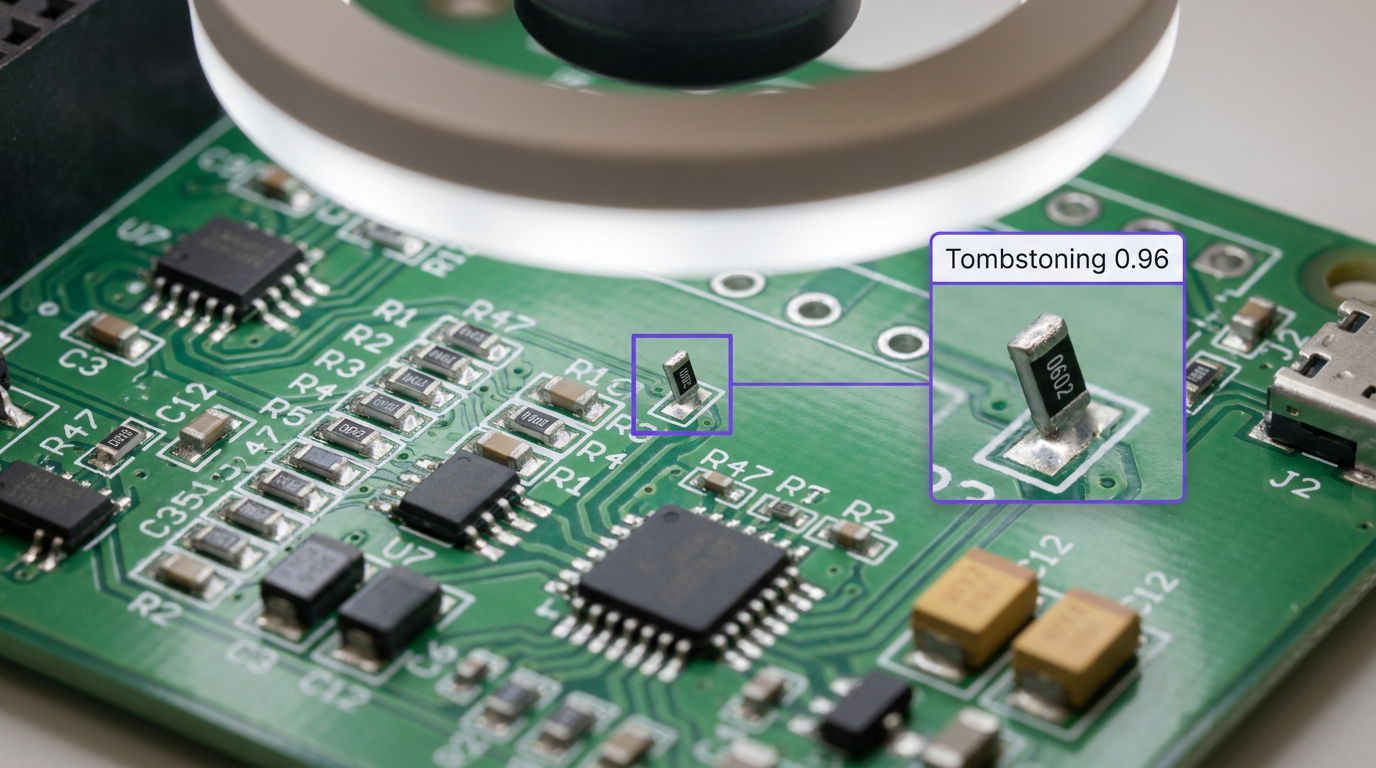
Add a real-time inspection layer to every board on the SMT line with Vision AI for PCB manufacturing and assembly inspection. Built for the operations where one solder bridge, missing component, or tombstoned chip resistor can mean a field failure in an automotive ECU, a defense product that fails reliability test, or a medical implant recall years after delivery. Whether you're inspecting solder paste deposits at SPI, components at pre-reflow and post-reflow AOI, hidden BGA joints at AXI, conformal coating coverage, silk screen markings, or final electrical assemblies, Roboflow extends your QC coverage to every board on the line across high-mix low-volume NPI builds and high-volume production alike.
Solder Paste, Component Placement, and Post-Reflow AOI:
- Verify solder paste volume, area, height, and offset at SPI before pick-and-place
- Catch missing components, wrong components, polarity errors, and misalignment at pre-reflow and post-reflow AOI
- Detect tombstoning, billboarding, lifted leads, and skewed components across high-mix board designs
Hidden Joint Inspection, BGA, and Through-Hole:
- Inspect BGA and other hidden solder joints with AXI integration and deep-learning interpretation
- Verify gull-wing and J-lead solder fillets, through-hole solder, and lead frame condition against IPC-A-610 class-of-service criteria
- Catch solder bridges, opens, voids, head-in-pillow, and insufficient fill on every joint, not just sampled boards
Marking, Coating, and NPI Flexibility:
- Read and verify silk screen markings, component IDs, lot codes, 2D codes, and traceability data
- Inspect conformal coating coverage, thickness, and edge boundaries on finished boards
- Validate new product introduction (NPI) builds in hours instead of weeks by training models on a few hundred labeled boards instead of rewriting AOI rule sets per SKU
Bring intelligence to every board today. Stop PCB defects from becoming field failures, automotive recalls, or Class 3 reliability test escapes.
Frequently asked questions
What is PCB manufacturing and assembly inspection with Vision AI?
PCB manufacturing and assembly inspection with Vision AI uses computer vision models to inspect boards at every stage of PCB fabrication and assembly, from solder paste application through pick-and-place, pre-reflow and post-reflow automated optical inspection (AOI), automated X-ray inspection (AXI) for hidden joints, wave soldering, conformal coating, marking, and final test. The system extends QC coverage to every board on the line, catching solder bridges, opens, insufficient and excess solder, missing or wrong components, polarity errors, tombstoning, billboarding, lifted leads, BGA voids, and foreign material across high-mix low-volume NPI builds and high-volume production. Electronics manufacturing services (EMS) providers and OEM in-house PCBA teams use it to cut false rejects, reduce field-failure escapes, shorten NPI ramp time, and document compliance under IPC-A-610, IPC-A-600, IPC-J-STD-001, IATF 16949, AS9100, and ISO 13485.
Can Vision AI inspect solder joints, BGA, and hidden joints at SMT line speed?
Yes. Hidden joint inspection on BGAs, QFNs, and other bottom-terminated components is one of the highest-stakes and historically hardest tasks in PCBA inspection, and exactly where deep learning extends what rule-based AOI and AXI systems can catch reliably. A single voided BGA solder ball, head-in-pillow defect, or non-wet joint that survives to a finished product can mean field failure under thermal cycling in an automotive ECU, an aerospace avionics module, or a medical implant. Roboflow models can be trained on your specific X-ray imagery from AXI systems to interpret BGA solder ball geometry, void percentages, head-in-pillow signatures, and non-wet joint patterns, with edge-optimized models that flag suspect joints for engineer adjudication at line speed. For visible solder joints (gull-wing, J-lead, through-hole, chip resistors and capacitors), the system runs on standard AOI imagery and applies the same pass/fail logic your IPC-A-610 inspectors use, scaled to every board on the line.
Does PCB inspection support IPC-A-610, IPC-A-600, and IPC-J-STD-001 acceptance criteria?
Yes. Roboflow models can be trained against your specific IPC-A-610 (Acceptability of Electronic Assemblies, the industry standard for solder joint and assembly visual acceptance), IPC-A-600 (Acceptability of Printed Boards, for bare board acceptance), IPC-J-STD-001 (Requirements for Soldered Electrical and Electronic Assemblies), IPC-7711/7721 (Rework, Modification, and Repair), and customer-specific reliability and class-of-service requirements (Class 1 consumer, Class 2 dedicated service, Class 3 high-reliability for aerospace, medical, and defense). The system also supports IATF 16949 (automotive), AS9100 (aerospace), ISO 13485 (medical device PCBA), and ISO 9001 audit requirements. Your quality and PCBA engineering teams own the acceptance criteria and class-of-service definitions; Roboflow provides the inspection engine that enforces them at line speed across every board.
Can it integrate with our SPI, AOI, AXI, MES, and SMT line stack?
Yes. Roboflow Inference (opens in a new tab) exposes a standard API and supports common SMT line and EMS factory protocols, so Vision AI inspection events flow into your existing SPI, AOI, AXI, MES, ERP, and traceability stack. Roboflow can deploy alongside existing AOI and AXI systems from major SMT inspection vendors as a deep-learning second-pass that reduces false rejects and catches the borderline defects rule-based systems struggle with, or run as the primary inspection on new lines. The system integrates with SAP, Oracle, Aegis FactoryLogix, Cogiscan, Valor MSS / Mentor (Siemens), 42Q, and custom EMS MES platforms through REST, MQTT, OPC UA, IPC-CFX (Connected Factory Exchange), and direct database writes.