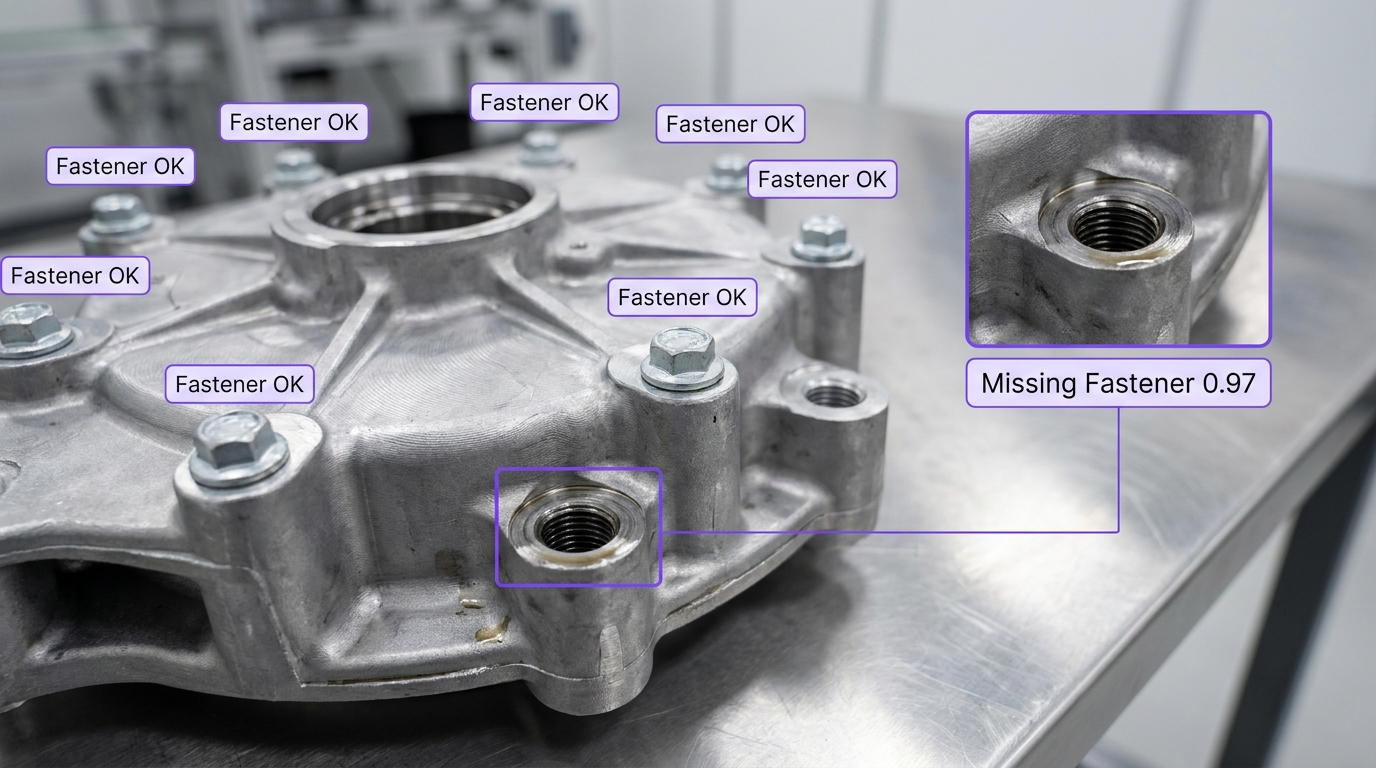
Add a real-time presence-detection layer to every assembly, kit, board, and package on the line with Vision AI for missing component detection and presence detection. Built for the operations where one missing fastener, chip resistor, sub-assembly, seal, or label can mean rework downstream, a field failure under load, or a customer audit finding that puts a supplier contract at risk. Whether you're checking presence on multi-part assemblies at build stations, missing components on populated PCBs, missing parts in pre-assembly kits, or missing labels and inserts in packaged products, Roboflow extends your QC coverage to every unit on the line across SKUs that change daily.
Assembly, Kitting, and Sub-Assembly Presence Detection:
- Verify every required fastener, screw, bolt, clip, and clamp is present on the assembly
- Check kit completeness, part count, and sub-assembly presence before downstream consumption
- Catch missing connectors, cables, harnesses, and routing-critical components before final QC
Electronic Component and Critical-Part Presence:
- Verify every chip resistor, capacitor, IC, connector, and BGA is present on populated PCBs
- Inspect seals, gaskets, O-rings, and other small-but-critical assembly elements
- Catch missing labels, hazard stickers, instruction sheets, and inserts in packaged products
Multi-SKU Flexibility and Audit-Ready Records:
- Switch presence-detection logic with new SKUs in minutes by swapping models instead of rewriting rules per product
- Distinguish wrong-part-present from missing-part-entirely, an important quality distinction rule-based vision often misses
- Generate validated inspection records that support customer PPAP, audit response, and traceability for every unit on the line
Bring intelligence to every assembly today. Stop missing components from creating rework, field failures, or customer audit findings.
Frequently asked questions
What is missing component detection and presence detection with Vision AI?
Missing component detection and presence detection with Vision AI uses computer vision models to verify that every required part, component, fastener, sub-assembly, label, or insert is present on an assembly, kit, board, or package before it moves to the next station or ships to a customer. The system extends QC coverage to every unit on the line, catching missing fasteners on build stations, missing chip resistors and ICs on populated PCBs, missing parts in pre-assembly kits, missing seals and gaskets on subassemblies, and missing labels and inserts in packaged products across SKUs that change daily. Manufacturers use it to cut rework, prevent field failures, protect first-pass yield, and document compliance under IATF 16949, AS9100, ISO 9001, ISO 13485, and IPC-A-610.
Can Vision AI distinguish a wrong-part-present from a missing-part-entirely?
Yes, and the wrong-part-present versus missing-part-entirely distinction is exactly where deep learning extends what rule-based machine vision can reliably do. Traditional rule-based presence verification systems answer "Is there something there or not?" by thresholding pixel intensity or matching template features at a fixed location, which works well when products are stable and components are visually distinct from an empty pad or fixture. They struggle when a wrong part is present (a different-size fastener in the same position, a different-value chip resistor in the same SMT pad, a wrong-variant gasket that looks similar to the right one), because the rules see something there and pass it.
Roboflow models can be trained to distinguish wrong-part-present from missing-part-entirely from right-part-present, applying the same three-way pass/fail logic your trained engineers and operators use. This discrimination matters because a wrong-part assembly is often a more dangerous failure mode than a missing-part one. The line keeps moving, the customer receives a product that looks complete but contains the wrong component, and the failure surfaces only in the field.
Does presence detection support IATF 16949, AS9100, and IPC-A-610?
Yes. Roboflow models can be trained against your specific IATF 16949 (automotive quality management system), AS9100 (aerospace quality management), ISO 9001 (general quality management), ISO 13485 (medical device quality management), IPC-A-610 (Acceptability of Electronic Assemblies, with class-of-service requirements for Class 1, Class 2, and Class 3 electronics), and customer-specific PPAP (Production Part Approval Process) and APQP (Advanced Product Quality Planning) acceptance criteria. The system applies the same pass/fail logic your trained inspectors and quality engineers use, against your written specifications and build drawings, and produces a validated inspection record for every assembly or component verification. That record supports customer PPAP submissions, audit response, traceability requirements, and class-of-service documentation. Your quality and manufacturing engineering teams own the acceptance criteria; Roboflow provides the inspection engine that enforces them at line speed across every unit.
Can it integrate with our PLC, MES, eQMS, and pick-to-light stack?
Yes. Roboflow Inference (opens in a new tab) exposes a standard API and supports common industrial protocols, so Vision AI presence-detection events flow into your existing PLC, MES, eQMS, ERP, pick-to-light, and traceability stack. Customers integrate with Siemens, Rockwell, Beckhoff, and Mitsubishi PLCs through OPC UA, with Ignition, Wonderware, AVEVA, and SCADA platforms through native connectors and REST, and with SAP, Oracle, MasterControl, Sparta TrackWise, Aegis FactoryLogix, and custom MES platforms through REST, MQTT, OPC UA, and direct database writes.
Pass/fail decisions can drive line behavior directly: gate-out for a missing component, alert the operator at pick-to-light, or hold the downstream station until the issue is resolved. Models are designed to be validatable for regulated assembly environments with FDA 21 CFR Part 11 audit trails and IQ/OQ/PQ documentation when applicable.