Manual Assembly Process Monitoring AI
Verify each step of a manual assembly as it happens, so a skipped fastener, missed connection, or out-of-order operation is flagged at the station instead of found at test.
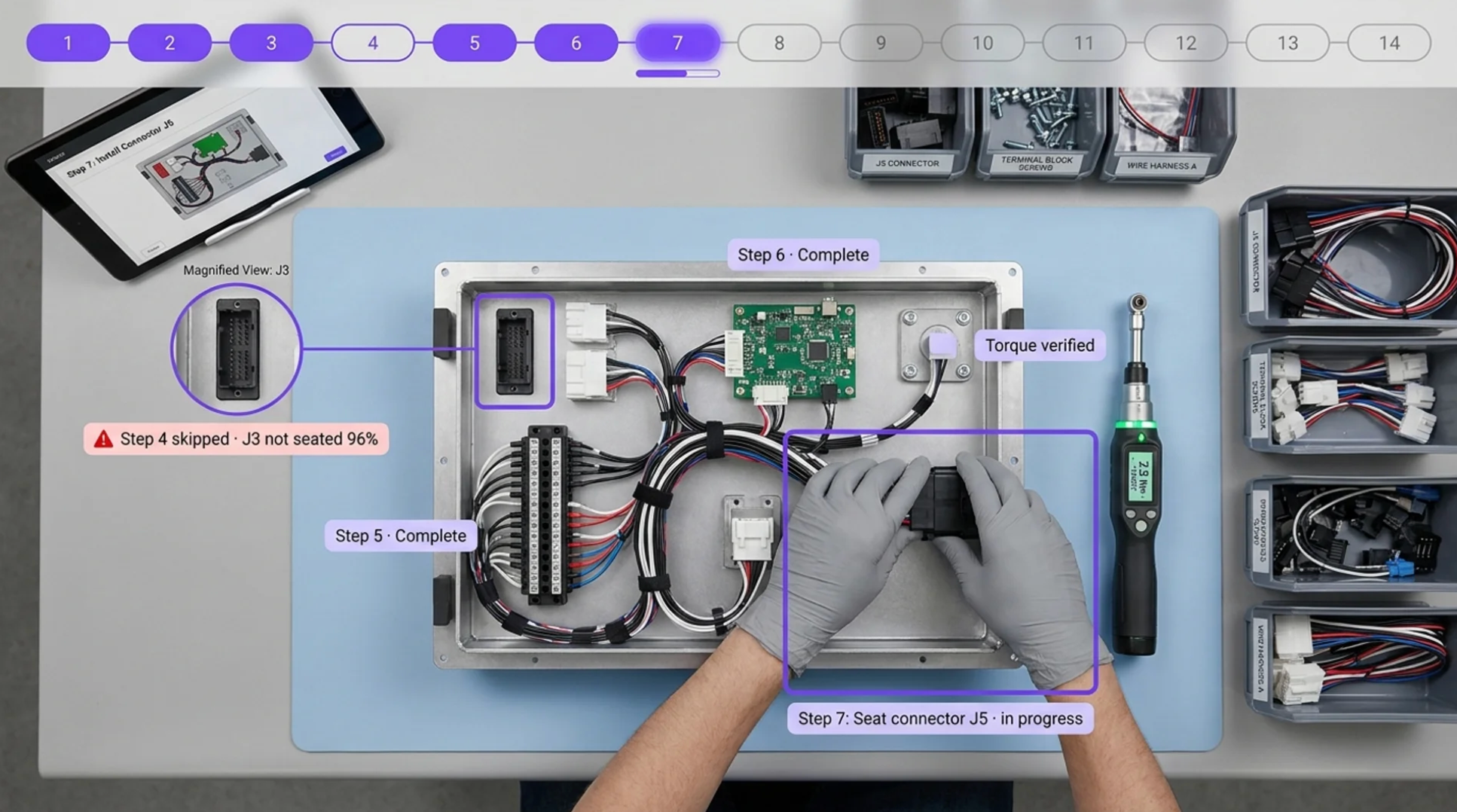
Manual Assembly Process Monitoring AI Across Step Verification, Operator Guidance, and Traceability
Deploy Anywhere, Run Everywhere
Run process monitoring on overhead cameras at manual assembly stations, cell-mounted cameras, operator screens, the edge, on-prem, in your VPC, or via API, wherever your assembly line needs it.
One Platform, Full Adoption
Tools every assembly team can adopt, from line operators and industrial engineers to quality, continuous improvement, and training leads, no separate ML team required to ship and own the models.
Secure, Compliant, and Audit-Ready
Data stays safe with SOC 2 Type II compliance, encrypted data, and an uptime SLA, with per-unit step records that support ISO 9001, IATF 16949, and AS9100 process control and traceability requirements.
- Step Completion & Sequence Verification
- Skipped, Repeated & Out-of-Order Steps
- Critical-to-Quality Connection & Fastener Checks
- Tool Use, Torque & Fixture Confirmation
- Real-Time Operator Feedback on Screen
- Cycle Time, Bottleneck & Per-Unit Traceability
“Roboflow has been instrumental in accelerating our deployment of innovative AI solutions.”
Travis Turnbull
Vice President & CIO, Pella Corporation
Talk to a Vision AI engineer who's shipped process monitoring on manual assembly lines.
Bring us your toughest manual assembly monitoring problem and we'll map a working solution.
Ask us about:
- Solution architecture for ISO 9001, IATF 16949, and AS9100 process control and traceability requirements
- Live demo on video from your own assembly stations
- Deployment options: overhead station cameras, operator screens, edge, on-prem, air-gapped, or VPC
- ROI modeling against functional test failures, rework and teardown hours, training time for new operators, and cycle time
Over 16,000 organizations build with Roboflow.
- Rivian
- Pella
- Chobani
- USG Corporation
- BNSF Railway
- American Woodmark
Vision AI is transforming businesses
Customers across the board are solving complex challenges and driving meaningful impact.
- Automotive customer
$10 million
Saved by automatically detecting defects on the production line
- Logistics & freight company
90%
Less time spent manually tracking shipping inventory
- Building materials supplier
60%
Lower customer return rate with improved product quality
Bring Real-Time Intelligence to Every Step of Manual Assembly, from the First Operation to the Last
Add a real-time inspection layer to every manual assembly station with Vision AI for manual assembly process monitoring.
Step Verification as the Operator Works:
- Detect each step as it is completed and confirm the sequence matches the work instruction for that part number
- Flag skipped, repeated, or out-of-order steps on the operator's screen while the unit is still at the station
- Confirm critical-to-quality connections, fasteners, and components are in place before the next step covers them
Operator Guidance and Training:
- Show the operator the next step and a pass/fail on the last one, so new hires reach standard work faster
- Confirm the right tool, fixture, and torque driver were used for the step
- Reduce reliance on end-of-line inspection by moving the check to the moment the work is done
Traceability and Continuous Improvement:
- Log every step, timestamp, and image per unit serial, so a field return traces back to the exact step and station
- Measure cycle time per step and per station to find bottlenecks and balance the line
- Feed results to your MES and andon systems, and hold the unit at the station when a critical step is missed
More About Manual Assembly Process Monitoring
What is manual assembly process monitoring with vision AI?
Manual assembly process monitoring with vision AI uses overhead or station cameras and computer vision models to recognize each step of a manual assembly as the operator performs it, compare the sequence to the work instruction for that part number, and flag skipped, repeated, or out-of-order steps on the operator's screen while the unit is still at the station. It also confirms critical-to-quality connections, fasteners, and components are present before the next step covers them, and logs every step with a timestamp and image per unit serial. It adds a process-control layer alongside the operator's own work, so coverage extends to every step on every unit rather than the final state an end-of-line check can see.
Can Vision AI tell whether a step was actually completed, not just whether a hand moved?
Distinguishing a completed step from motion near the work is the hard part of process monitoring, and it is where simple motion or zone-based approaches fall short. Models such as RF-DETR are trained on images and video from your own stations to recognize the outcome of the step (a connector seated, a fastener installed, a component in its location) as well as the tool and hand activity around it, so the check is on the result, not just the movement.
Does manual assembly process monitoring support ISO 9001, IATF 16949, and AS9100?
ISO 9001 (quality management systems), IATF 16949 (automotive quality management, including error-proofing and process control requirements), and AS9100 (aerospace quality management) all expect controlled processes with records that show each unit was built to the defined method. Vision AI supports that by producing a per-unit, per-step record with timestamps and images, which quality teams can attach to the unit's traveler or device history and use in customer audits and PPAP or first article submissions.
Can it integrate with our MES, andon, and operator screens?
Yes. Roboflow Inference exposes a standard API and supports common industrial protocols, so step events and pass/fail results flow into MES platforms like SAP, Siemens Opcenter, and Ignition, andon and HMI systems, and your traceability database through REST, MQTT, OPC UA, and direct database writes. Operator feedback can be shown on the station screen or an existing HMI, and PLC-level integration can hold the unit or block the next fixture when a critical step is missed.