Inventory Cycle Counting AI
Count every location as the forklift passes it, reconcile against the WMS, and put a photo behind every variance.
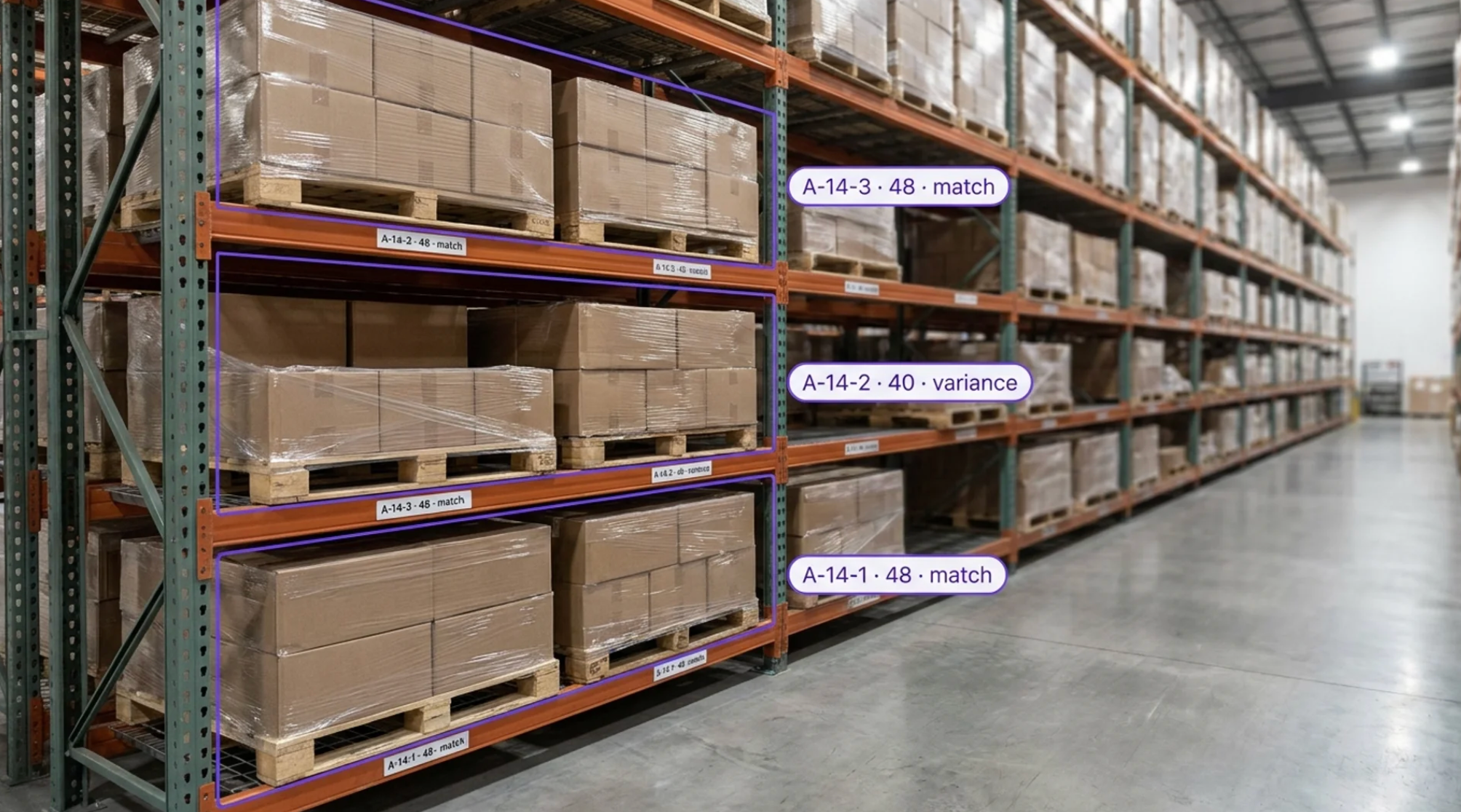
Inventory Cycle Counting AI Across Distribution Centers, Stockrooms, Backrooms, and 3PL Sites
Deploy Anywhere, Run Everywhere
Run inventory cycle counting on forklift-mounted cameras, indoor drones, handhelds, and fixed rack cameras, on-prem, in your VPC, or via API, wherever your racks, floor stacks, and bins need it.
One Platform, Full Adoption
Tools every warehouse team can adopt, from forklift operators and count teams to inventory control, operations managers, and finance and audit, no separate ML team required to ship and own counting models.
Secure, Compliant, and Audit-Ready
Data stays safe with SOC 2 Type II compliance, encrypted data, and an uptime SLA, with photo-backed count records that support SOX inventory controls, external audit observation, and ISO 9001 requirements.
- Rack, Bin & Floor Location Counts
- SKU & Quantity Verification Against WMS
- Location & Pallet Label Reading
- Forklift, Drone & Handheld Capture
- Variance Flags with Photo Evidence
- Shrink & Mis-Slot Trend Records
“Achieving positive results using AI in a lab environment is easy, but the real challenge comes when scaling the solution across a network like ours without disrupting day-to-day operations. Our partnership with Roboflow is allowing us to do just that.”
Asim Ghanchi
AVP of Technology, BNSF
Talk to a Vision AI engineer who's shipped cycle counting in a live warehouse.
A single pallet the WMS swears is in another building, year-end physical that shuts down shipping for two days, or variance report that cannot tell a mis-pick from a mis-slot from a theft can mean a write-off the controller has to explain, an audit finding, and a customer order you could not fill from stock that was sitting on level five the whole time. Bring us your toughest inventory cycle counting problem and we'll map a working solution.
Ask us about:
- Solution architecture for SOX inventory controls, external audit observation, and ISO 9001 environments
- Live demo on your rack and pallet imagery, forklift camera footage, or drone captures
- Deployment options: forklift-mounted cameras, indoor drones, handhelds, fixed cameras, on-prem, or VPC, with integration into WMS and ERP
- ROI modeling against count labor, year-end shutdown days, inventory write-offs, shrink, and stockouts on stock you actually had
Over 16,000 organizations build with Roboflow.
- Rivian
- Pella
- Chobani
- USG Corporation
- BNSF Railway
- American Woodmark
Vision AI is transforming businesses
Customers across the board are solving complex challenges and driving meaningful impact.
- Automotive customer
$10 million
Saved by automatically detecting defects on the production line
- Logistics & freight company
90%
Less time spent manually tracking shipping inventory
- Building materials supplier
60%
Lower customer return rate with improved product quality