Hospital Supply Room Inventory with Computer Vision
Count every bin, catch expired product, and trigger restocks from what is actually on the shelf.
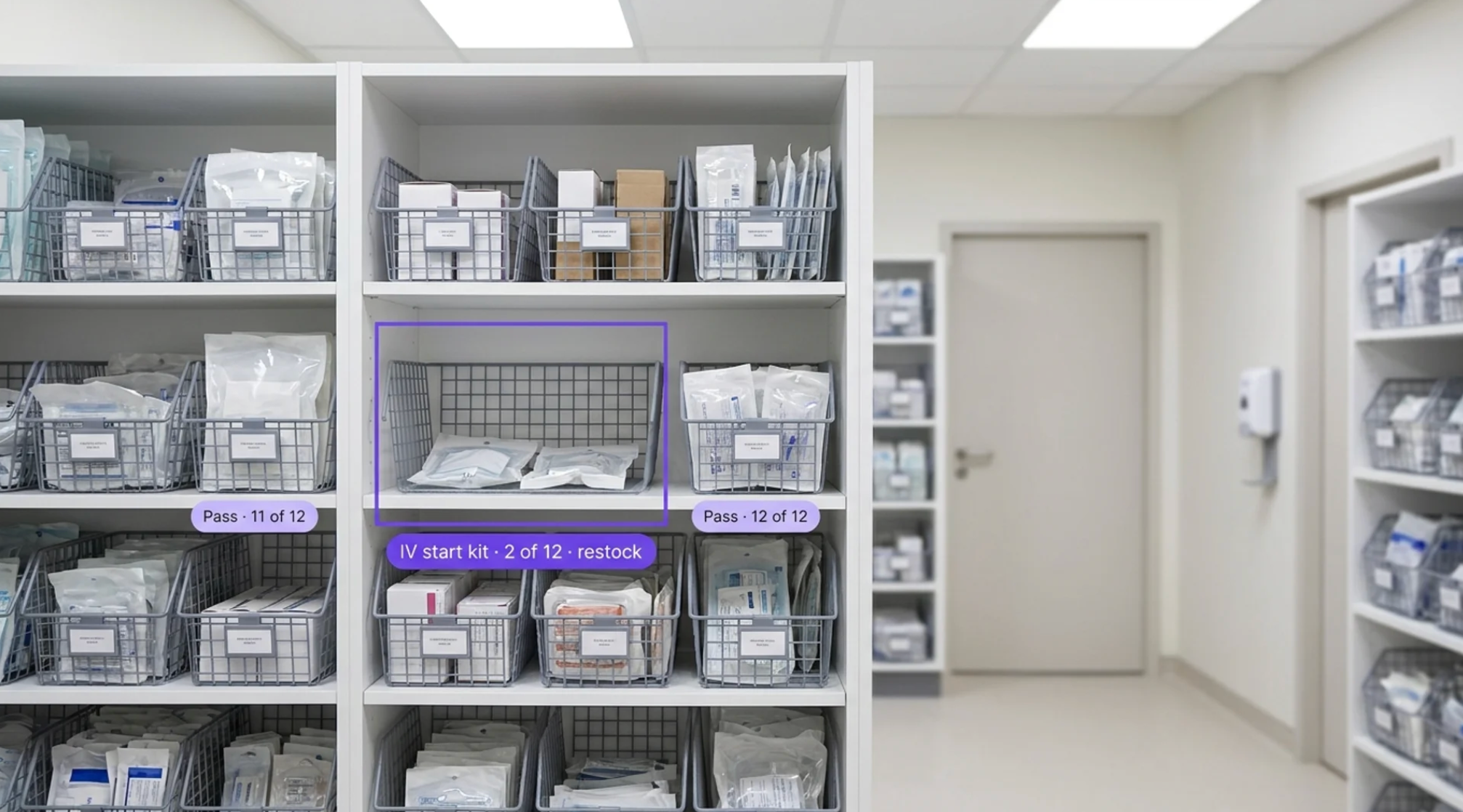
Hospital Supply Room Inventory AI Across Nursing Units, Procedure Areas, and Central Supply
Deploy Anywhere, Run Everywhere
Run hospital supply room inventory on fixed room cameras, handhelds, and phones, on-prem, in your VPC, or via API, wherever your supply rooms, par carts, and procedure-area cores need it.
One Platform, Full Adoption
Tools every hospital team can adopt, from supply techs and unit nurses to materials management, perioperative services, and value analysis, no separate ML team required to ship and own inventory models.
Secure, Compliant, and Audit-Ready
Data stays safe with SOC 2 Type II compliance, HIPAA compliance, encrypted data, and an uptime SLA, with bin-level photo records that support Joint Commission storage standards, FDA UDI traceability, and materials management audits.
- Bin Counts & Par-Level Replenishment
- Stockout & Near-Empty Bin Alerts
- Expiration Date Reading & Flags
- Lot & UDI Recall Location
- Wrong-Bin & Misplaced Item Detection
- Usage Trends & Shrink Visibility
“Roboflow has been instrumental in accelerating our deployment of innovative AI solutions.”
Travis Turnbull
Vice President & CIO, Pella Corporation
Talk to a Vision AI engineer who's shipped inventory in hospital supply rooms.
Bring us your toughest hospital supply room inventory problem and we'll map a working solution.
Ask us about:
- Solution architecture for Joint Commission storage standards, FDA UDI traceability, and HIPAA-aligned camera placement and data handling
- Live demo on your supply room photos, par cart images, or existing room camera footage
- Deployment options: fixed room cameras, handheld and phone audits, on-prem, or VPC, with integration into ERP, point-of-use, and EHR supply systems
- ROI modeling against expired product write-offs, stockout-driven case delays, manual cycle count hours, and hoarding and shrink
Over 16,000 organizations build with Roboflow.
- Rivian
- Pella
- Chobani
- USG Corporation
- BNSF Railway
- American Woodmark
Vision AI is transforming businesses
Customers across the board are solving complex challenges and driving meaningful impact.
- Automotive customer
$10 million
Saved by automatically detecting defects on the production line
- Logistics & freight company
90%
Less time spent manually tracking shipping inventory
- Building materials supplier
60%
Lower customer return rate with improved product quality
See Every Bin in Every Supply Room, in Real Time, with Computer Vision
Bring real-time intelligence to every supply room, par cart, and procedure-area core with computer vision for hospital supply room inventory. Built for the hospitals where a nurse walks to the next unit for a chest tube kit because the bin was empty and the count said otherwise, a box of expired sutures sits at the back of a shelf until a Joint Commission surveyor finds it, and a supply tech counts the same two hundred bins every morning by hand while the OR waits on a case cart. Whether you're running nursing unit supply rooms, the OR and cath lab core, the ED, or central supply, Roboflow reads the shelves on the cameras your rooms already have or a few fixed ones you add, with bin-level counts, expiration flags, and replenishment triggers behind every room.
Bin Counts and Par Levels:
- Count items in every bin, on every shelf, continuously, so par-level reorders trigger from what is actually on the shelf instead of what was scanned out
- Flag stockouts and near-empty bins in real time and route a restock task to the supply tech before the next shift finds the bin empty
- Verify put-away, so the item scanned in is in the right bin and the bin that was restocked actually got restocked
Expiration, Recalls, and Placement:
- Read lot and expiration dates on packaging and flag product approaching or past expiry, with the bin and shelf location, before a surveyor or a clinician finds it
- Match lot numbers and UDI against recall notices, so a recalled product is located across every room in hours instead of days
- Detect wrong-bin and misplaced items, the sterile item stored in the wrong place and the look-alike product in the wrong slot
Rooms, Carts, and Systems Integration:
- Cover supply rooms, par carts, case cart staging, and procedure-area cores with fixed cameras, and audit any room with a handheld or phone capture
- Trend usage by room, item, and shift, so par levels reflect real consumption and hoarding and shrink show up as a pattern, not a surprise at the annual count
- Push counts, alerts, and tasks into your ERP, point-of-use, and EHR systems through API and webhooks, with a photo record behind every count and every expiration flag
Bring intelligence to every supply room today. Stop empty bins, expired product, and blind par levels from becoming delayed cases, survey findings, or a supply budget that grows while shelves stay empty.
More About Hospital Supply Room Inventory with Computer Vision
What is hospital supply room inventory with computer vision?
Hospital supply room inventory with computer vision uses cameras and vision AI models to read the shelves in nursing unit supply rooms, procedure-area cores, and central supply: counting items per bin, flagging stockouts and near-empty bins against par levels, reading lot and expiration dates, matching lots and UDI against recalls, and detecting misplaced product. Models trained on your actual items, bins, and rooms run continuously on fixed cameras or on demand from a handheld, with bin-level counts and photo records that support Joint Commission medication and supply storage standards, FDA UDI traceability, and your materials management audits.
Can computer vision count items inside bins and behind packaging?
The supply bin is the hard case: items are packed in translucent or opaque pouches, stacked in wire bins at different depths, partly hidden behind the item in front, and shelved at heights and angles a fixed camera sees obliquely, with look-alike products a few bins apart. Deep-learning models trained on your actual items, bins, and camera positions learn each product's packaging and how a bin looks at every fill level, estimate counts from visible faces and depth cues, and read lot and expiry text where it is legible. Where a bin cannot be counted exactly from the shelf, the model reports fill level and a confidence, and the room's count reconciles against scan-out data, so the number the supply tech acts on is the best available one, with the photo behind it.
Does this meet Joint Commission and HIPAA requirements?
Yes, with the right design. The Joint Commission's storage standards (expired and recalled product removed from use, sterile items stored correctly) and FDA UDI requirements expect that expired and recalled product is found and pulled, and the vision record shows every shelf checked, every flag raised, and every item pulled, with a timestamp. HIPAA (the privacy and security rules for protected health information) is addressed at design time: cameras point at shelves and bins, not at patients or charts, capture can be limited to the supply room, and imagery is stored under your BAA and retention policy. Roboflow is the inventory engine; your supply chain, nursing, and compliance teams own the par levels, storage rules, and privacy controls that sit on top.
Can it integrate with our ERP, point-of-use, and EHR systems?
Yes. Roboflow Inference exposes a standard API and webhooks, so supply room counts and flags flow into your existing systems: ERP and materials management platforms like Oracle, Infor, and Workday Supply Chain, point-of-use and par management systems like Omnicell, Cardinal WaveMark, PAR Excellence, and Tecsys, and EHR supply modules like Epic, through REST, webhooks, HL7 and FHIR interfaces, and direct database writes. A near-empty bin becomes a replenishment task, an expiring lot becomes a pull list, a recall becomes a located-in-minutes report, and every event carries room, shelf, bin, item, lot, timestamp, and the image, with a full audit trail behind every count.