Vision AI for Electrical Equipment Manufacturing
Inspect windings, welds, bushings, and final assemblies on transformers, switchgear, and capacitors, so defects are caught on the line instead of at test or in the field.
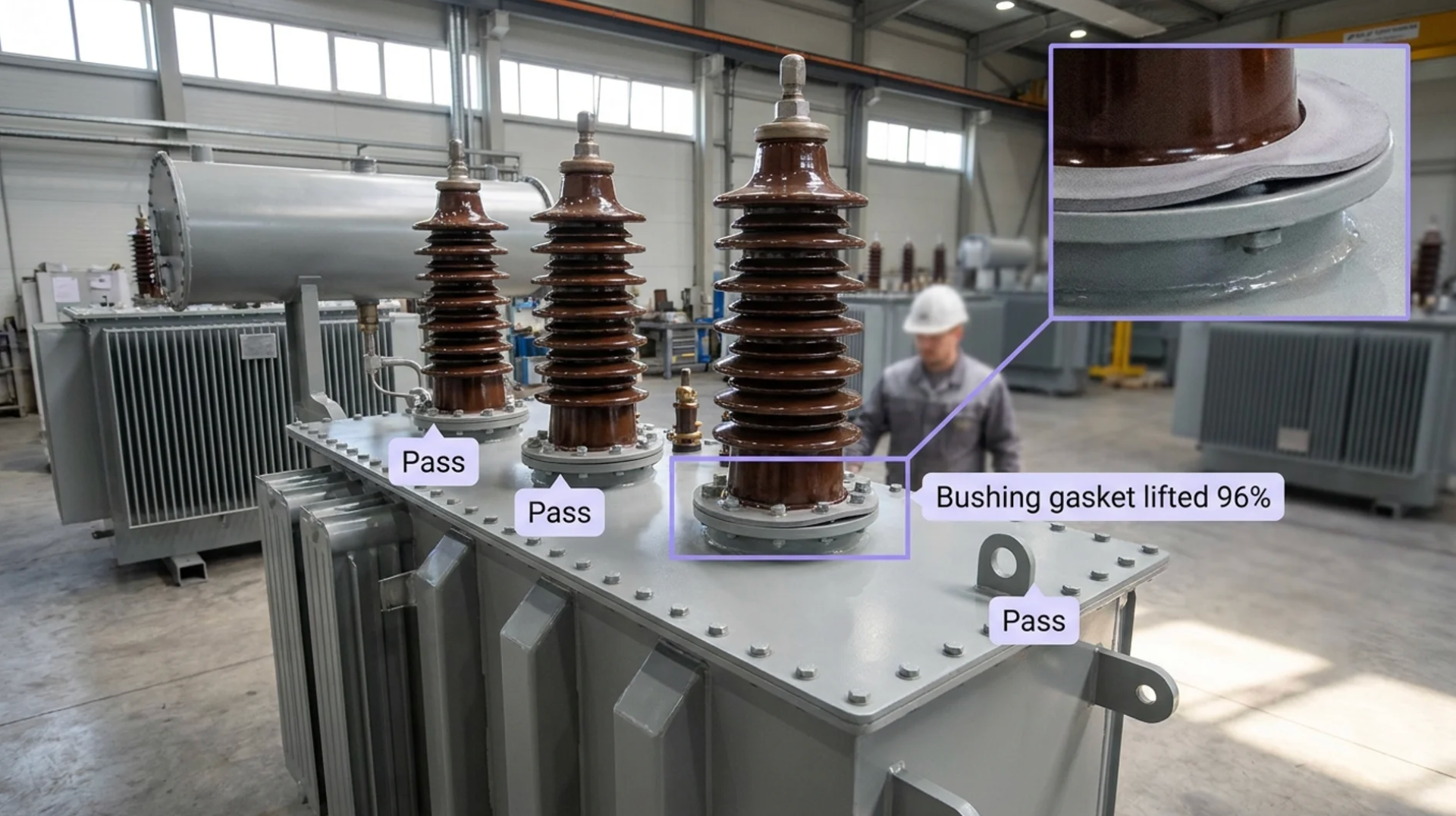
Electrical Equipment Manufacturing AI for Transformers, Switchgear, and Capacitors
Deploy Anywhere, Run Everywhere
Run inspection on winding machines, weld cells, tank and bushing assembly stations, final test bays, the edge, on-prem, in your VPC, or via API, wherever your electrical equipment plant needs it.
One Platform, Full Adoption
Tools every electrical equipment team can adopt, from process and manufacturing engineers to quality, test, and digitalization leads, no separate ML team required to ship and own inspection models.
Secure, Compliant, and Audit-Ready
Data stays safe with SOC 2 Type II compliance, encrypted data, and an uptime SLA, with inspection records that support ISO 9001, IEC 60076, IEEE C57, IEC 62271, and IEC 60871 quality and factory acceptance test documentation.
- Transformer & Capacitor Winding Inspection
- Tank, Radiator & Lead Weld Inspection
- Bushing, Gasket & Seal Verification
- Core Stacking & Clamping Verification
- Missing Hardware, Labels & Nameplates
- Switchgear Busbar, Breaker & Wiring Assembly
“Roboflow has been instrumental in accelerating our deployment of innovative AI solutions.”
Travis Turnbull
Vice President & CIO, Pella Corporation
Talk to a Vision AI engineer who's shipped in electrical equipment manufacturing.
A single winding defect, porous tank weld, or missing ground pad can mean a unit that fails at final test, a teardown that pulls the core and drains the oil, or a field failure on a live line. Bring us your toughest electrical equipment inspection problem and we'll map a working solution.
Ask us about:
- Solution architecture for ISO 9001, IEC 60076, IEEE C57, IEC 62271, and IEC 60871 quality and test requirements
- Live demo on images from your winding machines, weld cells, or assembly stations
- Deployment options: edge at the station, on-prem, air-gapped, VPC, or integrated with the camera vendors you already run
- ROI modeling against first pass yield at test, rework and teardown hours, scrap, and on-time delivery
Over 16,000 organizations build with Roboflow.
- Rivian
- Pella
- Chobani
- USG Corporation
- BNSF Railway
- American Woodmark
Vision AI is transforming businesses
Customers across the board are solving complex challenges and driving meaningful impact.
- Automotive customer
$10 million
Saved by automatically detecting defects on the production line
- Logistics & freight company
90%
Less time spent manually tracking shipping inventory
- Building materials supplier
60%
Lower customer return rate with improved product quality
Bring Real-Time Intelligence to Every Stage of Electrical Equipment Manufacturing, from Winding to Final Test
Add a real-time inspection layer to every unit on the line with Vision AI for electrical equipment manufacturing.
Winding, Core, and Coil Inspection:
- Inspect windings for conductor crossovers, gaps, and insulation and spacer placement during winding, not at test
- Verify core stacking, clamping, and lead routing before the core-and-coil assembly is tanked
- Check capacitor element windings and layer counts for high-voltage capacitor banks
Welds, Tanks, Bushings, and Seals:
- Detect porosity, incomplete fusion, and hollow welds on tanks, radiators, and lead connections before oil fill
- Verify bushings, gaskets, and seals are correctly installed and undamaged, catching the leaks that show up after test
- Confirm ground pads, hardware, and accessories are present on customized builds where every unit differs
Final Assembly and Factory Acceptance:
- Verify nameplates, labels, and wiring on switchgear, panels, and control cabinets against the build documentation
- Log a pass/fail record and image history per unit serial for factory acceptance and customer witness tests
- Feed results to your MES, SPC, and traceability systems, and drive station hold states through the PLC
More About Vision AI for Electrical Equipment Manufacturing
What is Vision AI for electrical equipment manufacturing?
Vision AI for electrical equipment manufacturing uses cameras at winding, welding, assembly, and test stations and computer vision models trained on your own units to inspect transformers, switchgear, capacitors, bushings, and reactors as they are built. It covers the checks that are hard to standardize by hand when every unit is built to a different specification: winding defects, weld porosity, bushing and gasket installation, missing hardware, and final wiring. Results and images are logged per unit serial, in a form that supports ISO 9001 quality systems and the factory acceptance test documentation utilities require under IEC 60076, IEEE C57, IEC 62271, and IEC 60871.
Can Vision AI inspect units where every transformer or switchgear lineup is built differently?
High-mix, engineered-to-order production is exactly where electrical equipment manufacturers feel the most pressure, because a rules-based vision system tuned to one design breaks on the next. Deep-learning models such as RF-DETR learn the components and defect types themselves (a spacer, a weld pore, a ground pad, a bushing gasket) rather than a fixed pixel layout, so the same model holds across configurations, and the expected build for each unit can be pulled from the work order or bill of materials.
Does it support IEC 60076, IEEE C57, IEC 62271, and IEC 60871?
IEC 60076 (power transformers), IEEE C57.12.00 (liquid-immersed distribution, power, and regulating transformers), IEC 62271 (high-voltage switchgear and controlgear), and IEC 60871 (shunt capacitors for AC power systems) define the tests and requirements a finished unit must meet, and ISO 9001 governs the quality system around them. Vision AI does not replace those tests. It reduces how often a unit fails them by catching defects during manufacture, and it produces the inspection evidence, defect classification, and image history that quality teams attach to unit records, customer witness tests, and factory acceptance test packages. Roboflow is the inspection engine; your quality and test engineering teams own the acceptance criteria.
Can it integrate with our MES, SPC, and station PLCs across multiple plants?
Yes. Roboflow Inference exposes a standard API and supports common industrial protocols, so inspection events flow into SAP, Siemens Opcenter, Ignition, AVEVA, or your traceability system through REST, MQTT, OPC UA, and direct database writes, and PLC-level integration can hold a station when a critical defect is found. Because plants in a group often run their own vendors and processes, the same model and workflow can be deployed at the edge, on-prem, or in your cloud VPC at each site, with each plant owning its own data and retraining while sharing the process. Models and data export in standard formats with no lock-in.