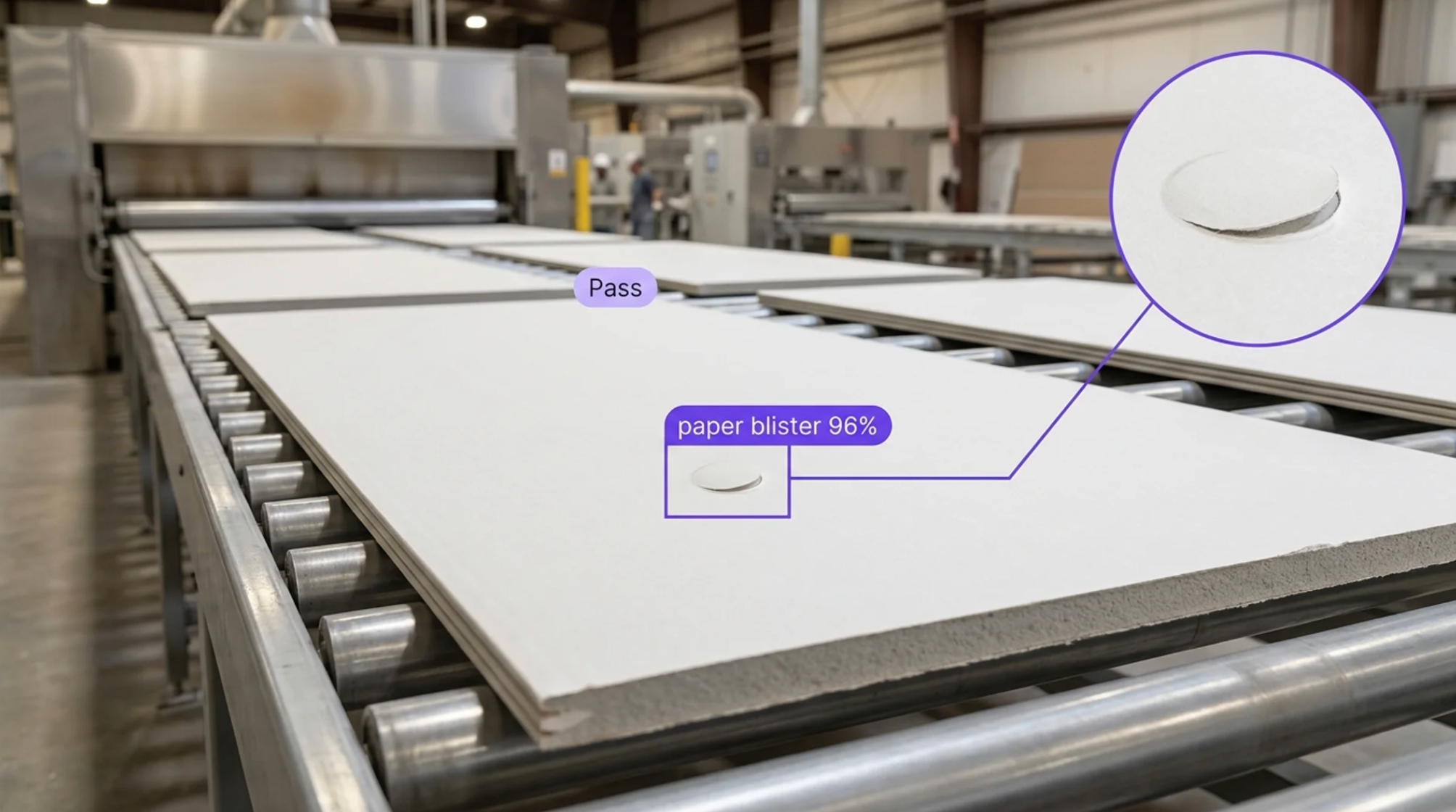
Add a real-time inspection layer to every panel with vision AI for drywall and building-panel inspection. Built for the operations where a line makes a sheet every few seconds, the product is a flat surface under bright light where a shadow and a defect look the same from the catwalk, and the panel that reaches the job site with a delaminated edge or a soft spot comes back as a whole unit with a claim attached. Whether you're running gypsum wallboard, OSB and plywood, MDF and particleboard, fiber cement and MgO board, or insulated and structural panels, Roboflow inspects every panel on the cameras and stations your plant already runs, with per-panel records and line-level trends behind every cull.
Surface and Face Defects:
- Detect paper blisters, wrinkles, and delamination on drywall face and back paper, and veneer lifts, splits, and open defects on plywood and OSB faces
- Flag scorch, wet spots, stains, and resin bleed on any panel type, so a dryer zone or a press problem surfaces as a flagged sheet instead of a shift of them
- Catch fiber pulls, chips, and surface texture faults on fiber cement, MgO, and MDF before primer, paint, or laminate makes them permanent
Edges, Cores, and Dimensions:
- Detect edge crush, corner breaks, tapered-edge damage, and tongue-and-groove faults at the saw, the transfer, and the stacker
- Flag core voids, cracks, soft spots, and blows on gypsum, OSB, and insulated panels, so a forming, press, or foam problem gets caught at the panel and traced to its source
- Verify length, width, squareness, thickness, and cut quality on every sheet, so the panel that will not fit the wall never leaves the plant
Grading, Marking, and Systems Integration:
- Grade panels consistently against your own accept, downgrade, and cull thresholds, holding the same line across lanes, shifts, and product changeovers
- Verify grade stamps, edge marks, labels, and bundle counts, so every unit ships with the right mark and the right grade on it
- Route culls and downgrades in real time through PLC integration, and trend defects by line, press, dryer zone, and saw for maintenance and claims
Bring intelligence to every panel today. Stop surface, edge, and core defects from becoming job-site rejections, downgraded units, or the account that moves to another supplier over finish quality.
More About Drywall and Building-Panel Inspection
What is drywall and building-panel inspection with Vision AI?
Drywall and building-panel inspection with vision AI uses computer vision models to inspect flat panel products at line speed: paper and veneer defects, scorch, stains, and bleed, edge crush and corner damage, core voids and soft spots, dimensional and squareness checks, grade stamps and bundle marks, and grading against your own thresholds. It covers gypsum wallboard, OSB and plywood, MDF and particleboard, fiber cement and MgO board, and insulated and structural panels. Models trained on your actual panels and lines run on every sheet, with per-panel records that support ASTM C1396, PS 1 and PS 2, ASTM C1186, ANSI A208, and ISO 9001 documentation.
Can Vision AI tell a real defect from a shadow on a flat panel?
Flat panels are the hard case: the product is a wide, uniform surface under bright plant light, a wrinkle and a shadow look the same from the catwalk, OSB and fiber cement have a busy natural texture that hides a real crack in plain sight, and the line moves a sheet every few seconds. Deep-learning models trained on your actual panels, lighting, and your quality team's own accept-and-cull calls learn how defects present on each product, separate a paper blister from a lighting artifact and a resin spot from a stain, and hold that judgment identically across lanes and shifts. Lighting and camera placement are sized to each panel type during solution design, and borderline sheets route to review by policy instead of guesswork.
Does this support ASTM C1396, PS 2, and ISO 9001 documentation?
Yes. ASTM C1396 (the standard specification for gypsum board), PS 1 and PS 2 (the voluntary product standards for plywood and OSB structural panels, backed by APA audits), ASTM C1186 (flat fiber cement sheets), ANSI A208.1 and A208.2 (particleboard and MDF), and ISO 9001 quality management systems each expect documented inspection with traceable records. Roboflow is the inspection engine that generates those records, per-panel imagery, line, timestamp, and disposition, while your quality and process teams own the acceptance criteria, the sampling plans, and the test methods that sit behind them. The vision record shows every panel that was inspected and how it was dispositioned; your lab tests stay the instruments of record for strength and physical properties.
Can it integrate with our line controls, MES, and quality systems?
Yes. Roboflow Inference (opens in a new tab) exposes a standard API and supports common industrial protocols, so panel inspection events flow into your existing systems: line and press PLCs from Allen-Bradley and Siemens driving culls and downgrade lanes, MES and ERP platforms like SAP and Oracle, and SCADA and HMI platforms like Ignition and AVEVA, through REST, MQTT, OPC UA, and direct database writes. PLC-level integration pulls a flagged panel before the stacker, and every event carries line, lane, press or dryer zone where derived, timestamp, and imagery, with a full audit trail behind every unit shipped.