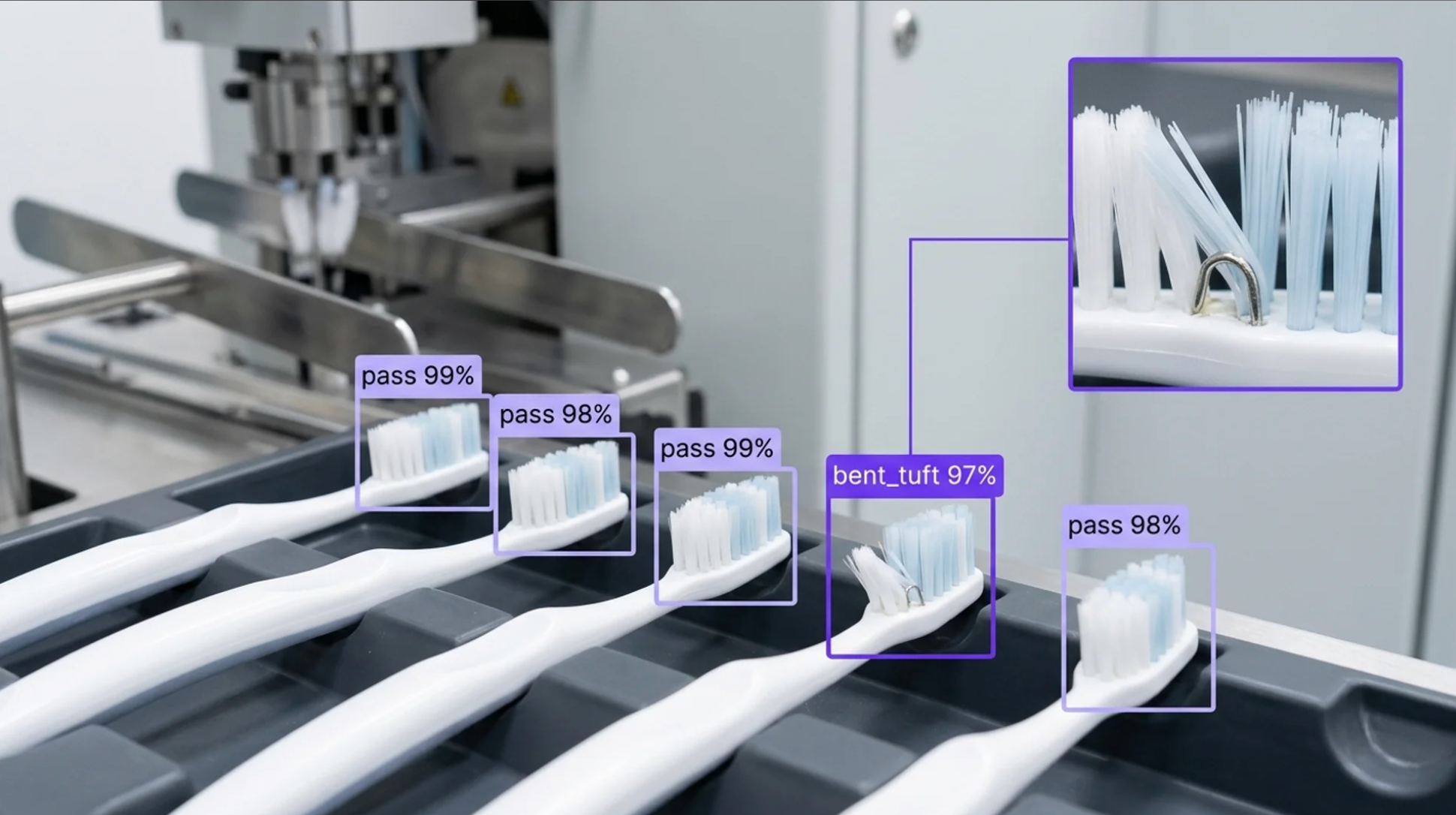
Add a real-time inspection layer to every unit on the line with Roboflow Vision AI for oral care manufacturing inspection.
Toothbrush heads and handles:
- Detect missing, bent, loose, and over-trimmed tufts, uneven trim profiles, and exposed anchor wire on heads coming off Zahoransky and Boucherie tufting machines, trained on your own bristle colors, head geometries, and lighting.
- Classify bristle end-rounding at the tip level so ISO 20126 and ISO 20127 acceptance checks run on every head instead of a pulled sample.
- Flag handle flash, short shots, sink marks, color streaks, and rubber grip overmold voids on multi-shot injection molded handles before assembly.
Toothpaste tubes, mouthwash bottles, and floss:
- Inspect tube crimps and ultrasonic seals for open, angled, wrinkled, or product-contaminated seals, and verify cap presence, cocked caps, and cap-to-tube alignment cues that signal under- or over-torque.
- Verify fill level on laminate and plastic tubes and on clear and opaque mouthwash bottles, plus induction seal presence, tamper band integrity, and cap color match to SKU.
- Confirm floss dispenser assembly: spool present, cutter blade seated, lid closed, and label placed.
Print, codes, and secondary packaging at line speed:
- Read and verify batch codes, expiry dates, and inkjet or laser lot codes on tubes, cartons, and bottle shoulders, and grade GS1 barcodes and 2D codes for legibility.
- Check carton and blister completeness: tube in carton, leaflet present, toothbrush seated in the blister, flaps closed, label placement and skew within tolerance, and SKU match across multi-pack lines.
- Write pass/fail to the rejecter, log every decision with an image, and roll the same models across every line and plant with a fleet deployment manager.
Bring intelligence to every toothbrush, tube, and carton today.
Frequently asked questions
What is oral care manufacturing inspection with Vision AI?
Oral care manufacturing inspection with Vision AI uses the cameras on your tufting, molding, filling, capping, and cartoning equipment and a trained computer vision model (opens in a new tab) to inspect every toothbrush, toothpaste tube, mouthwash bottle, floss dispenser, and carton for defects that rules-based vision struggles to define: bent or missing tufts, exposed anchor wire, handle flash and short shots, wrinkled or open tube crimps, cocked caps, low fills, and smeared batch codes. Models are trained on your own images so they handle bristle color, tube artwork, and lighting changes lot to lot, and they extend coverage to every unit instead of a pulled sample. Decisions are logged with an image for each unit, which supports FDA 21 CFR Part 211 for fluoride toothpaste sold as an OTC drug, the 21 CFR Part 700 series and ISO 22716 for cosmetic products, and ISO 20126 and ISO 20127 for manual and powered toothbrushes.
Can Vision AI reliably catch a single bent or over-trimmed tuft at tufting machine speed?
Yes. A detection model trained on head images from your own tufting cells learns what a correctly seated, trimmed, and end-rounded tuft looks like for each head geometry and bristle color, and flags tufts that are missing, bent, loose, over-trimmed, or showing anchor wire, along with trim profile deviations across the head. Machine-integrated checks from the tufting OEM cover a fixed set of conditions, and a Vision AI layer sits alongside them to cover the morphology-based defects those rules do not describe well. We typically start with a bench study on your heads before committing to thresholds, and the same approach applies to handle molding defects.
Does oral care manufacturing inspection support FDA 21 CFR Part 211 and ISO 22716?
Yes. Roboflow supports the documentation and validation expectations of FDA 21 CFR Part 211 (current good manufacturing practice for finished pharmaceuticals, which applies to fluoride toothpaste and anticavity mouthwash regulated as OTC drugs), the FDA 21 CFR Part 700 series (the cosmetic regulations covering non-fluoride toothpaste, cosmetic mouthwash, and labeling), ISO 22716 (the cosmetics GMP standard covering production, control, storage, and shipment), and FDA 21 CFR Part 11 (electronic records and signatures, including audit trails) by producing a timestamped image and decision record for every inspected unit and IQ/OQ/PQ documentation for the deployment. ISO 20126 and ISO 20127 (the requirements and test methods for manual and powered toothbrushes, including tuft retention and bristle end-rounding) and GS1 general specifications (barcode symbology, placement, and print quality grading) define the acceptance criteria the models are checked against. Roboflow serves as the inspection engine, and your quality, regulatory, and validation teams own the acceptance criteria, the sampling plan for verification, and the release decision.
Can it integrate with our tufting machines, fillers, cappers, PLCs, and MES?
Yes. Roboflow writes pass/fail and defect class to a PLC tag over OPC UA, Modbus TCP, or MQTT, so Allen-Bradley, Siemens, and Beckhoff controllers on Zahoransky, Boucherie, Norden, and IWK equipment can fire the rejecter, stop the tufting cell, or hold a carton lane. Per-unit results, images, and batch counts go over REST (opens in a new tab) or direct database writes to MES and SCADA platforms such as Ignition, AVEVA, Siemens Opcenter, and SAP, and to quality systems such as MasterControl and Veeva Vault QMS for deviation records. The same pipeline can carry cap and closure, fill level, and batch code verification results into the same batch record.