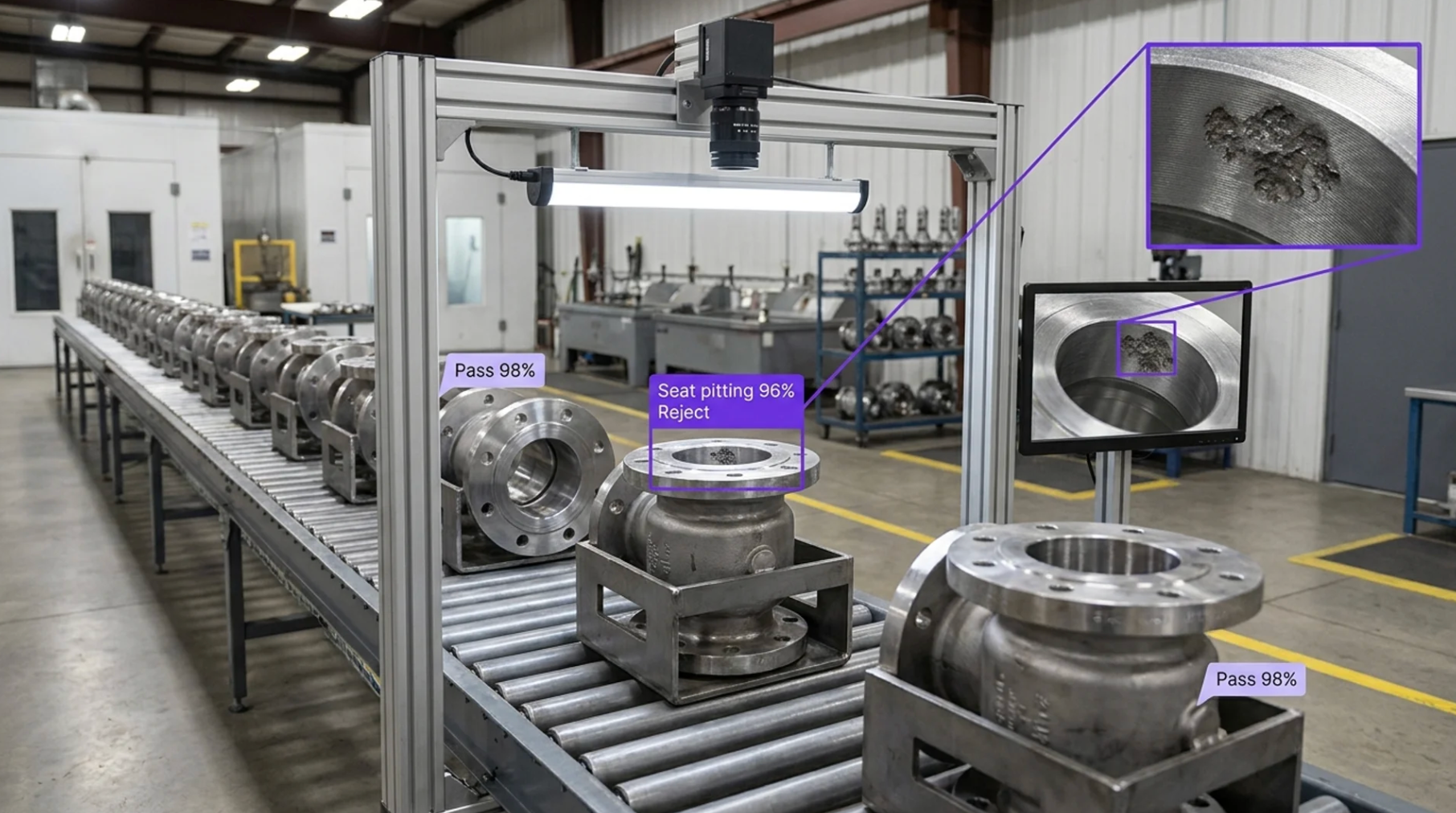
Whether you're running incoming inspection at a valve repair shop, refurbishing a fleet of frac and wellhead valves, or walking in-service valves at a refinery or water treatment plant, Roboflow extends your inspection coverage to every valve, not just the ones an inspector had time to reach, on the cameras, tablets, and inspection stations your facility already runs, documented against API 598, API 6D, API 6A, ASME B16.34, and ISO 5208.
Shop and refurbishment inspection:
- Grade rust and corrosion on plug, gate, ball, and check valve bodies, bonnets, and flanges from bench photos, and separate cosmetic surface rust from pitting that takes a valve out of refurbishment
- Detect scoring, pitting, and galling on seats, plugs, balls, and stems, the wear that sets seat leakage rate under API 598 and ISO 5208 tests
- Flag missing or damaged hardware on incoming valves, including stem nuts, gland packing, bolting, lifting lugs, and nameplates, before the valve moves to teardown
In-service and field inspection:
- Spot coating damage, external corrosion, and weeping around stems, bonnets, and body-bonnet joints from fixed wellhead and manifold cameras, drone passes, and technician phones
- Confirm valve position indication (open, closed, partial) on manual and actuated valves and reconcile it against the expected lineup, so a mispositioned valve gets caught before the next process step
- Detect leaks, drips, and staining around control valves and wellhead assemblies on every pass, with alerts routed to the integrity or operations team
Maintenance integration and audit trail:
- Push every finding into SAP PM, IBM Maximo, or your CMMS as a work order or inspection record, with the image, severity, location, and valve tag attached
- Keep a per-valve image history so you can see how corrosion on a specific asset progressed from one inspection to the next, and build the evidence file PSM audits and customer claims ask for
- Run the same inspection models across shop benches and field cameras from one platform, so the acceptance criteria your quality team writes apply in both places
Bring intelligence to every valve today.
Frequently asked questions
What is valve inspection with Vision AI?
Valve inspection with Vision AI uses camera images and video, from a shop bench, a technician's phone, or a fixed camera on a wellhead, to detect and grade defects on industrial valves: rust and corrosion, seat and stem wear, scoring and pitting, coating damage, leaks, missing hardware, and valve position. The models are trained on your own valve images, so they learn what a plug valve from your fleet looks like at incoming inspection, mid-refurbishment, and after years in service. Findings flow into your maintenance system as records and work orders. It adds a consistent inspection layer to every valve alongside the pressure tests and NDT your program already runs under API 598, API 6D, API 6A, ASME B16.34, and ISO 5208.
Can Vision AI tell cosmetic surface rust from corrosion that scraps a plug valve?
Vision AI handles this with segmentation models trained on your own images, labeled by your technicians with the categories your acceptance criteria use (surface rust, scale, pitting, loss of section), and the model learns the texture, color, and extent differences between them. Consistent lighting and a fixed camera position on the bench raise accuracy considerably, and the model improves as your team reviews and corrects its calls.
Does valve inspection with Vision AI support API 598 and OSHA PSM?
Yes. API 598 (Valve Inspection and Testing, covering seat and shell leakage limits for gate, globe, plug, ball, and check valves), API 6D (pipeline and piping valves), API 6A (wellhead and tree equipment), ASME B16.34 (valve pressure-temperature ratings, materials, and testing), and ISO 5208 (industrial valve pressure testing) set the acceptance criteria, and OSHA 29 CFR 1910.119 Process Safety Management requires documented mechanical integrity inspections on process equipment. Roboflow is the inspection engine: it captures the image evidence, applies the visual criteria consistently, and produces a timestamped, traceable record for each valve. Your quality, integrity, and PSM teams own the acceptance criteria, the pressure test procedures, and the sign-off. The result is a mechanical integrity file that shows what was inspected, when, and what was found.
Can it integrate with SAP, Maximo, and our field inspection tools?
Yes. Roboflow Workflows connects inspection results to SAP PM, IBM Maximo, Infor EAM, and other CMMS and EAM systems over REST APIs, MQTT, or direct database writes, so a detected defect creates a notification or work order against the right functional location or asset tag with the image attached. For field inspection, the same models run on tablets and phones, on edge devices at the wellhead or manifold, or on drone and crawler footage after the pass, and results sync when connectivity returns. Where a valve inspection result should gate a step, for example holding a valve from shipping until a supervisor reviews a flagged seat, Workflows can trigger that hold. Because the workflows are low-code, the same team that builds the valve inspection can extend it to flanges, pumps, and other assets without starting over.