Storage Tank and Pressure Vessel Inspection AI
Turn thousands of drone frames into a positioned defect list, so your certified inspector spends the day judging instead of scrolling.
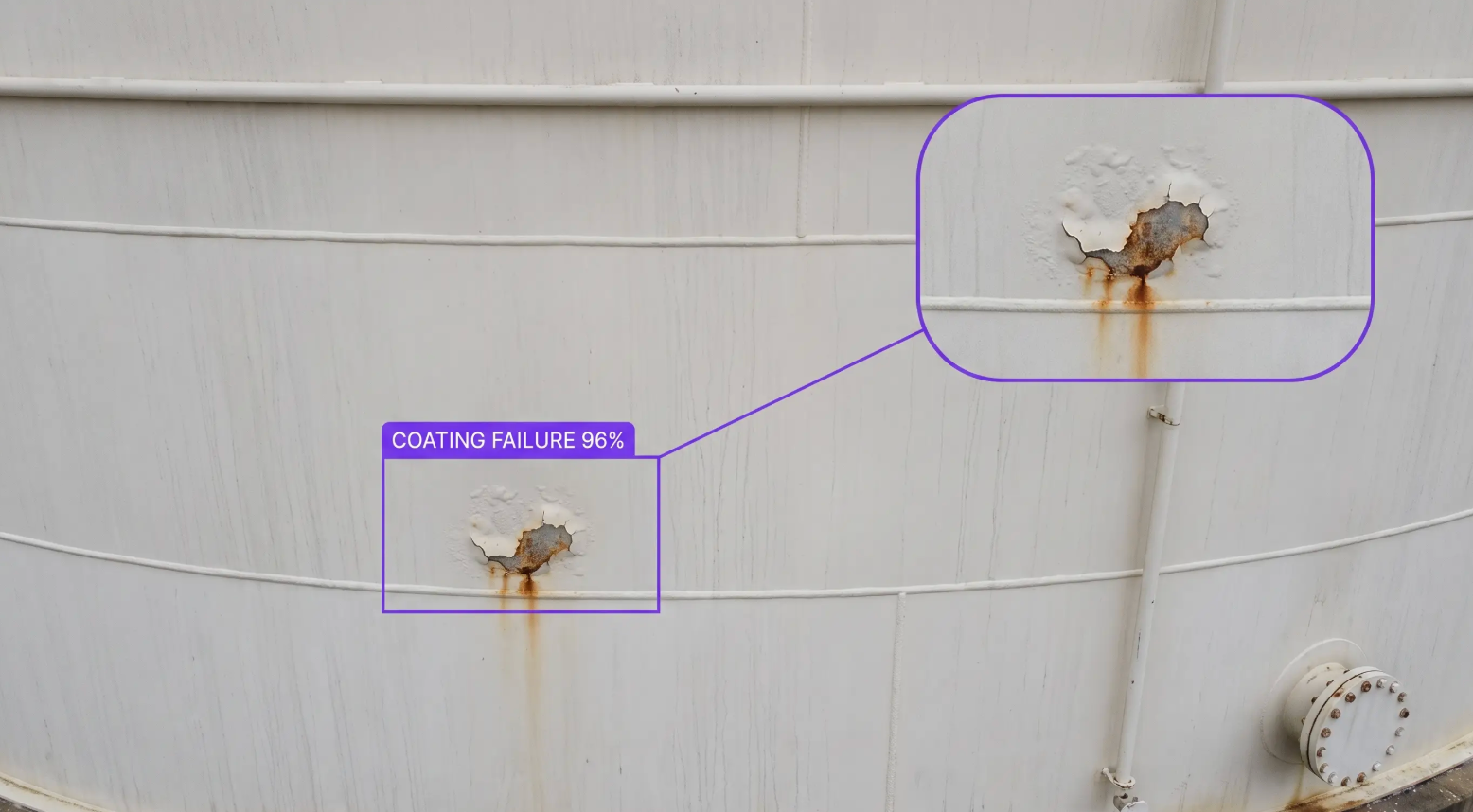
Tank and Vessel Inspection AI Across Tank Farms, Terminals, Refineries, and Chemical Plants
Deploy Anywhere, Run Everywhere
Run tank and pressure vessel inspection on drone and rope-access imagery, fixed and handheld cameras, the edge at remote terminals, on-prem, in your VPC, or via API, wherever your tank farms, vessels, and containment areas need it.
One Platform, Full Adoption
Tools every integrity organization can adopt, from API 653 and 510 inspectors and integrity engineers to turnaround planners, reliability, and the inspection service providers you contract, no separate ML team required to ship and own detection models.
Secure, Compliant, and Audit-Ready
Data stays safe with SOC 2 Type II compliance, encrypted data, and an uptime SLA, with positioned, image-backed defect records that support API 653 and API 510 inspection reports, API 580 and 581 risk-based inspection programs, and EPA SPCC documentation.
- Coating Breakdown & External Corrosion
- Weld Seam & Shell Condition
- Roof, Seal & Drain Condition
- Jacketing Damage & CUI Indicators
- Nozzle, Manway & Appurtenance Checks
- Positioned Defect Records
Talk to a vision AI engineer who's shipped tank and vessel inspection at scale.
A coating failure on the windward shell that nobody flags until the next five-year external, a floating roof drain that has been passing product to the dike for a month, or jacketing damage that quietly became corrosion under insulation can mean an unplanned outage on a tank you were counting on, an SPCC finding written on your own containment, or a thickness reading that arrives one inspection cycle too late. Bring us your toughest tank inspection problem and we'll map a working solution.
Ask us about:
- Solution architecture for API 653, API 510, API 570, API 580 and 581 risk-based inspection, and EPA SPCC 40 CFR 112 programs
- Live demo on your own drone survey imagery, across your coatings, insulation systems, and tank and vessel types
- Deployment options: drone and rope-access imagery pipelines, fixed and handheld cameras, edge at remote terminals, on-prem, air-gapped, or VPC, with integration into your inspection data management system
- ROI modeling against external inspection hours, image review time, rope access and scaffolding cost, and unplanned tank outage exposure
Over 16,000 organizations build with Roboflow.
- Rivian
- Pella
- Chobani
- USG Corporation
- BNSF Railway
- American Woodmark
Vision AI is transforming businesses
Customers across the board are solving complex challenges and driving meaningful impact.
- Automotive customer
$10 million
Saved by automatically detecting defects on the production line
- Logistics & freight company
90%
Less time spent manually tracking shipping inventory
- Building materials supplier
60%
Lower customer return rate with improved product quality