Screw Thread Inspection AI
Catch pitch errors, damaged threads, missing crests, surface defects, and dimensional out-of-spec across every fastener.
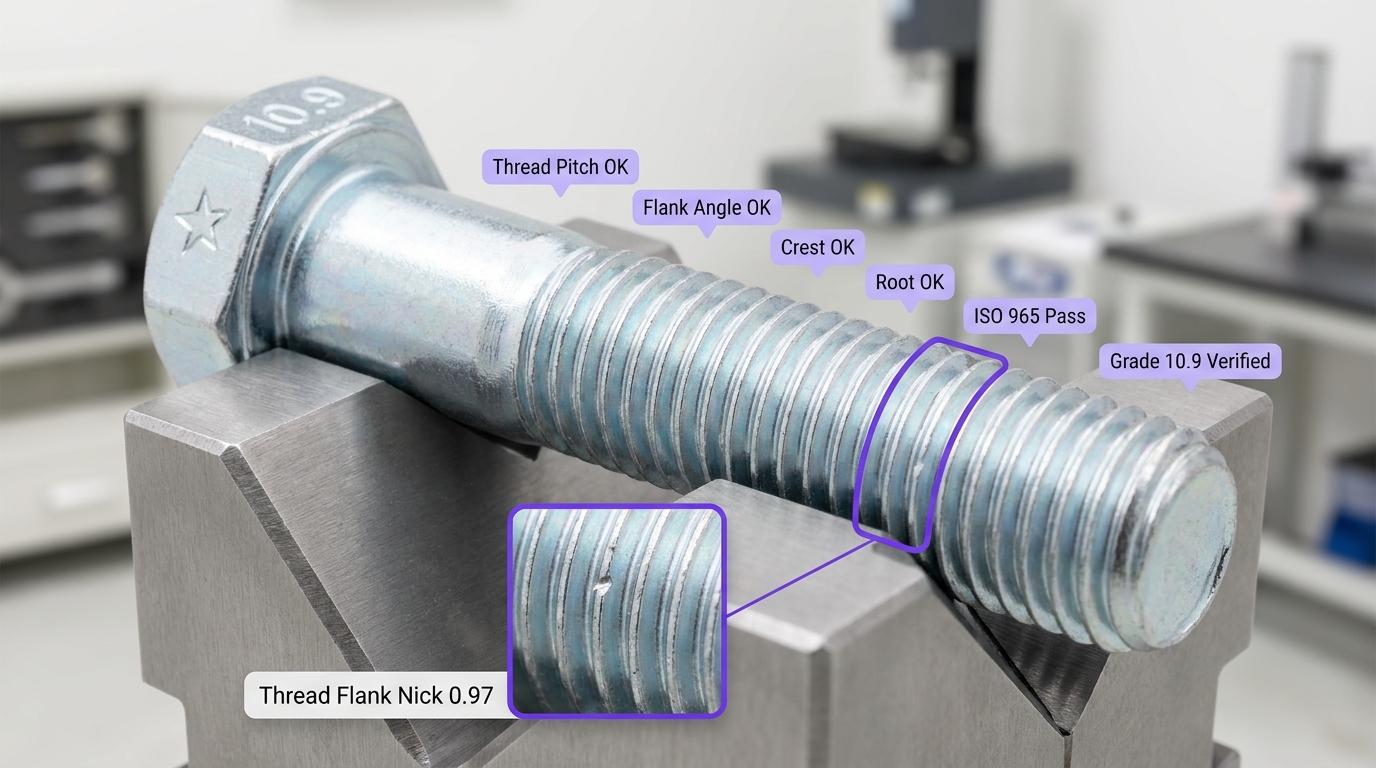
Screw Thread Inspection AI Across Automotive, Aerospace, Medical, and Industrial Fasteners
Deploy Anywhere, Run Everywhere
Run screw thread inspection on sorting lines, cold-forming exit, post-plating QC, robot-mounted vision, and end-of-line pack-out. Deploy on the edge, on-prem, in your VPC, or via API.
One Platform, Full Adoption
Tools every fastener team can adopt, from cold-forming engineers and thread-rolling specialists to quality and operations leaders, no separate ML team required.
Built for Fastener Manufacturing Standards and Audit-Ready Records
Update inspection logic in minutes, with audit-ready records that support ISO 68-1, ISO 965, ANSI/ASME B1.1 and B1.13M, DIN 13, MIL-S-8879, IATF 16949, AS9100, ISO 13485, and customer PPAP and APQP documentation. SOC 2 Type II, encrypted data, HIPAA, and an uptime SLA on every deployment.
- Thread Pitch & Pitch Diameter Verification
- Thread Form & Angle Inspection
- Crossed & Stripped Thread Detection
- Nicks, Burrs & Chip Damage
- Missing & Incomplete Thread Detection
- Head, Chamfer & Drive Style QC
“Roboflow has been instrumental in accelerating our deployment of innovative AI solutions.”
Travis Turnbull
Vice President & CIO, Pella Corporation
Talk to a Vision AI engineer who's shipped screw thread inspection.
A single missed pitch error on a chassis fastener, undetected crossed thread on an engine bolt, or damaged crest on a medical bone screw can mean rework downstream, a warranty claim from the field, a recall on a deployed automotive program, a customer chargeback that erodes margin and PPAP standing, or a patient safety event on an implantable device. Bring us your toughest screw thread inspection problem and we'll map a working solution.
Ask us about:
- Solution architecture for ISO 68-1, ISO 261, ISO 965, ANSI/ASME B1.1 and B1.13M, DIN 13, MIL-S-8879, IATF 16949, AS9100, ISO 13485, and customer-specific PPAP and APQP environments
- Live demo on your sorting line footage, cold-forming exit imagery, post-plating QC video, or robot-mounted inspection samples
- Deployment options: edge, on-prem, air-gapped, robot-mounted, or VPC, with integration into cold-forming press PLCs, thread-rolling machine control, plating line automation, sorting machines, and MES
- ROI modeling against rework, scrap, warranty claims, customer chargebacks, PPAP re-submissions, and recall risk on safety-critical automotive, aerospace, and medical fasteners
Over 16,000 organizations build with Roboflow.
- Rivian
- Pella
- Chobani
- USG Corporation
- BNSF Railway
- American Woodmark