Flare Stack Monitoring AI

Know the pilot is lit, the flare is not smoking, and every event is logged, on the cameras already pointed at the stack.
Shipping container with OCR output

Flare Stack Monitoring AI Across Refineries, Terminals, Chemical Plants, and Upstream Sites

Deploy Anywhere, Run Everywhere

Run flare stack monitoring on fixed stack cameras, existing perimeter and control room feeds, the edge at remote pads, on-prem, in your VPC, or via API, wherever your elevated flares, ground flares, and combustion devices need it.

One Platform, Full Adoption

Tools every operations organization can adopt, from environmental and compliance leads to unit operators, the control room, and reliability engineering, no separate ML team required to ship and own detection models.

Secure, Compliant, and Audit-Ready

Data stays safe with SOC 2 Type II compliance, encrypted data, and an uptime SLA, with timestamped, image-backed event records that support 40 CFR 60.18 and 63.11 flare requirements, NSPS Subpart Ja, Refinery MACT, and state permit reporting.
Pilot Flame Presence & Loss
Smoke & Visible Emissions
Steam Plume vs Smoke Discrimination
Flare Event Start, Stop & Duration
Flame Height & Intensity Trending
Timestamped Event Records
Pilot Flame Presence & Loss
Smoke & Visible Emissions
Steam Plume vs Smoke Discrimination
Flare Event Start, Stop & Duration
Flame Height & Intensity Trending
Timestamped Event Records
Pilot Flame Presence & Loss
Smoke & Visible Emissions
Steam Plume vs Smoke Discrimination
Flare Event Start, Stop & Duration
Flame Height & Intensity Trending
Timestamped Event Records
Pilot Flame Presence & Loss
Smoke & Visible Emissions
Steam Plume vs Smoke Discrimination
Flare Event Start, Stop & Duration
Flame Height & Intensity Trending
Timestamped Event Records

Talk to a vision AI engineer who's shipped flare monitoring on live stacks.

A pilot that went out on a night shift and stayed out until the morning round, a flare that smoked for six minutes when the standard allows five, or an event nobody logged until the agency asked for the records can mean raw gas going to atmosphere uncombusted, a deviation on the next semiannual report, or a consent decree written around gaps in your own monitoring. Bring us your toughest flare monitoring problem and we'll map a working solution.
  • Solution architecture for 40 CFR 60.18 and 63.11 flare requirements, NSPS Subpart Ja, Refinery MACT Subpart CC, OOOOb and OOOOc, and state permit conditions
  • Live demo on your own stack camera footage, across day, night, weather, and your steam-assist behavior
  • Deployment options: fixed stack cameras, existing perimeter and CCTV feeds, edge at remote pads, on-prem, air-gapped, or VPC, with integration into DCS, historian, and environmental reporting
  • ROI modeling against deviation and reporting exposure, steam consumption, flare gas recovery performance, and observation hours
  • We will connect you with an AI subject matter expert on our team based on your answers.
    What challenges would you like to solve with vision AI?
    Where will you run vision AI?
    Are you replacing a current solution with AI or will this be a new solution?
    How many detections do you anticipate per month?
    Describe the business problem you would like to solve.
    Oops! Something went wrong while submitting the form.

    Over 16,000 organizations build with Roboflow.

    “Roboflow has been instrumental in accelerating our learning and deployment of innovative AI solutions”
    Travis Turnbull Vice President & CIO, Pella Corporation
    See customer stories
    Trusted by top manufacturers

    Vision AI is transforming manufacturing

    Customers are deploying solutions across the entire business and driving meaningful impact
    $0 million
    Saved by automatically detecting defects
    0%
    Less time spent manually tracking inventory
    0%
    Reduction in customer return rate

    Know the Pilot Is Lit and the Flare Is Clean, Around the Clock, with Vision AI

    Add a continuous monitoring layer to every flare with vision AI for flare stack monitoring. Built for the sites where a pilot outage at two in the morning is discovered at shift change, a steam plume and a smoke plume look identical on a control room monitor, and the record of what the flare actually did during an upset gets reconstructed from memory a week later. Whether you're running elevated refinery flares, ground flares, terminal and chemical plant combustion devices, or upstream pad flares, Roboflow watches every stack on the cameras your site already runs, with a timestamped record behind every event.

    Flame Presence and Combustion Condition:

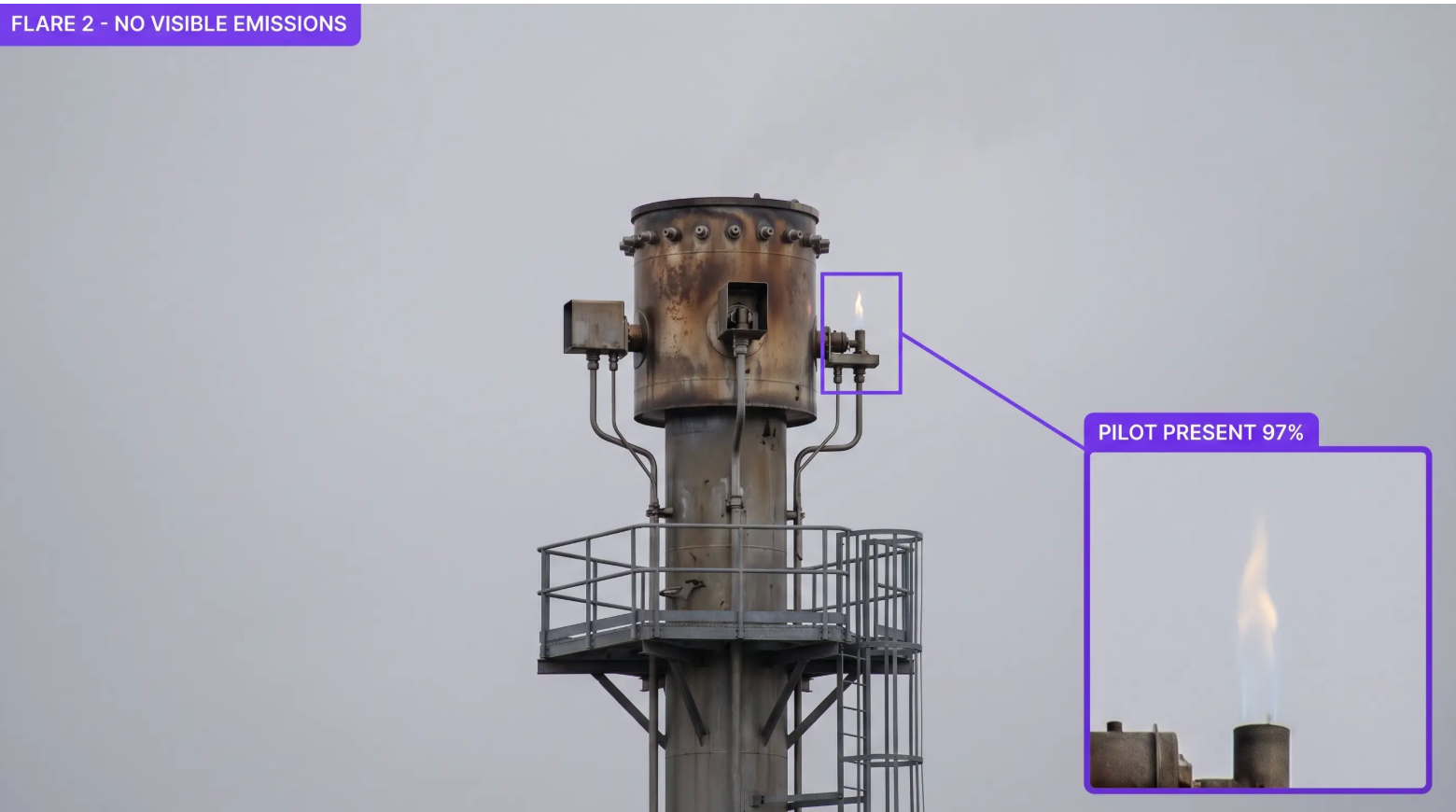
    • Detect pilot flame presence and loss continuously, so an unlit flare surfaces in seconds rather than at the next round
    • Flag smoking flares and visible emissions against the duration limits your permit and 40 CFR 60.18 set
    • Separate a steam plume from a smoke plume, the confusion that makes generic camera alarms useless on a steam-assisted flare

    Events, Duration, and Trending:

    • Detect flare event start and stop and log duration, without depending on an operator to write it down
    • Trend flame height and intensity as a visual proxy for flaring rate, alongside your flow meter data
    • Correlate events with unit upsets and relief activity, so the cause attaches to the event while it is still fresh

    Steam Assist, Records, and Reporting:

    • Feed smoke detection back toward steam assist control, so operators add steam when the flare needs it rather than by rule of thumb
    • Push events and imagery into DCS, historian, and environmental reporting systems as they happen
    • Keep a timestamped, image-backed event history that supports permit reporting, agency inquiries, and after-action review

    Bring intelligence to every stack today. Stop an unlit pilot from becoming an uncontrolled release, a smoking flare from becoming a deviation, or an upset from becoming a records problem.

    More About Flare Stack Monitoring

    What is flare stack monitoring with Vision AI?

    Flare stack monitoring with vision AI uses computer vision models on cameras already aimed at the flare to watch combustion continuously: whether the pilot flame is present, whether the flare is producing visible emissions, when an event starts and stops, and how flame height and intensity change through it. Models trained on your own stacks learn what your flares look like across day, night, weather, and steam-assist behavior, and every alert carries the frame that triggered it. The output is a timestamped, image-backed event history that environmental and operations teams can use for permit reporting, agency inquiries, and after-action review of upsets.

    Can Vision AI tell a steam plume from smoke, and does it work at night?

    Steam versus smoke is the problem that decides whether a flare camera program is useful, and it is why generic motion or change alarms fail on assisted flares. A steam-assisted flare produces a white plume constantly, and the difference between that and a smoking flare is a matter of opacity, color, texture, and how the plume behaves as it leaves the tip. Models trained on your specific flares, in your weather, learn that distinction in a way a threshold cannot. Night is a genuine split: pilot flame presence and flare events are easier to detect at night than in daylight because the flame is the brightest thing in the frame, but visible emissions are the opposite, since smoke against a night sky is close to invisible in the visible spectrum and reliable night opacity work requires an IR or thermal camera. The strongest programs run visible-spectrum detection for flame and event logging around the clock, and pair it with IR where night smoke detection actually matters.

    Does flare monitoring satisfy 40 CFR 60.18 and EPA Method 22 requirements?

    Not by itself, and this is worth being precise about rather than optimistic. Federal flare standards specify monitoring methods: 40 CFR 60.18 and 63.11 require a device such as a thermocouple to verify the presence of a pilot flame, and visible emissions determinations under EPA Method 22 and opacity determinations under Method 9 require a trained or certified human observer following a defined procedure. A camera model is not automatically an approved substitute for either. Where vision inspection earns its place is as continuous supplemental monitoring that runs between required observations and alerts operations in real time, surfacing a pilot outage or a smoking flare in seconds rather than at the next round, and building the image-backed event record that reporting and root cause work depend on. If you want vision monitoring recognized as a compliance method rather than a supplement, that is an alternative monitoring plan conversation with your regulator, and your environmental team owns it. Roboflow is the detection engine underneath either path.

    Can it integrate with our DCS, historian, and environmental reporting?

    Yes. Flare events, pilot state, and visible emissions alerts push into DCS and SCADA through OPC UA and MQTT, and write to historians like PI, Ignition, Wonderware, and AVEVA through REST and direct database writes, so a visual event sits alongside the flow, pressure, and gas composition data for the same window. Alerts can route to the control room, to unit operators, and to environmental on-call, with the triggering frame attached so the first decision is made on evidence. Inference can run at the edge at remote pads and at sites where video cannot leave the fence line, which is the normal constraint on upstream locations and air-gapped refinery networks.

    Stay Connected

    Get the Latest in Computer Vision First

    Thank you for subscribing!
    Oops! Something went wrong!.
    Unsubscribe at any time. Review our Privacy Policy.

    Additional resources

    Vision AI is transforming every industry. Let’s transform yours.