Cosmetics Manufacturing AI
Catch the short fill, the cross-threaded cap, the skewed label, and the cracked compact on every unit, before it reaches the retailer's shelf.
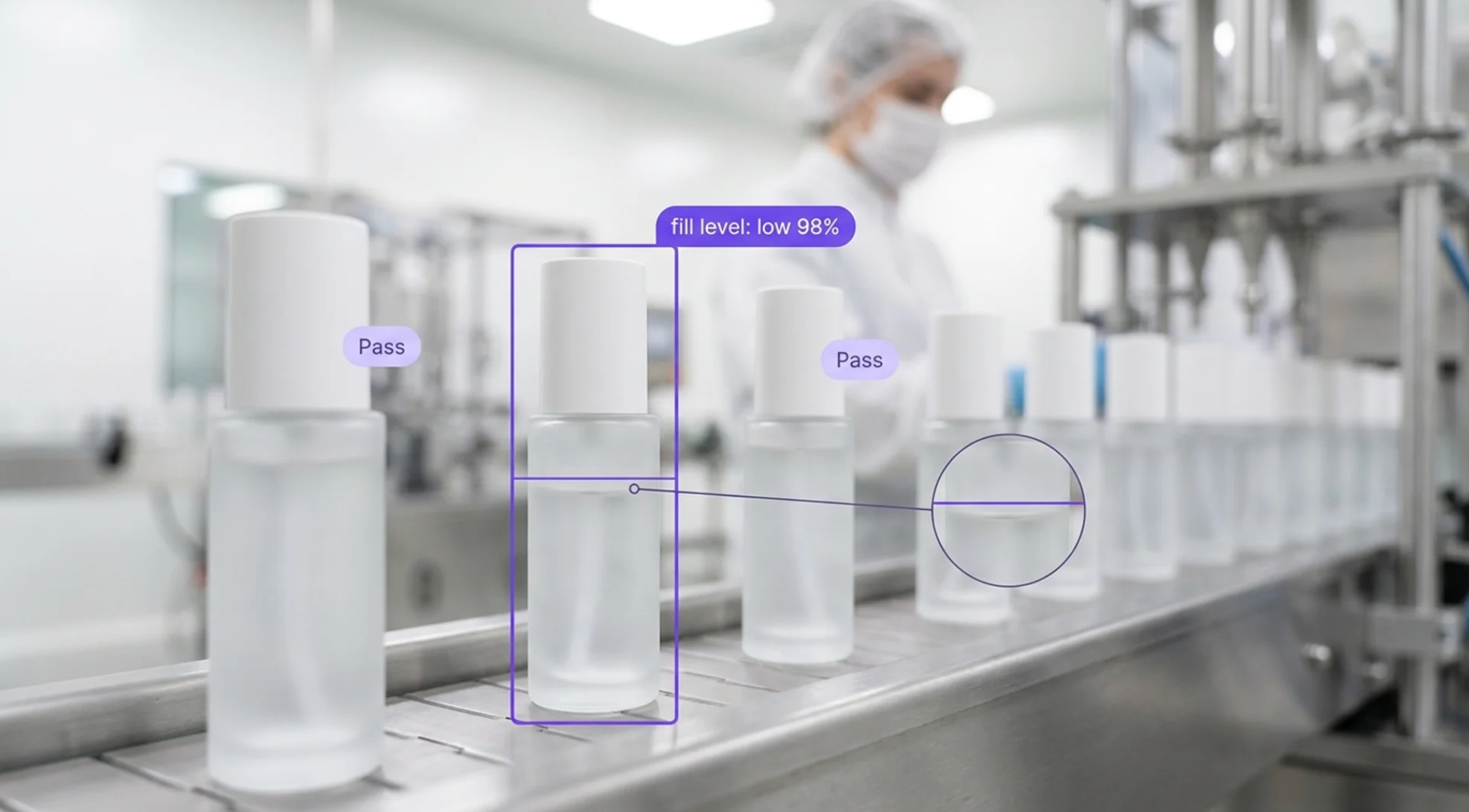
Cosmetics Manufacturing AI Across Filling, Capping, Labeling, Assembly, and Packing
Deploy Anywhere, Run Everywhere
Run cosmetics inspection on the cameras already over your filling, capping, labeling, and cartoning lines and an edge device at the line, on-prem, air-gapped, in your VPC, or via API, wherever your fill lines, assembly cells, and packing stations need it.
One Platform, Full Adoption
Tools every cosmetics and personal care plant can adopt, from line operators and QA technicians to quality managers, packaging engineers, and regulatory leads, no separate ML team required to ship and own inspection models.
Secure, Compliant, and Audit-Ready
Data stays safe with SOC 2 Type II compliance, encrypted data, and an uptime SLA, with per-unit image records that support FDA MoCRA registration and adverse event files, ISO 22716 cosmetics GMP, EU Cosmetics Regulation 1223/2009, and retailer and brand-owner audits.
- Fill Level, Short Fill & Overfill Detection
- Cap, Pump, Closure & Seal Verification
- Label Presence, Skew, Print & Batch Code Inspection
- Compact, Palette & Applicator Assembly Verification
- Scratch, Crack & Cosmetic Surface Defect Detection
- Foreign Material & Contamination Detection
“Roboflow has been instrumental in accelerating our deployment of innovative AI solutions.”
Travis Turnbull
Vice President & CIO, Pella Corporation
Talk to a Vision AI engineer who's shipped inspection on a live cosmetics line.
A single short-filled bottle, a cross-threaded pump that leaks in transit, or an unreadable batch code on a shipped case can mean a retailer chargeback, a pallet returned from the distribution center, or a lot you cannot trace when a MoCRA adverse event report comes in. Bring us your toughest cosmetics manufacturing problem and we'll map a working solution.
Ask us about:
- Solution architecture for liquid, cream, and powder filling, capping and pump insertion, front and back labeling, compact and palette assembly, and cartoning and case packing, alongside existing checkweighers and vision sensors
- Live demo on your line camera footage or product images, with the defect, short fill, skewed label, cracked compact, or missing applicator, that drives the most complaints or returns
- Deployment options: existing cameras and an edge device at the line, on-prem, air-gapped, or VPC, with integration into MES, quality, PLCs, and serialization and traceability systems
- ROI modeling against retailer chargebacks and returns, giveaway and overfill, rework and scrap, manual inspection labor, changeover verification time, and recall and adverse-event exposure
Over 16,000 organizations build with Roboflow.
- Rivian
- Pella
- Chobani
- USG Corporation
- BNSF Railway
- American Woodmark
Vision AI is transforming businesses
Customers across the board are solving complex challenges and driving meaningful impact.
- Automotive customer
$10 million
Saved by automatically detecting defects on the production line
- Logistics & freight company
90%
Less time spent manually tracking shipping inventory
- Building materials supplier
60%
Lower customer return rate with improved product quality