Contact Lens Inspection AI

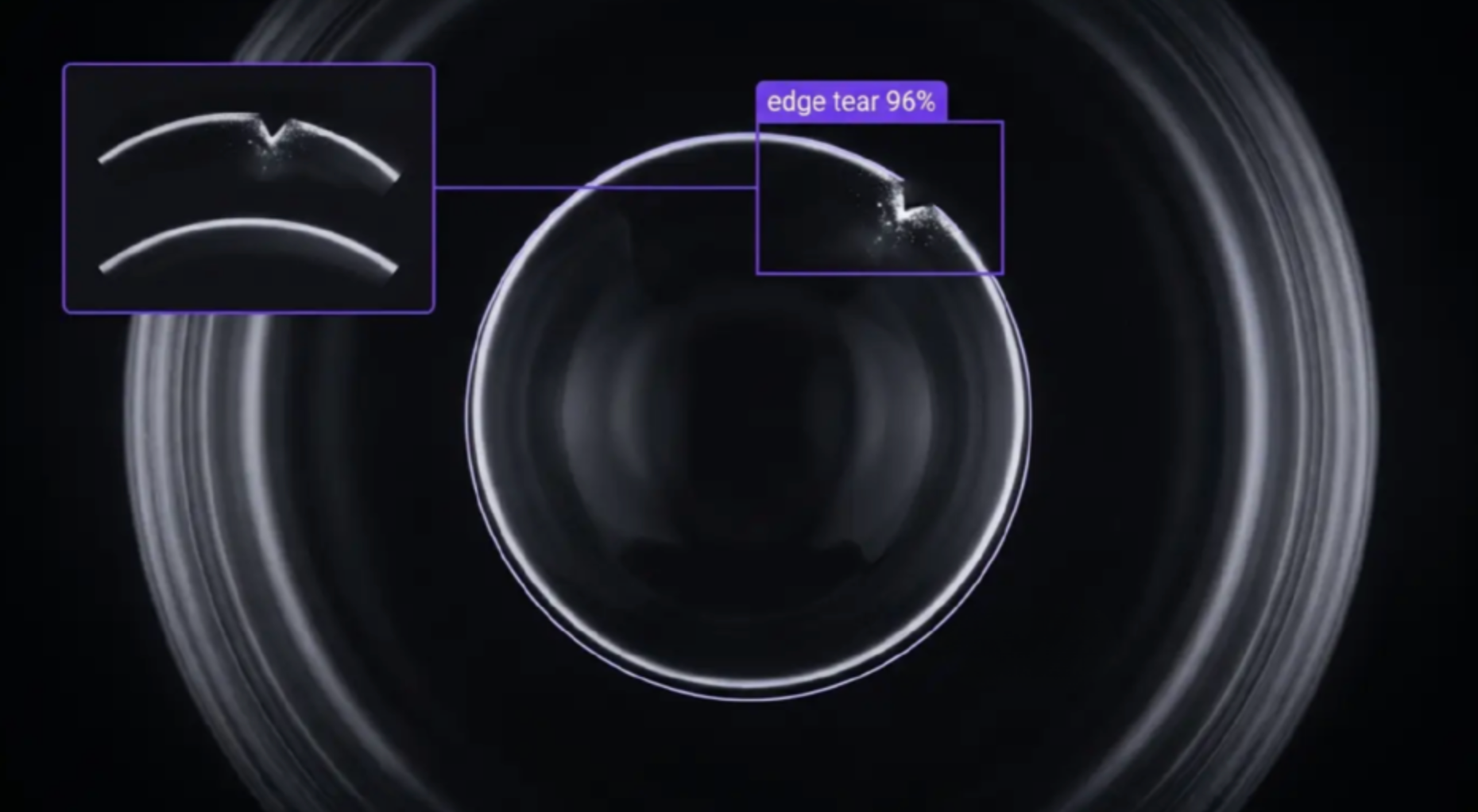
Catch edge tears, bubbles, and empty blisters on every lens, in a product designed to be invisible.
Shipping container with OCR output

Lens Inspection AI Across Molding, Hydration, and Packaging

Deploy Anywhere, Run Everywhere

Run contact lens inspection on the edge, on-prem, in your VPC, or via API, wherever your molding lines, inspection stations, and blister fill lines need it.

One Platform, Full Adoption

Tools every lens team can adopt, from molding and hydration operators to inspection techs, packaging leads, and QA, no separate ML team required to ship and own inspection models.

Secure, Compliant, and Audit-Ready

Data stays safe with SOC 2 Type II compliance, encrypted data, and an uptime SLA, with per-lot records that support ISO 13485, FDA 21 CFR 820, and ISO 18369 documentation.
Edge Tear & Chip Detection
Bubble & Inclusion Flags
Surface Defect Inspection
Blister Fill & Lens Presence
Seal & Label Verification
Per-Lot Inspection Records
Edge Tear & Chip Detection
Bubble & Inclusion Flags
Surface Defect Inspection
Blister Fill & Lens Presence
Seal & Label Verification
Per-Lot Inspection Records
Edge Tear & Chip Detection
Bubble & Inclusion Flags
Surface Defect Inspection
Blister Fill & Lens Presence
Seal & Label Verification
Per-Lot Inspection Records
Edge Tear & Chip Detection
Bubble & Inclusion Flags
Surface Defect Inspection
Blister Fill & Lens Presence
Seal & Label Verification
Per-Lot Inspection Records

Talk to a vision AI engineer who's shipped lens inspection.

An edge tear that announces itself on someone's eye, a blister that opens empty in a customer's bathroom, or two lenses folded into one well can mean a complaint rate that moves at daily-disposable volumes, a lot investigation across millions of units, and a defect budget measured in parts per million. Bring us your toughest lens inspection problem and we'll map a working solution.
  • Solution architecture for ISO 13485, FDA 21 CFR 820, and ISO 18369 environments
  • Live demo on your lens imagery, cuvette footage, or blister line photos
  • Deployment options: edge, on-prem, air-gapped, or VPC, with integration into inspection stations, line PLCs, and MES
  • ROI modeling against escape ppm, complaint rates, scrap, and manual inspection stations
  • We will connect you with an AI subject matter expert on our team based on your answers.
    What challenges would you like to solve with vision AI?
    Where will you run vision AI?
    Are you replacing a current solution with AI or will this be a new solution?
    How many detections do you anticipate per month?
    Describe the business problem you would like to solve.
    Oops! Something went wrong while submitting the form.

    Over 16,000 organizations build with Roboflow.

    “Roboflow has been instrumental in accelerating our learning and deployment of innovative AI solutions”
    Travis Turnbull Vice President & CIO, Pella Corporation
    See customer stories
    Trusted by top manufacturers

    Vision AI is transforming manufacturing

    Customers are deploying solutions across the entire business and driving meaningful impact
    $0 million
    Saved by automatically detecting defects
    0%
    Less time spent manually tracking inventory
    0%
    Reduction in customer return rate

    Inspect Every Lens You Can Barely See, with Vision AI

    Add a real-time inspection layer to every lens with vision AI for contact lens inspection. Built for the lines where the product is transparent, floating in transparent solution, behind transparent plastic, a torn edge is a complaint that arrives from someone's eye, and a million lenses a day hold a defect budget measured in parts per million. Whether you're cast molding, hydrating and inspecting, or filling and sealing blisters, Roboflow inspects every lens, well, and seal at line rate, with per-lot records behind every shipment.

    Lenses and Edges:

    • Catch edge tears, chips, and nicks around the full circumference of every lens
    • Detect bubbles, inclusions, and surface defects in the optic zone and periphery
    • Verify toric and orientation marks present and legible where the design carries them

    Blisters, Fill, and Seals:

    • Verify a lens is present in every well, one lens, not folded, not two
    • Check saline fill and flag debris in the solution before the foil goes down
    • Inspect foil seal placement and integrity, and read lot and expiry printing on every blister

    Lines, Molds, and Systems Integration:

    • Trend defects by mold, cavity, and line, so a wearing cavity shows up in edge quality before it shows up in complaints
    • Hold one judgment standard across materials, designs, and daily-disposable volumes
    • Route rejects in real time through PLC and MES integration, with per-lot records that support ISO 13485 and 21 CFR 820 documentation

    Bring intelligence to every lens today. Stop lens defects from becoming red-eye complaints, empty-blister claims, or the lot investigation that spans a million units.

    More About Contact Lens Inspection

    What is contact lens inspection with Vision AI?

    Contact lens inspection with vision AI uses computer vision models to inspect lenses through molding, hydration, and packaging: edge tears, chips, and nicks, bubbles, inclusions, and surface defects, toric and orientation marks, lens presence and condition in every blister well, saline fill, foil seal integrity, and lot and expiry printing. Models trained on your actual lenses inspect every unit at line rate, with per-lot records that support ISO 13485, FDA 21 CFR 820, and ISO 18369 documentation.

    Can Vision AI inspect a transparent lens in solution?

    The contact lens is the ultimate low-contrast case: a transparent product floating in transparent saline behind transparent plastic, where a defect is a slight change in how light bends and the whole point of the product is that you can barely see it. Deep-learning models trained on your actual lenses, optics, and illumination setups learn each design's normal refractive signature under your lighting, flag the edge tear, bubble, or fold that breaks it, hold that judgment across materials and designs, and route uncertain lenses to review instead of guessing, at the volumes where a manual station is a bottleneck and a sampling plan is a gamble.

    Does this replace optical power measurement?

    No. Power verification and optical metrology keep their role as the lens's functional record, and your sterilization and biocompatibility programs keep owning what they own. Vision AI adds the cosmetic and physical layer those measurements never see: the torn edge on a lens with perfect power, the bubble at the periphery, the well sealed with no lens in it, and the folded pair that counts as one, on every unit instead of a sample. Power data and visual findings land in the same per-lot record.

    Can it integrate with our inspection stations, PLCs, and MES?

    Yes. Roboflow Inference exposes a standard API and supports common industrial protocols, so lens inspection events flow into your existing systems: inspection station and blister line PLCs from Allen-Bradley and Siemens, MES and ERP platforms like SAP and Oracle, and SCADA and HMI platforms like Ignition and AVEVA, through REST, MQTT, OPC UA, and direct database writes. PLC-level integration rejects a lens or diverts a blister the moment a check fails, and every event carries lot, line, cavity, imagery, and disposition, with a full audit trail behind every shipment.

    Stay Connected

    Get the Latest in Computer Vision First

    Thank you for subscribing!
    Oops! Something went wrong!.
    Unsubscribe at any time. Review our Privacy Policy.

    Additional resources

    Vision AI is transforming every industry. Let’s transform yours.